




During the past year, stocks of public sector enterprises (PSEs) performed well in the stock market. This is well reflected in the 26% rise in the Nifty PSE Index (as on 2 March 2026).
During the same period, the equity benchmark index Nifty 50 gained 12.4%, and the broader market indices, such as the BSE smallcap index, gained 7.4%, and the BSE midcap index gained 24%.
Even though PSEs performed better than broader markets, foreign institutional investors (FIIs) didn’t show much interest in the PSEs during Q3FY26, except for two stocks.
And ironically, both these stocks are from the same sector.
It is the oil and gas sector, or petroleum sector to be specific, which is unfortunately the hottest topic in the world right now. As we are writing this article, there’s a chance the Strait of Hormuz could be shut down, stranding the flow of oil from this all important region.
So, in this article, we will try to understand why FIIs increased their stake in these two petroleum stocks, while their overall stance on PSE stocks remained muted during the quarter. Note, that we are looking at data as on 31st December 2026. So, given the situation today, things could change anytime.
#1 Bharat Petroleum Corporation Limited: A fortune 500 company fueling massive expansion plans
Bharat Petroleum Corporation Ltd. (BPCL) is a government-owned integrated oil refinery and marketing company that has a Maharatna Status. This company is also part of the Fortune 500 companies. Currently, it is the second-largest refining company in the country and the third-largest oil marketing company. It represents around 14% of the total installed refining capacity in India and 25% in the domestic petroleum products.
During Q3FY26, FIIs increased their stake by 1.93% points in this petroleum giant, taking the total holding to 18.5% at the end of the quarter.
Project Aspire: Big expansion projects underway
As mentioned above, BPCL already holds a significant market share both in the oil refinery space and marketing of petroleum products. The company is now aiming higher with Project Aspire. This is a refinery expansion programme which is going on in all of the three existing refineries and also includes a greenfield project in Andhra Pradesh.
In the Mumbai refinery, the existing fluid catalytic cracking units (FCCU) and the catalytic cracking unit are getting replaced with an upgraded petro resid FCCU. This project’s cost is around ₹14,200 crore and is expected to be completed by May 2029.
In the Bina refinery, BPCL is investing ₹50,000 crore to increase refining capacity. The current capacity is 7.8 million metric tonnes per annum (MMTPA), and it is expected to go up to 11 MMTPA post the expansion. This is anticipated to be completed by 2028, post which BPCL’s market share in the refining space can increase further.
In the Kochi refinery, a 400 KTPA polypropylene (PP) plant is being installed along with the overhauling of the existing petro resid FCCU. This project is costing BPCL around ₹5,000 crore, and the scheduled completion is around October 2027.
Now that’s not all, BPCL is opening another refinery-cum-petrochemical complex in Andhra Pradesh. Currently, ₹6,100 crore has been allocated for the pre-project activities towards this greenfield project.
These expansion plans are a clear indication of why FIIs are getting drawn to this PSE.
Record profit growth
Often, it has been observed that companies expanding their businesses witnessed sluggish profit growth or even losses due to capital expenditure and operational inefficiencies.
However, BPCL, breaking all the cliches, delivered a whopping 90% YoY profit growth during Q3FY26. The profit surged from ₹3,806 crore in Q3FY25 to ₹7,188 crore in Q3FY26.
What is more surprising is that this massive rise in profit has come from just a 5.2% rise in sales. During the period, sales only rose from ₹1,13,166 crore to ₹1,19,029 crore.
This indicates high operational efficiency of the refinery giant as well. High-capacity utilisation at all the refineries, along with their proximity to the coast help the company operate efficiently and save on logistic costs, which translates to better profits.
The return on capital employed (ROCE) is at 16.2% while that of the industry is way below at 7.6%.
BPCL is also a regular dividend payer offering a current dividend yield of 4.7%, when the industry median is just 0.4%.
Valuation
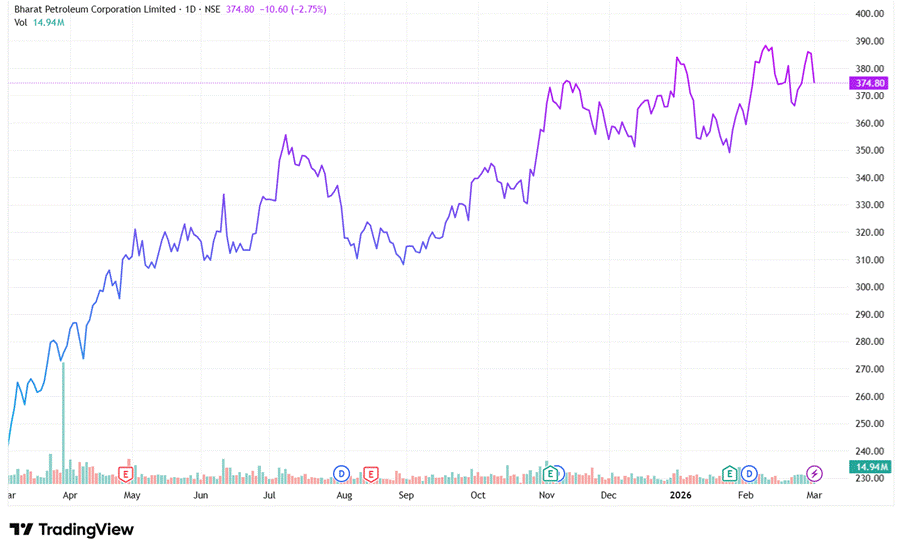
The stock is currently trading at a price/earnings (PE) of 6.5x, which is half of the industry median of 13.8x, suggesting the stock is currently trading cheaper.
1-Year Share Price Chart of BPCL
#2 Hindustan Petroleum Corporation Limited: Owning the largest lube refinery in India
Hindustan Petroleum Corporation Ltd. (HPCL) is also a Maharatna Company with 100 years of legacy in the refining business in India. However, what sets it apart is its largest lube refining infrastructure in India, which is used to produce base oils and lubricants.
Apart from that, HPCL has the 2nd largest retail network with 24,572 retail outlets as of 31 December 2025. It also ranks 2nd in the cross-country product pipeline network and as an LPG marketer.
HPCL also holds 13.9% market share in India’s refining capacity, similar to that of BPCL, and around 20% in the petroleum products market.
During Q3FY26, FIIs raised 1.87% points stake in HPCL, taking the overall holding to 16.4% at the end of the quarter.
A joint venture between HPCL and the Rajasthan government: HRRL
HPCL and the government of Rajasthan have entered into a joint venture for a greenfield refinery project, which is expected to boost the total refining capacity of the company by 9 MMTPA. As of 31 December 2025, 90.4% of the project (physical progress) is completed, and the cost for the same is around ₹74,459 crore. This refinery & petrochemical complex is expected to be operational by 2027, which could take the total refining capacity from the current 35.8 MMTPA to 45.3 MMTPA by FY28.
Apart from refining capacity, this JV is expected to add 2.4 MMTPA of petrochemical capacity as well.
Robust expansion plans
Apart from the HRRL project, HPCL is also undergoing a Lube modernisation project and bottom-upgradation project at the Mumbai lube refinery.
Now coming to the pipeline network, the company is expecting the same to increase to 6,000 km of network by 2027-28, which stood at 5,134 km by the end of FY25.
Similarly, the terminal or depots are expected to increase to 85 from 80 during the same period.
The number of retail outlets is expected to grow up to 26,000 by 2027-28, and LPG bottling plant units to 60.
At the end of FY25, the number of CNG stations was around 2,038, which can jump up to 3,000 by 2027-28.
Green energy push
HPCL is going all green with massive expansion projects in the green energy space. The company’s biofuel capacity is expected to rise from 12.1 thousand metric tonnes per annum (TMTPA) in FY25 to a whopping 300 TMTPA in FY28.
Different biofuel projects are underway, which include a compressed biogas (CBG) plant at Budaun in UP with a daily capacity of 14 tonnes and another one at Pathmeda, Rajasthan, which has a capacity of 1.6 tonnes per day (TPD). Both facilities have started to sell commercially.
There are two other ongoing projects – a 100-kilo litre per day capacity 2G Ethanol Bio-refinery at Bathinda, Punjab, and a 20 TPD CBG plant at ELuru in Andhra Pradesh.
HPCL is planning to boost its total renewable capacity to 2,400 MW by FY28, which was last recorded at 224 MW at the end of FY25.
However, that’s not all, HPCL has also entered the green hydrogen space and is rapidly scaling up. At the end of FY25, the green hydrogen capacity stood at 3.5 TPA, and this is anticipated to increase to a whopping 9,670 TPA by FY28.
HPCL already commissioned a 370 TPA Green Hydrogen plant at Visakh Refinery, which is the first-ever Green Hydrogen plant to be built within any Indian refinery. Two more plants are underway – a 5,000 TPA plant at Visakh Refinery again, and another one with a 4,300 TPA capacity at the HRRL.
Strong financials
Even HPCL witnessed a massive surge in its net profit in Q3FY26 by 58% YoY, even amidst such extensive expansion plans. The profit jumped from ₹2,544 crore to ₹4,011 crore between Q3FY25 and Q3FY26.
Sales, however, rose marginally by 4% during the period from ₹1,10,608 crore to ₹1,15,153 crore.
HPCL has a ROCE of 10.5%, higher than the industry median, but lower than that of BPCL.
Similarly, the dividend yield of HPCL is 2.5%, way higher than the industry median but lower than BPCL.
Valuation
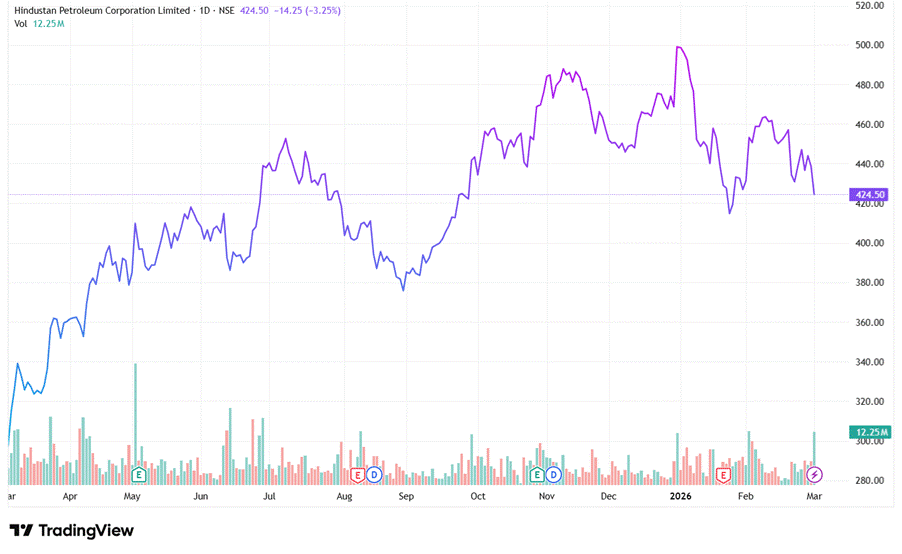
The stock is trading at a PE of 5.9x, lower than the industry median of 13.8x, indicating a cheaper valuation.
1-Year Share Price Chart of HPCL
Final thoughts
FIIs’ selective investment in the petroleum giants perhaps signals a thematic buying rather than random accumulation. Both companies are undergoing aggressive capacity expansion, which is expected to bring business augmentation in the mid to long term.
Having said that, with these massive expansion plans comes execution risk, which is why you need to keep a close eye on these stocks if you are interested in investing in them. For now, you can just add them to your watchlist and see how they are performing and how the ongoing projects are progressing.
We have relied on data from www.Screener.in throughout this article. Only in cases where the data was not available have we used an alternate, but widely used and accepted source of information.
The purpose of this article is only to share interesting charts, data points, and thought-provoking opinions. It is NOT a recommendation. If you wish to consider an investment, you are strongly advised to consult your advisor. This article is strictly for educational purposes only.
Maumita Mitra is a seasoned writer specializing in demystifying the world of investment for a broad audience. She has a keen eye for detail and a knack for explaining complex financial concepts in the simplest manner possible.
Disclosure: The writer and her dependents do not hold the stocks discussed in this article.
The website managers, their employees (s), and contributors/writers/authors of articles have or may have an outstanding buy or sell position or holding in the securities, options on securities, or other related investments of issuers and/or companies discussed therein. The content of the articles and the interpretation of data are solely the personal views of the contributors/ writers/authors. Investors must make their own investment decisions based on their specific objectives, resources, and only after consulting such independent advisors as may be necessary.