



India’s power sector is entering a major investment cycle. Electricity demand is rising with industrial expansion, urbanisation and growing household consumption. Longer summers and wider use of air conditioners are lifting peak demand. Data centres, electric vehicles and the electrification of railways are adding new sources of consumption. At the same time, India is rapidly adding renewable capacity, creating the need to move electricity from solar- and wind-rich regions to major consumption centres.
Adding generation capacity alone will not be enough. India also needs more transmission lines, substations and distribution infrastructure. Power engineering, procurement and construction (EPC) companies execute these projects. Their work covers design, procurement, construction, installation, testing and commissioning. Some companies also manufacture transmission towers, conductors and other equipment used in these projects.
The growing investment in power infrastructure has created a large pipeline of opportunities for EPC companies. Their order books show the value of projects secured but not yet executed. A large order book can provide revenue visibility for several years. However, actual performance also depends on execution, margins, project timelines and working-capital management.
For this article, we filtered listed power EPC companies with a market capitalisation of more than Rs 2,000 crore. We then selected the three companies with the largest disclosed order books.
#1 Kalpataru Projects International: Bigger Projects, Wider Markets
Kalpataru Projects International is a global EPC player with diversified interest in power transmission and distribution, oil and gas pipeline, railways and biomass based power generation.
Kalpataru Projects International Financial Performance
| Metric | FY26 |
| Revenue growth | 22% YoY |
| Net profit growth | 82% YoY |
| Order book | Rs 65,457 crore |
| RoCE | 18.3% |
| RoE | 13.7% |
| EV/EBITDA | 9.5x |
Kalpataru Projects International ended FY26 with its highest-ever order book of Rs 65,457 crore. This provides strong visibility across its engineering, procurement and construction businesses. The company secured orders worth more than Rs 26,000 crore during the year. Nearly half of these bookings came from projects valued above Rs 1,000 crore.
Analyzing the Regional Mix and Execution Strategy of Kalpataru’s Rs 65,457-Crore Order Book
Power transmission and distribution remains the largest part of the order book. The segment closed FY26 with orders worth Rs 28,572 crore. Its revenue grew 25% during the year. Transmission and distribution (T&D) order inflows were close to Rs 13,000 crore. India contributed around 35%. The remaining 65% came from the Nordics, South America, Africa and the Middle East.
The company expects the T&D segment to remain a key growth driver in FY27. It sees a healthy tender pipeline in India and overseas. Domestic opportunities include projects from Power Grid and large private developers. A few major high-voltage direct current projects are also expected to come up. International opportunities remain strong in the Middle East, South America and the Nordic region.
The wider business also reported healthy growth. Buildings and factories revenue increased 19%, while its order book reached Rs 18,295 crore. Demand is emerging from residential projects, data centres, airports and industrial facilities. Oil and gas revenue rose 55%, supported by the execution of projects in Saudi Arabia. Urban infrastructure revenue grew 49%, led by metro rail projects. The water business generated revenue of Rs 2,112 crore, though delayed collections remained a concern.
Consolidated revenue increased 22% year-on-year (YoY) to Rs 27,143 crore in FY26. Net profit rose 82% to Rs 1,031 crore. The working-capital cycle improved to 75 days. Net debt declined by more than half to Rs 915 crore. Operating cash flow increased 68% to Rs 1,535 crore.
KPIL invested more than Rs 900 crore in FY26. This covered construction equipment, plant modernisation and international operations. It has budgeted more than Rs 800 crore for FY27. The company may also expand plant capacity, with more details expected by the end of the second quarter.
Evaluating the Execution Risks to Kalpataru’s Backlog Conversion
Management expects FY27 order inflows to exceed Rs 30,000 crore. It has guided for revenue growth of around 15% and a 75-basis-point improvement in consolidated profit-before-tax margin. However, geopolitical tensions, supply-chain disruptions, labour availability and cost pressures remain key risks.
The stock trades at an EV/EBITDA multiple of 9.5 times. This is below the industry median of 10.1 times. Its return on capital employed stands at 18.3%, while return on equity is 13.7%. The large order book supports visibility, but timely execution and cash conversion will determine how much of that potential reaches earnings.
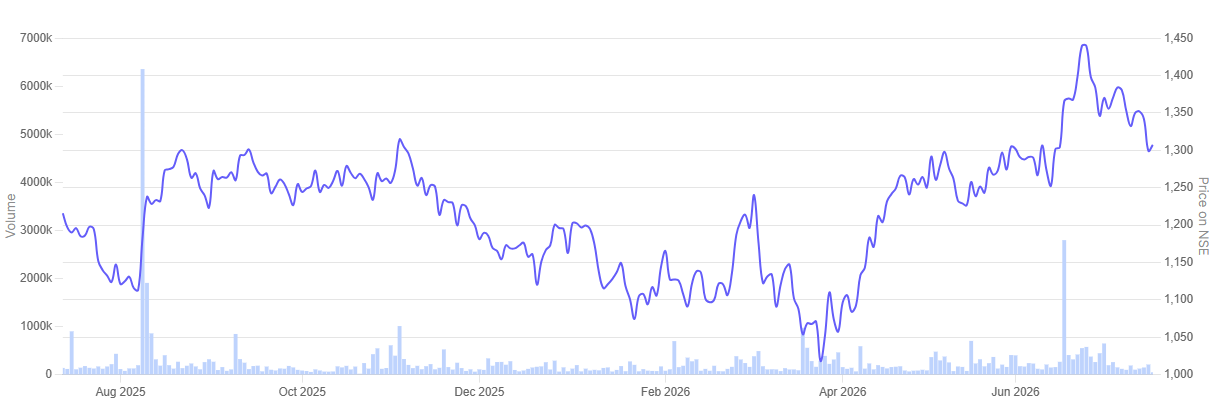
In the past year, the share price of Kalpataru Projects International is up 7.6%.
Kalpataru Projects International 1 Year Share Price Chart
#2 KEC International: Fewer Orders, Bigger Tickets
KEC International is a global infrastructure EPC major. It has presence in the verticals of power transmission and distribution, railways, civil, urban infrastructure, solar, oil & gas pipelines, and cables. It is the flagship Company of the RPG Group.
KEC International Financial Performance
| Metric | FY26 |
| Revenue growth | 8% YoY |
| Operating net profit growth | 6.1% YoY |
| Order book | Rs 36,267 crore |
| RoCE | 14.5% |
| RoE | 11.3% |
| EV/EBITDA | 10.8x |
KEC International closed FY26 with an order book of Rs 36,267 crore. Its order intake reached a record Rs 25,280 crore. Around 70% of the inflows came from the T&D business. The company also had an L1 position of more than Rs 3,000 crore. Together, these provide revenue visibility for the next six to seven quarters.
Why KEC’s Shift Toward Large-Ticket Contracts Alters Its Risk Profile
The composition of new orders is changing. KEC is targeting fewer but larger contracts. Its average order size increased from Rs 350 crore in FY25 to more than Rs 500 crore in FY26. The number of orders fell 25%, even as total inflows increased. Larger projects can improve execution control and working-capital management. However, they can also increase the impact of delays in individual projects.
The T&D business remained the main growth engine. Its revenue rose 24% to Rs 15,883 crore. Order inflows stood at around Rs 17,700 crore. In India, the company secured its largest integrated T&D order of more than Rs 1,000 crore. The project covers a 765-kV transmission line and a 765/400-kV substation. KEC is also executing five high-voltage direct current projects. It commissioned its first HVDC converter station project in Maharashtra during the year.
International T&D orders exceeded Rs 11,300 crore and grew more than 35%. KEC won its first 380-kV gas-insulated substation order in Saudi Arabia. It also secured its largest composite order in the country. The scope includes transmission lines, substations and extra-high-voltage cabling. SAE Towers reported 36% revenue growth to Rs 1,800 crore, supported by demand across the US, Mexico and Brazil.
Capacity expansion is underway to support this pipeline. KEC has completed upgrades at its Dubai, Jaipur and Jabalpur plants. The expansion of its Butibori facility in Nagpur is expected to be completed during the current quarter. It has also expanded manufacturing facilities in Brazil.
Consolidated revenue grew 8% to a record Rs 23,506 crore in FY26. Net profit rose 6.1% to Rs 606 crore. T&D contributed 68% of revenue, up from 59% in the previous year. Management expects revenue to grow 12-15% in FY27. It is targeting order inflows of around Rs 30,000 crore.
Navigating KEC’s High Debt Burden and Middle East Logistics Headwinds
The near-term environment remains difficult. Middle East disruptions have delayed shipments and increased freight costs. Labour shortages and slow payments from water projects have also affected execution. Net debt remained high at Rs 6,722 crore and is expected to improve by the second quarter.
The stock trades at an EV/EBITDA multiple of 10.8 times. This is above the industry median of 10.1 times. Its return on capital employed is 14.5%, while return on equity stands at 11.3%. The order book offers visibility. The pace of execution and debt reduction will determine the quality of growth.
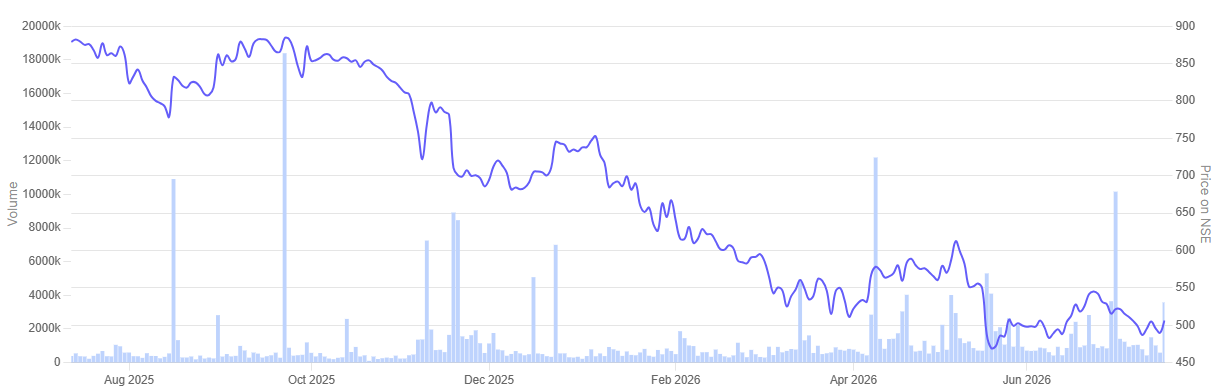
In the past year, the share price of KEC International is up 7.6%.
KEC International 1 Year Share Price Chart
#3 Transrail Lighting: Can Capacity Expansion Turn a Rs 16,361-Crore Pipeline into Growth?
Incorporated in 2008, Transrail Lighting is an integrated transmission & distribution, and pole manufacturing company.
Transrail Lighting Financial Performance
| Metric | FY26 |
| Revenue growth | 30% YoY |
| Operational net profit growth | 23.5% YoY |
| Order book, including L1 orders | Rs 16,361 crore |
| RoCE | 29.2% |
| RoE | 20% |
| EV/EBITDA | 7.7x |
Transrail Lighting closed FY26 with strong growth in its core T&D business. Revenue rose 30% YoY to Rs 6,880 crore. Net profit increased 23.5% to Rs 404 crore.
Assessing the Execution Timelines of Transrail’s Rs 16,361-Crore L1 Backlog
The order pipeline remains central to the company’s growth outlook. Order inflows reached Rs 8,520 crore during FY26. The unexecuted order book, including L1 orders, stood at Rs 16,361 crore. It was Rs 14,551 crore a year earlier. The pipeline provides more than two years of revenue visibility. However, L1 projects will enter the executable backlog only after formal awards.
Transrail is adding capacity to support this workload. Its tower manufacturing capacity more than doubled during FY26. The first phase of its expansion programme is expected to be completed by the end of the first half of FY27. Tower capacity will then rise to 196,000 tonnes a year. Conductor manufacturing capacity is also set to double.
Capital Expenditure Strategy: How Transrail’s Capacity Doubling Impacts Working Capital
The board has approved another Rs 203 crore of capital expenditure. The funds will largely be used for construction equipment and execution capabilities. Management expects better equipment availability to shorten project timelines by one to two months. This is significant in contracts that usually run for 24 to 30 months.
Execution remained steady during the year. Transrail completed seven 765-kV transmission projects in India. It supplied more than 150,000 tonnes of towers and around 4,000 km of conductors. The first phase of a river-crossing transmission project in Bangladesh was completed. Work on the second phase also made substantial progress.
International markets are becoming a larger part of the opportunity. The company entered Abu Dhabi, Tunisia, Djibouti and Botswana during the year. Africa, the SAARC region and the Gulf remain priority markets. Transrail is also targeting projects funded by multilateral development banks. Such contracts can offer better payment protection in overseas markets.
Management expects FY27 revenue to grow by 20-22%. It is targeting order inflow growth of more than 25%. The opportunity is supported by renewable-energy integration, grid modernisation and demand for high-voltage transmission infrastructure.
Cash generation has also improved. Operating cash flow more than doubled to Rs 817 crore. Working-capital days declined to 81 from 91. Net debt fell by Rs 80 crore.
Transrail trades at an EV/EBITDA multiple of 7.7 times. This is below the industry median of 10.1 times. Its return on capital employed is 29.2%, while return on equity stands at 20%. The order pipeline and capacity additions support the growth case. Execution discipline and conversion of L1 orders will remain critical. Overseas risks, inflation and logistics costs also require close attention.
Conclusion
India’s transmission build-out has opened a long runway for power EPC companies. The size of the order books offers reasonable revenue visibility. Capacity additions and a growing overseas presence could support the next leg of growth.
But the headline number is only the starting point. Projects must move on schedule and protect margins. Payments must also arrive without stretching working capital. Commodity costs, execution delays and overseas disruptions remain key risks. Investors should therefore track how steadily the backlog converts into revenue, profit and cash flow. Valuation will matter just as much as growth.
Power EPC Companies: Order Book, Growth and Valuation
| Metric | Kalpataru Projects | KEC International | Transrail Lighting |
| FY26 revenue growth | 22% YoY | 8% YoY | 30% YoY |
| FY26 net profit growth | 82% YoY | 6.1% YoY | 23.5% YoY |
| Order book | Rs 65,457 crore | Rs 36,267 crore | Rs 16,361 crore* |
| RoCE | 18.3% | 14.5% | 29.2% |
| RoE | 13.7% | 11.3% | 20% |
| EV/EBITDA | 9.5x | 10.8x | 7.7x |
*Transrail’s order book includes L1 orders awaiting formal awards.
For now, order visibility remains strong across the power EPC sector. However, the pace at which these orders move into execution will decide how quickly they support revenue and profit growth.
Project timelines, working-capital requirements and raw material costs will be the main factors to watch. Overseas disruptions could also affect execution and margins. Valuations and return ratios need attention, particularly where a stock trades above the industry median EV/EBITDA of 10.1 times.
You can track how these are progressing by adding stocks to your watchlist.
Disclaimer:
Note: We have relied on data from www.Screener.in throughout this article. Only in cases where the data was not available, have we used an alternate, but widely used and accepted source of information.
The purpose of this article is only to share interesting charts, data points and thought-provoking opinions. It is NOT a recommendation. If you wish to consider an investment, you are strongly advised to consult your advisor. This article is strictly for educative purposes only.
Ekta Sonecha Desai has a passion for writing and a deep interest in the equity markets. Combined with an analytical approach, she likes to deep dive into the world of companies, studying their performance, and uncovering insights that bring value to her readers.
Disclosure: The writer and her dependents do not hold the stocks discussed in this article.
The website managers, its employee(s), and contributors/writers/authors of articles have or may have an outstanding buy or sell position or holding in the securities, options on securities or other related investments of issuers and/or companies discussed therein. The content of the articles and the interpretation of data are solely the personal views of the contributors/ writers/authors. Investors must make their own investment decisions based on their specific objectives, resources and only after consulting such independent advisors as may be necessary.