
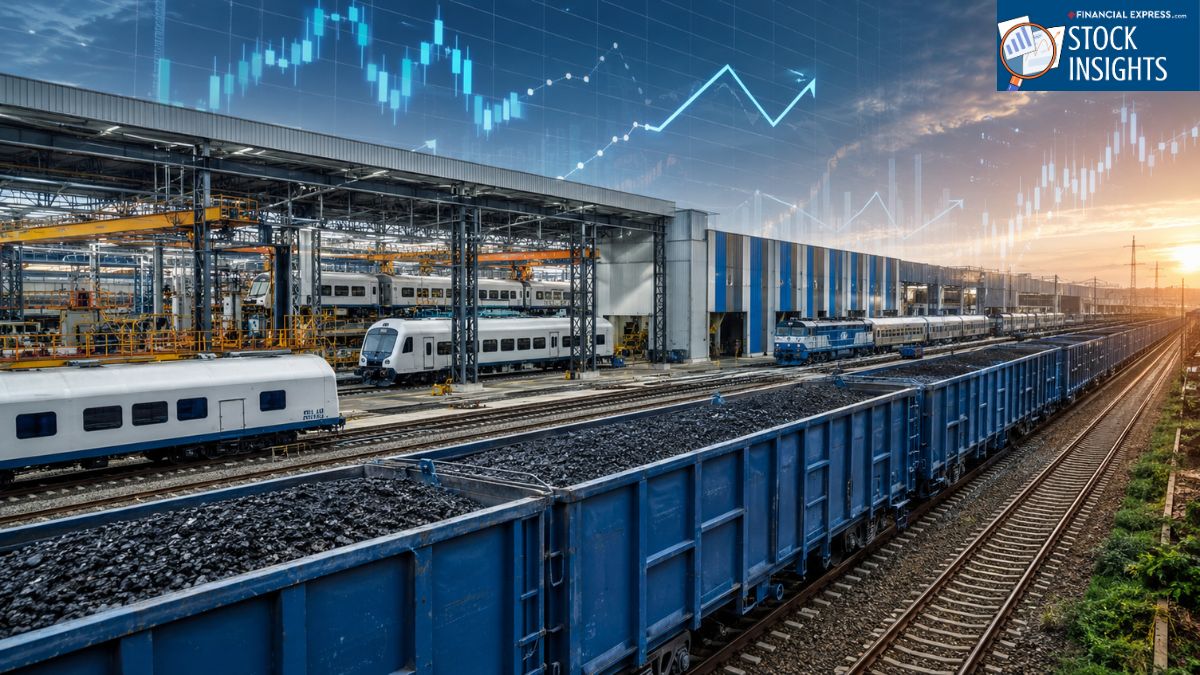
Railway wagons and rolling stock form the backbone of India’s freight and passenger rail network. The industry manufactures freight wagons, coaches and other rail-based equipment. It serves Indian Railways, private freight operators and industrial customers.
The sector is gaining importance as India expands its railway infrastructure. New railway lines, dedicated freight corridors and higher freight movement are increasing the need for rolling stock. Indian Railways is also replacing older wagons and adding capacity to carry more goods.
These developments have led to a sharp rise in orders for wagon and rolling-stock manufacturers. Large order books can provide revenue visibility for several years. However, actual growth will depend on how quickly these companies execute orders and convert them into revenue and profit.
The listed universe is limited. There are only four such stocks in India. Therefore, this is not a stock-picking exercise. The article covers the entire listed universe linked to railway wagon and rolling-stock manufacturing.
#1 Titagarh Rail Systems: Can Its Rs 27,540-Crore Order Book Restore Growth?
Titagarh Rail Systems (Formerly Titagarh Wagons), incorporated in 1997, is mainly engaged in the manufacturing and selling of freight wagons, passenger coaches, metro trains, train electricals, steel castings, specialised equipment & bridges, ships, etc. The company caters to both domestic and export markets.
Titagarh Rail Systems Financial Performance
| Metric | FY26 |
| Revenue growth | -16.1% YoY |
| Net profit growth | 95.8% YoY |
| Order book | Rs 27,540 crore |
| RoCE | 10.6% |
| RoE | 6.5% |
| EV/EBITDA | 31x |
Titagarh Rail Systems closed FY26 with an order book of about Rs 27,540 crore. This includes its share of orders held through joint ventures. The company’s own order book, including its subsidiary, stood at around Rs 14,240 crore.
Freight rolling stock accounted for Rs 3,115 crore of orders. The pending book covered around 6,500 wagons. These orders are scheduled for delivery in FY27. Titagarh dispatched 7,019 wagons in FY26. Production was affected by wheelset shortages and supply disruptions linked to West Asia.
The company expects to produce 650-700 wagons a month in FY27. This can rise to 1,000 wagons after Indian Railways awards fresh tenders. Its upgraded foundries can now produce 50,000 tonnes annually. This should meet the casting requirement for wagon production.
Titagarh also secured a wagon-leasing licence. Its first contract covers two rakes for Balmer Lawrie. The company supplied specialised wagons to the Dedicated Freight Corridor Corporation of India. It also won a Rs 273.24-crore order for rail-borne maintenance vehicles.
Evaluating The Shift From Freight Margins to Metro Margins
Passenger rolling stock is becoming a larger growth driver. Its order book stood at Rs 10,625 crore. The company plans to increase sales from 63 units in FY26 to at least 200 in FY27. It expects to deliver two Vande Bharat trains during the year. Supplies for Gujarat Metro have begun. Mumbai Metro deliveries are also expected to start in FY27.
Revenue from operations fell 16.1% year-on-year (YoY) to Rs 3,143.6 crore in FY26. However, net profit from continuing operations rose 95.8% to Rs 150.7 crore – a surge heavily driven by a non-operational structural optimization rather than core manufacturing growth, as the company formally exited its loss-making Italian subsidiary, Firema. Passenger rail revenue more than doubled to Rs 539.3 crore and partly offset weaker wagon execution.
The company has exited its loss-making Italian business, Firema. Management expects no further losses or liabilities from the venture.
Titagarh trades at an EV/EBITDA multiple of 31 times. This is above the industry median of 29.2 times. Its return on capital employed (RoCE) stands at 10.6%, while return on equity (RoE) is 6.5%. The order book offers visibility. However, returns will depend on faster wagon execution and the timely ramp-up of passenger projects.
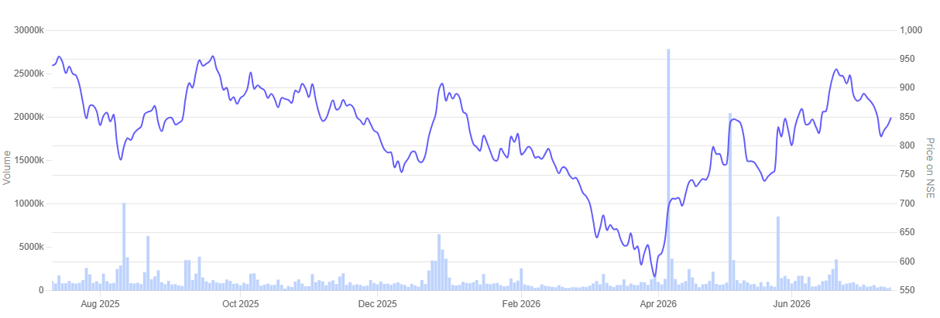
In the past year, the share price of Titagarh Rail Systems is down 9.3%.
Titagarh Rail Systems 1 Year Share Price Chart
#2 Texmaco Rail & Engineering: Can Export Orders Offset Slower Railway Demand?
Texmaco Rail & Engineering is an engineering infrastructure company & part of the Adventz Group. The company is involved in the business of manufacturing rolling stock, hydro-mechanical equipment, steel castings & construction of Rail EPC, bridges, and other steel structures.
Texmaco Rail & Engineering Financial Performance
| Metric | FY26 |
| Revenue growth | -14.3% YoY |
| Net profit growth | -22.1% YoY |
| Order book | Rs 5,408 crore |
| RoCE | 11.4% |
| RoE | 7.6% |
| EV/EBITDA | 12.1x |
Texmaco Rail & Engineering ended FY26 with an order book of Rs 5,408 crore. Freight cars accounted for 38.5% of the total. Rail and green-energy infrastructure contributed another 34.8%.
Structural Shift Toward Private and Export Backlogs
The customer mix has changed sharply. Private and export customers formed 79% of the freight-car order book. Indian Railways accounted for the remaining 21%. A year earlier, Indian Railways had contributed 79%. This shift has reduced Texmaco’s dependence on fresh railway tenders.
The order book received a major boost after the end of FY26. Texmaco secured an order worth over Rs 4,000 crore from South Africa. It covers about 2,200 wagons, 30 diesel locomotives and maintenance support for 15 years. Deliveries are expected by the end of FY28. The company is also supplying wagons to Cameroon and pursuing more opportunities in Africa.
Texmaco delivered 8,372 freight cars in FY26. This was lower than the previous year. Wheelset shortages, global supply disruptions and US tariffs affected production and exports. However, the company continued to manufacture specialised wagons for sectors such as steel, cement, petroleum and food grains.
Revenue from operations fell 14.3% YoY to Rs 4,377 crore in FY26. Net profit declined 22.1% to Rs 194 crore. The weaker performance reflected lower wagon production and slower execution in the rail infrastructure business. In contrast, the electrical infrastructure division grew revenue by 66.1% to Rs 610 crore.
Under its Vision 2030 plan, Texmaco aims to double revenue and expand beyond conventional wagons. Its focus areas include railway signalling, Kavach, propulsion systems and defence manufacturing. Planned capital expenditure could range between Rs 1,500 crore and Rs 2,000 crore through 2030.
Texmaco trades at an EV/EBITDA multiple of 12.1 times. This is well below the industry median of 29.2 times. Its RoCE stands at 11.4%, while RoE is 7.6%. The valuation appears moderate. However, improved returns will depend on timely export execution and a recovery in wagon volumes.
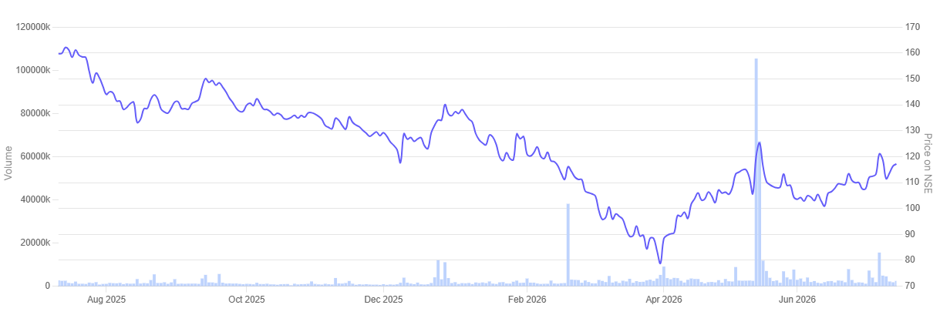
In the past year, the share price of Texmaco Rail & Engineering is down 26.9%.
Texmaco Rail & Engineering 1 Year Share Price Chart
#3 Jupiter Wagons: Can Its Rs 4,675-Crore Order Book Drive an FY27 Recovery?
Jupiter Wagons is primarily involved in the business of manufacturing metal fabrication comprising load bodies for commercial vehicles, rail freight wagons, and components.
Jupiter Wagons Financial Performance
| Metric | FY26 |
| Revenue growth | -26.4% YoY |
| Net profit growth | -56.4% YoY |
| Order book | Rs 4,675 crore |
| RoCE | 9.2% |
| RoE | 6.4% |
| EV/EBITDA | 29.2x |
Jupiter Wagons entered FY27 with an order book of Rs 4,675 crore. The wagon portion stood at around Rs 3,100 crore. It covered roughly 7,400 wagons. Of these, about 2,000 were for Indian Railways and 5,400 for private and other customers.
The order mix offers near-term visibility. However, fresh orders from Indian Railways remain important for a sharper rise in production. Management expects new railway tenders within the first half of FY27. Wagon execution is expected to improve from the second quarter as supply conditions stabilise.
FY26 was a difficult year for the industry. Wheelset shortages affected production during the first half. LPG availability and other supply-chain disruptions added pressure in the fourth quarter.
Revenue from operations fell 26.4% YoY to Rs 2,915.7 crore in FY26. Net profit declined 56.4% to Rs 166 crore. The fall reflected weaker wagon execution and lower operating margins. The wheelset division provided some support. Its revenue increased from Rs 343 crore to Rs 528 crore.
Component De-risking: In-House Wheelset Integration
Its Odisha wheelset plant is moving ahead after delays in equipment shipments. Partial production is expected by March 2027. Full commissioning is targeted by March 2028. Jupiter has also signed a long-term agreement to supply wheelsets to European wagon maker Tatravagonka from this facility.
The company is strengthening backward integration. Its subsidiary, Stone India, has received RDSO approval for freight braking systems. Commercial production is scheduled to begin in July 2026.
Jupiter Wagons trades at an EV/EBITDA multiple of 29.2 times. This is in line with the industry median. Its RoCE stands at 9.2%, while RoE is 6.4%. The order book provides visibility. However, better returns will depend on fresh railway orders, faster wagon execution and the timely commissioning of the Odisha plant.
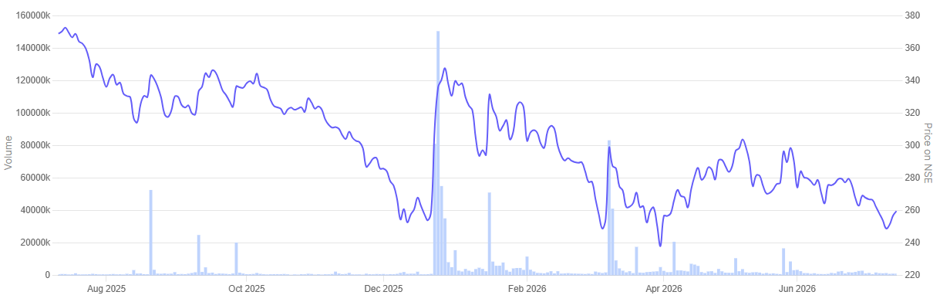
In the past year, the share price of Jupiter Wagons is down 29.6%.
Jupiter Wagons 1 Year Share Price Chart
#4 BEML: Can Its Rs 15,896-Crore Order Book Improve Rail Execution?
BEML manufactures a wide range of heavy earthmoving equipment catering to the mining and construction industry, vehicles for defence forces and coaches for the metro and Indian Railways.
BEML Financial Performance
| Metric | FY26 |
| Revenue growth | 8.2% YoY |
| Net profit growth | -51.7% YoY |
| Order book | Rs 15,896 crore |
| RoCE | 7.7% |
| RoE | 4.9% |
| EV/EBITDA | 48.7x |
BEML ended FY26 with its highest-ever order book of Rs 15,896 crore. Rail and metro projects accounted for about 65% of the total. This translates into orders worth over Rs 10,000 crore. Defence contributed 25%, while mining, construction and exports formed the balance.
The rail book covers metro coaches, Vande Bharat Sleeper trains, LHB coaches and high-speed rail projects. BEML expects to execute at least Rs 2,000 crore of rail and metro orders in FY27. Its executable order book across businesses stood at Rs 5,500 crore at the start of the year.
Progress has begun on key projects. The first Vande Bharat Sleeper train entered commercial service in January 2026. BEML has also received design clearance to dispatch coaches against its 600-coach LHB order.
Production of high-speed train components has started at the Bengaluru facility. The first car body is expected by August 2026. BEML aims to deliver the first train in early 2027. It will then undergo four to six months of testing.
Capital Allocation Scales: Balancing Defence Margins with High-Speed Rail Timelines
Capacity is also being expanded. The new high-speed rail facility can produce six to eight high-speed coaches a month. It can make up to 12 metro coaches. The proposed Bhopal plant could add capacity for another 300-350 coaches annually. It may take up to three years to become fully operational.
Revenue from operations rose 8.2% YoY to a record Rs 4,351 crore in FY26. However, net profit fell 51.7% to Rs 141 crore. The decline was largely due to one-time adjustments on legacy projects.
BEML’s export order book reached $107 million. This included a $60-million rolling-stock order from Africa. The company is also pursuing metro opportunities in Tel Aviv and Dublin with Delhi Metro’s international arm.
BEML trades at an EV/EBITDA multiple of 48.7 times. This is well above the industry median of 29.2 times. Its RoCE stands at 7.7%, while RoE is 4.9%. The order book is strong. However, the premium valuation leaves limited room for delays in execution or margin recovery.
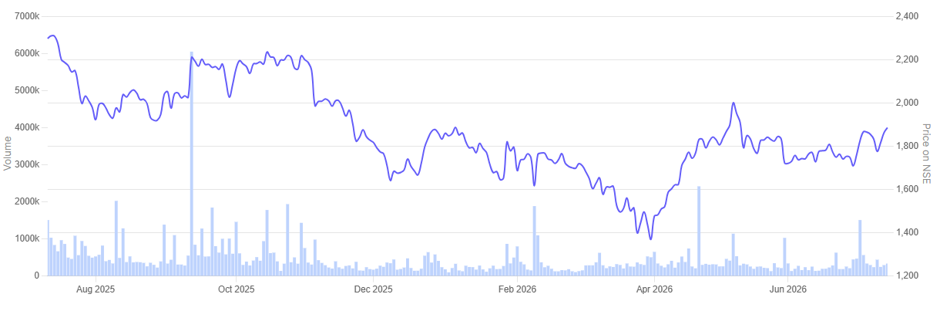
In the past year, the share price of BEML is down 17.9%.
BEML 1 Year Share Price Chart
Conclusion
The order books are large, but execution will matter now. Companies must deliver wagons and coaches on time while keeping costs under control.
Each company is taking a different route. Some still rely on Indian Railways, while others are moving into metros, wheelsets and exports. Investors should therefore look at what the orders can earn, not just how big they are. Valuation and return ratios also need a close watch.
Indian Railway Wagon and Rolling-Stock Makers: Order Books vs Returns vs Valuation
| Metric | Titagarh Rail Systems | Texmaco Rail | Jupiter Wagons | BEML |
| FY26 revenue growth | -16.1% | -14.3% | -26.4% | 8.2% |
| FY26 profit growth | 95.8% | -22.1% | -56.4% | -51.7% |
| Order book | Rs 27,540 crore | Rs 5,408 crore | Rs 4,675 crore | Rs 15,896 crore |
| RoCE | 10.6% | 11.4% | 9.2% | 7.7% |
| RoE | 6.5% | 7.6% | 6.4% | 4.9% |
| EV/EBITDA | 31x | 12.1x | 29.2x | 48.7x |
| Industry median EV/EBITDA | 29.2x | 29.2x | 29.2x | 29.2x |
| Key theme | Passenger rail ramp-up | Private and export wagons | Wagon recovery and wheelsets | Metro and high-speed rail |
For now, order visibility remains strong across the sector. However, FY26 performance shows that a large order book does not always translate into immediate growth.
Execution will be the main test. Wagon deliveries, passenger coach production and access to critical components will shape revenue growth. Valuations and return ratios also need attention, particularly where stocks trade at a premium to the industry median.
You can track how these are progressing by adding stocks to your watchlist.
Note: We have relied on data from www.Screener.in throughout this article. Only in cases where the data was not available, have we used an alternate, but widely used and accepted source of information.
The purpose of this article is only to share interesting charts, data points and thought-provoking opinions. It is NOT a recommendation. If you wish to consider an investment, you are strongly advised to consult your advisor. This article is strictly for educative purposes only.
Ekta Sonecha Desai has a passion for writing and a deep interest in the equity markets. Combined with an analytical approach, she likes to deep dive into the world of companies, studying their performance, and uncovering insights that bring value to her readers.
Disclosure: The writer and her dependents do not hold the stocks discussed in this article.
The website managers, its employee(s), and contributors/writers/authors of articles have or may have an outstanding buy or sell position or holding in the securities, options on securities or other related investments of issuers and/or companies discussed therein. The content of the articles and the interpretation of data are solely the personal views of the contributors/ writers/authors. Investors must make their own investment decisions based on their specific objectives, resources and only after consulting such independent advisors as may be necessary.


