



India’s electricity demand is steadily increasing, driven by shifts in energy consumption across homes, industries, and digital infrastructure. In FY25, peak power demand reached a record 250 GW, up nearly 70% over the past decade, driven by industrial expansion, wider access to electricity, and increased use of appliances such as air conditioners.
The Data Center & AI Catalyst
Cooling needs alone are expected to play a significant role in future demand. The International Energy Agency (IEA) estimates that air conditioners contributed around 60 GW to peak load in 2024 and could account for nearly a third of total demand by 2050.
Meanwhile, the growing footprint of data centers and the adoption of Artificial Intelligence are likely to increase power consumption. The Draft National Electricity Plan 2026 targets increasing per capita electricity consumption from the current 1,460 kWh to 2,000 kWh by 2030, and to over 4,000 kWh by 2047.
India is also racing toward a target of 500 GW of non-fossil fuel capacity by 2030. To meet this shift, India will need substantial investments in its power infrastructure. The government estimates an investment opportunity of over US$500 billion (₹40 lakh crore) over the next seven years to meet the country’s rising electricity demand, according to India’s Prime Minister.
In this context, we have selected three power-sector stocks that are well positioned to benefit. This deep dive is being undertaken following a sharp correction in sector stock prices. Given the Q3FY26 financials, are stock prices finally at attractive levels? Let’s take a look.
#1 GE Vernova T&D: The Backbone of India’s Renewable Evacuation
GE Vernova is a leading player in the power transmission and distribution (T&D) sector. The company focuses on grid modernization, renewable energy integration, and building the infrastructure required to evacuate power from generation sources to consumers.
Supporting the 500 GW Green Energy Shift
The company plays a critical role in India’s energy transition, particularly in supporting the country’s target of 500 GW of non-fossil fuel capacity by 2030. Each megawatt of renewable capacity added creates demand for T&D network capacity to ensure grid stability.
GE positions itself as essential to the evacuation backbone for transmitting renewable energy from remote generation sites, such as solar parks in Rajasthan and wind farms in Gujarat, to urban industrial centers.
Why Global Giants Control 98% Private Order Books
High Voltage Direct Current (HVDC) solutions are a key part of its portfolio. HVDC is essential for long-distance power transmission. To ensure financial security, the company also has minimal dependence on state utilities (less than 2%). The remaining 98% of its in-hand orders come from private customer utilities and public central enterprises.
Management remains confident in the company’s ability to maintain strong profitability. In FY26, the company expects to deliver margins at the higher end of the mid-20s range. These margins are expected to remain stable in the foreseeable future, driven by improved commercial terms and operational productivity.
The ₹14,380 Order Book
The company currently has a strong order backlog of ₹14,380 crore, providing revenue visibility of just over two years based on trailing 12-month (TTM) revenue of ₹5,722 crore. Beyond this, the company estimates a strong pipeline in both domestic and international markets. The company estimates FY27 will be much stronger for ordering activity.
In addition, management sees a big opportunity in the projected $80 billion investment in data centers and Artificial Intelligence factories by major US technology companies over the next 4–5 years. While export orders (currently 15% of the total) fluctuate quarterly, the pipeline remains active.
Why Chinese Rivals Face a 3-Year Entry Barrier
On Chinese competition, management cites ‘Make in India’ as a formidable barrier. It states that even if the policy is relaxed, new companies will face delays of 2-3 years due to stringent local testing, supply chain qualification, and manufacturing setup requirements. The same view was shared by its peer, the Transformer and Rectifiers management.
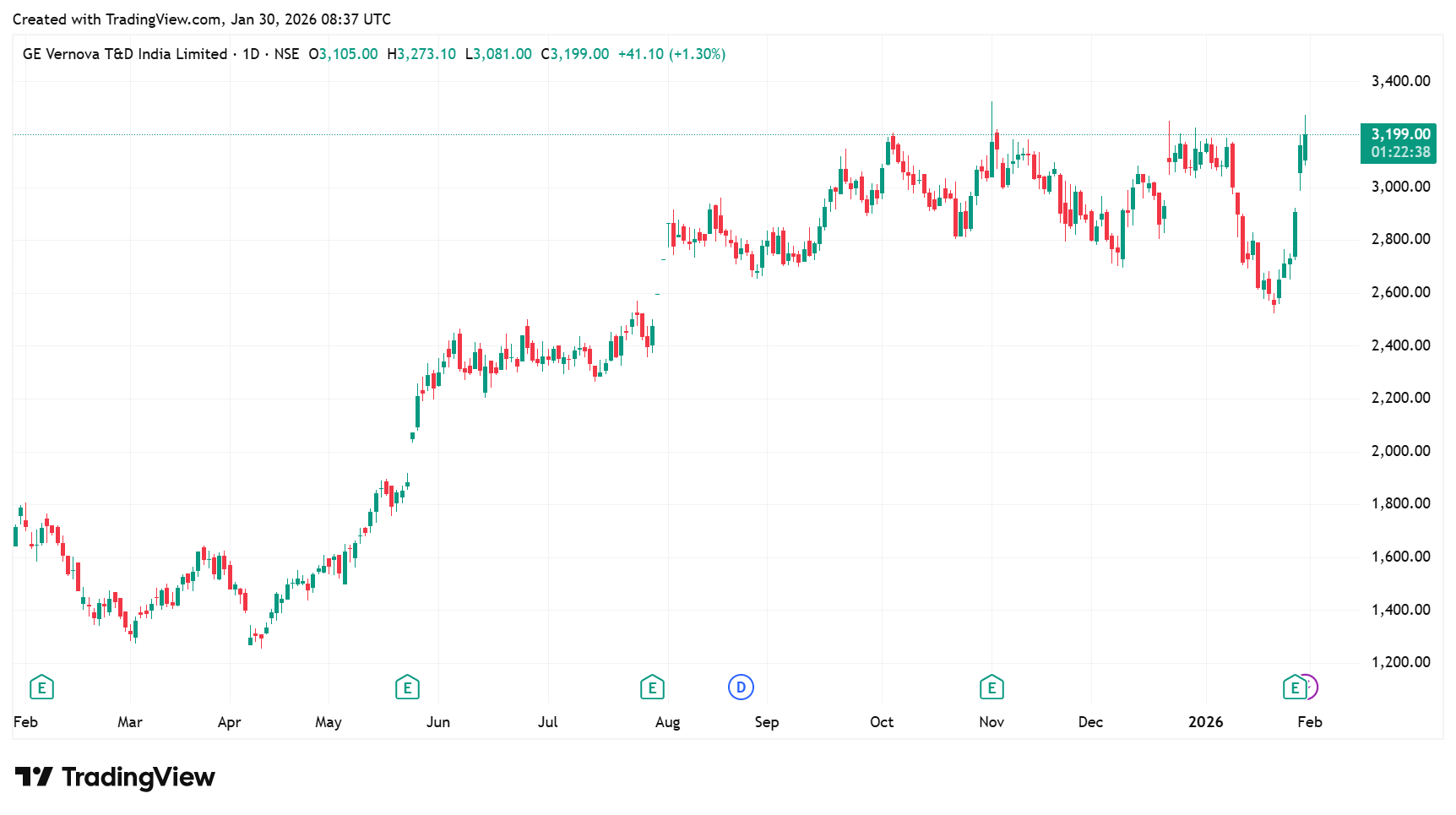
Speaking of financials, revenue in Q3FY26 grew 58% year-on-year to ₹1,701 crore, driven by order book execution. Approximately 72% of revenue came from domestic contracts, with the remainder (28%) from export contracts. Operating profit margins expanded by 1000 basis points (bps) to 27%. PAT more than doubled to ₹291 crore, up from ₹143 crore in Q3FY25.
#2 “CG Power: Leveraging Murugappa Group’s Industrial and Semiconductor Edge
CG Power, part of the Murugappa Group, is a leading engineering company in the electrical engineering industry. The company operates in Industrial Systems and Power Systems, with recent expansions into consumer appliances and semiconductors.
Industrial Systems: The Vande Bharat Tailwinds
The Industrial System segment manufactures a wide range of induction motors, drives, and allied products. It is also deeply integrated into the railway sector, producing traction motors, propulsion systems, and signaling relays for Indian Railways. The company has also diversified into consumer products, offering fans, pumps, and water heaters.
Segment revenue rose 8% year-on-year to ₹1,585 crore in Q3FY26, driven by steady sales growth in the motors and railway businesses. But, Profit Before Interest and Tax (PBIT) declined by 19% to ₹149 crore. This was attributed to lower price realizations and product mix changes in the railway segment, as well as commodity inflation in the Motors business.
In the power sector, it manufactures transformers and reactors. Its portfolio includes power transformers ranging from 25 kVA to 1500 MVA and reactors from 10 MVAr to 125 MVAr. This segment’s revenue rose sharply by 44% to ₹1,326 crore, driven by strong execution discipline and improved price realization. PBIT surged to ₹283 crore, as margins expanded by 378 bps.
It has also recently forayed into the semiconductor space. It is establishing an Outsourced Semiconductor Assembly and Testing (OSAT) facility to provide global test services. Additionally, CG acquired the Radio Frequency components business from Renesas and established Axiro Semiconductor, a fabless design company in high-performance semiconductor solutions
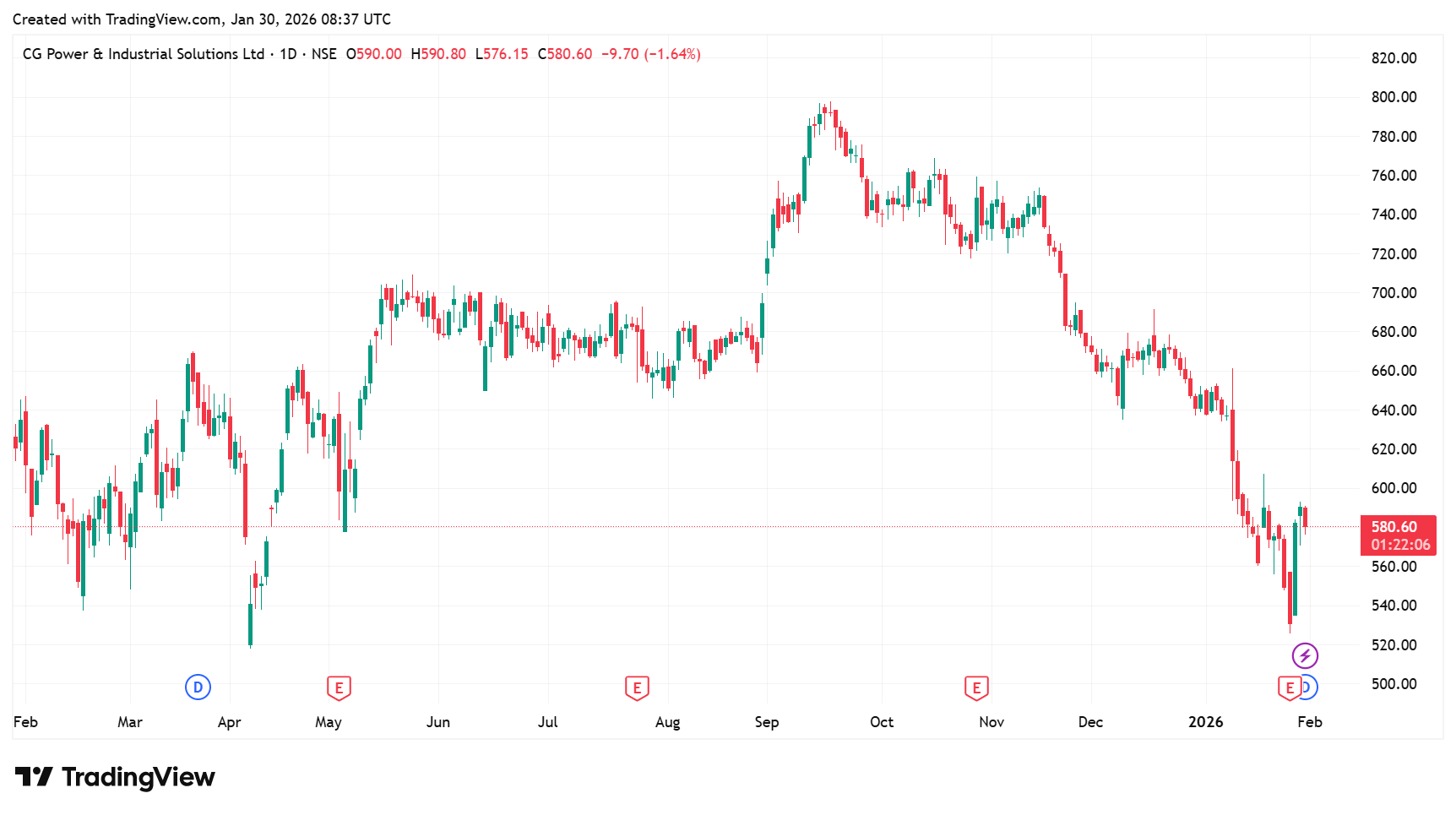
From a financial viewpoint, consolidated sales grew 26% year-on-year to ₹3,175 crore, driven by order book execution. EBITDA (Earnings Before Interest, Tax, Depreciation, and Amortization) rose by 30% to ₹474 crore, with margins at 14.9%, up by 40 bps. As a result, PAT grew by 19% to ₹284 crore.
The ₹15,753 crore Order Book
As of 31 December, 2025, the order book stood at ₹15,753 crore, including the ₹900 crore order for power transformers from Tallgrass Integrated Logistics Solutions LLC, USA, for a hyperscale data center project. This order book provides visibility into revenue of just over one year, at ₹11,729 crore per TTM.
Powering Hyperscale Data Centers in the US
Global CEO Amar Kaul described the data center order as a strategic platform win that validates CG Power’s ability to deliver mission-critical technology to hyperscalers. Management believes this win creates a “significant long-term opportunity pipeline” in the global data center market.
#3 TARIL: A Pure-Play Transformer Bet Targeting $1 Billion Revenue
Transformer & Rectifiers (TARIL) is a leading manufacturer of transformers and reactors, with a global footprint in over 25 countries. The company operates on a B2B model, catering to the power generation, transmission, distribution, and industrial sectors. Its installed capacity stands at approximately 40,000 MVA across its units.
TARIL manufactures a diverse range of products, including single-phase power transformers up to 1200kV class, furnace transformers, rectifiers, and distribution transformers. Its portfolio also includes series and shunt reactors, mobile substations, and transformers for solar and green hydrogen applications.
The company has supplied high-voltage equipment to major clients, including NTPC, Tata Power, Power Grid, Adani, and Siemens. As of 31 December 2025, Utilities accounted for 56% of revenue, followed by industrial/private clients (35%), among others. About 91% of revenue came from indigenous markets.
As of 31 December 2025, the unexecuted order book stood at ₹5,450 crores, with inquiries under negotiation exceeding ₹16,500 crores. Management expects to close FY26 with an order book of about ₹8,000 crores. That said, the current order book provides revenue visibility of around two years, based on the TTM of ₹2,403 crore.
Breaking the HVDC Monopoly for Power Grid
TARIL has received an order from Power Grid to repair an HVDC converter transformer, making it the first Indian-origin company to receive such an order. This development positions the company to qualify for future indigenous HVDC technology tenders.
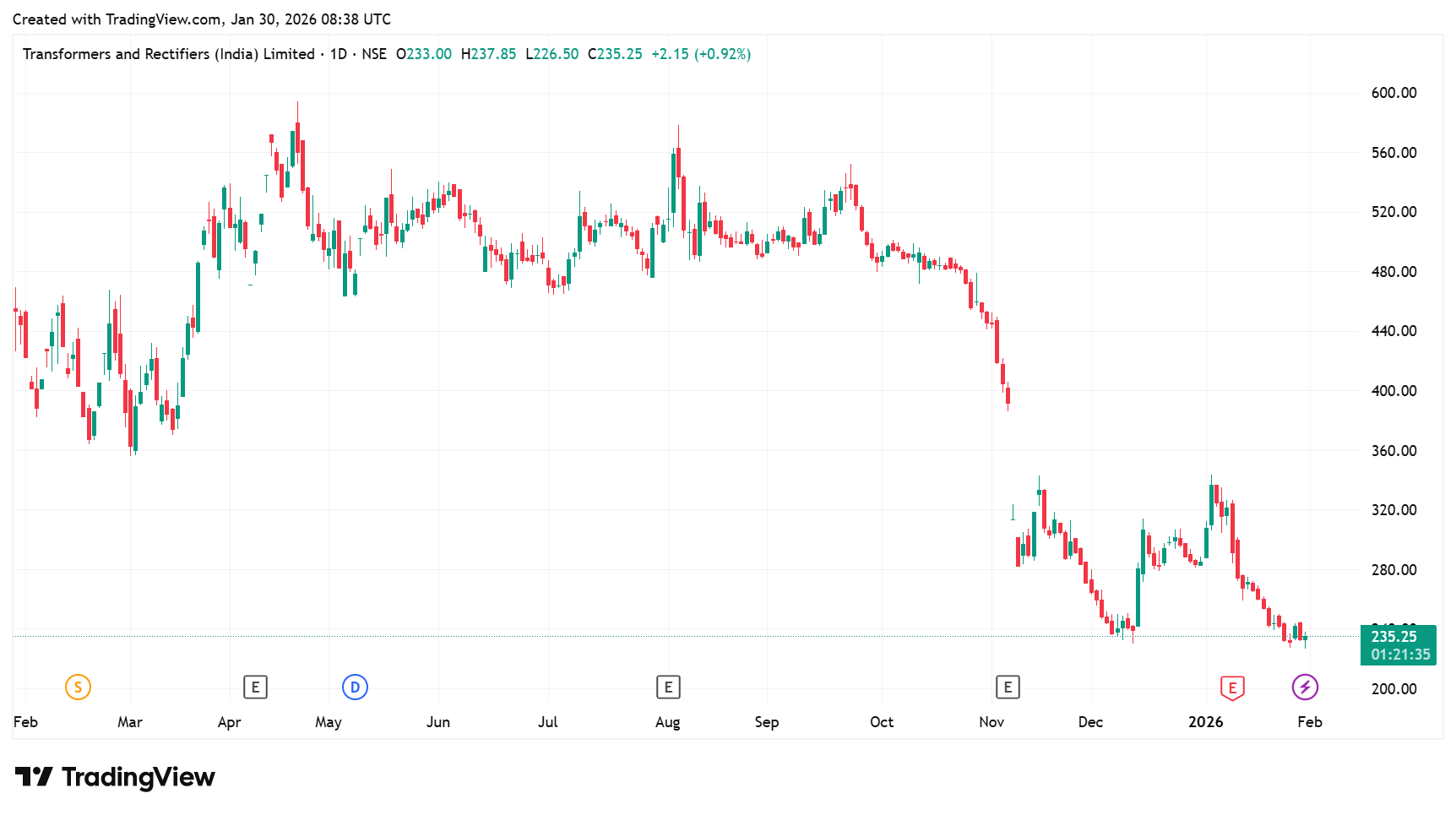
From a financial standpoint, TARIL revenue rose by 32% year-on-year to ₹737 crore in Q3FY26, driven by improved execution and enhanced capacity utilization. EBITDA expanded by 38% to ₹129 crore, while margins expanded by 79 bps to 17.5%. As a result, PAT rose by 37% to ₹76 crore.
Why TARIL is Nearly Doubling MVA to 75,000
TARIL is pursuing a capacity-expansion and backward-integration strategy to drive growth and efficiency. The company plans to increase its manufacturing capacity from the current 40,000 MVA to 75,000 MVA. This includes adding 15,000 MVA at the Changodar facility in Q1 FY27 and 22,000 MVA at the Moraiya facility in Q2 FY27.
To improve margins and supply chain resilience, TARIL is setting up facilities for internal value addition. These include a CTC plant targeted for commissioning in Q1FY27, a Press Board facility in Q3FY27, and an RIP bushing plant in Q4FY27. Also, to mitigate the risk of commodity price volatility, the company is deliberately limiting its order book visibility to 18 months.
Capacity Roadmap: The Path to ₹8,000 Crore Revenue
The company is targeting a long-term revenue goal of approximately $1 billion (₹8,000 crore) by FY29. This growth is expected to be driven by capacity expansion, the operationalization of backward integration facilities, and sustained demand in the Indian transformer industry.
Valuation Check: Is the Power Sector Rally Overextended?
As a part of a global giant, GE Vernova operates at leading return ratios, both Return on Capital Employed (ROCE) and Return on Equity (ROE). CG Power and TARIL return ratios are also stronger, reflecting strong profitability and efficiency. However, after the recent correction, TARIL’s valuation has declined the most, trading below historical and median multiples.
| Peer Comparison (X) | ||||
| Company | P/E | 5Y Median P/E | ROCE (%) | ROE (%) |
| GE Vernova | 73.5 | 114.4 | 54.7 | 40.4 |
| CG Power | 81.9 | 77.3 | 37.5 | 27.7 |
| TARIL | 26.5 | 55.7 | 28.0 | 23.4 |
| Industry Median | 39.6 | NA | 28.1 | 22.3 |
| source: screener.in | ||||
Although GE Vernova’s valuation has fallen below the historical median, it continues to trade at a premium to the industry. Even on a standalone basis, its valuation is high, comparable to CG Power’s. Any slight execution slip could send the price plummeting, as we’ve seen recently in stocks in the electronics manufacturing sector.
Disclaimer:
Note: Throughout this article, we have relied on data from http://www.Screener.in and the company’s investor presentation. Only in cases where the data was unavailable have we used an alternative, widely used and accepted source of information.
The purpose of this article is only to share interesting charts, data points, and thought-provoking opinions. It is NOT a recommendation. If you wish to consider an investment, you are strongly advised to consult your advisor. This article is strictly for educational purposes only.
About the Author: Madhvendra has been deeply immersed in the equity markets for over seven years, combining his passion for investing with his expertise in financial writing. With a knack for simplifying complex concepts, he enjoys sharing his honest perspectives on startups, listed Indian companies, and macroeconomic trends.
A dedicated reader and storyteller, Madhvendra thrives on uncovering insights that inspire his audience to deepen their understanding of the financial world.
Disclosure: The writer and his dependents do not hold the stocks discussed in this article.
The website managers, its employee(s), and contributors/writers/authors of articles have or may have an outstanding buy or sell position or holding in the securities, options on securities or other related investments of issuers and/or companies discussed therein. The articles’ content and data interpretation are solely the personal views of the contributors/ writers/authors. Investors must make their own investment decisions based on their specific objectives, resources, and only after consulting such independent advisors as may be necessary.