




Ace investor Mukul Agarwal has raised his stake in a small non-banking financial company (NBFC), which listed less than a year back.
The NBFC? Laxmi India Finance Ltd.
He first invested in Laxmi India Finance last year right after its listing and maintained a holding of 3.83% since. However, in the quarter ended on 30 June, he raised his stake by 0.75%, taking the total holding to 4.58%.
As Agarwal is always known for identifying emerging small and midcap companies which have scalable business models, this NBFC perhaps fits his investment style. Laxmi India Finance is a retail-focused NBFC primarily catering to the MSMEs and self-employed borrowers in Tier-II, Tier-III and rural markets.
Having said that, let’s try to understand what changed at Laxmi India Finance that made this ace investor raise his stake.
Laxmi India Finance: Targeting Underpenetrated Markets
In the age of digitalisation, Laxmi India Finance is targeting borrowers from Tier-II and Tier III and even rural markets, where formal credit penetration is relatively low. During FY26, 37% of the borrowers were first-time credit users, reflecting the demand and supply gap in these regions.
The NBFC has a presence across the central and western part of the country, including Rajasthan, Gujarat, Maharashtra, Madhya Pradesh, Uttar Pradesh, and Chhattisgarh.
The NBFC offers a wide range of both secured and unsecured loans, which includes MSME loans, loan against property (LAP), commercial vehicle loans, construction loans, electric vehicle financing, business loans, wholesale lending services, and personal loans. With over 176 branches, this NBFC was serving more than 42,800 customers as at the end of FY26.
Steady Loan Book Growth
One of the reasons why Mukul Agarwal increased his stake in this NBFC could be its loan book growth. At the end of FY26, overall assets under management (AUM) stood at ₹1,626.3 crore, reflecting a 27.4% YoY growth.
Out of the total AUM, the own-loan book of the NBFC stood at ₹1,518.6 crore, indicating that the NBFC kept the majority of the portfolio in its own book, while securitizing a nominal share of the same.
MSME loans have been the primary driving force behind the loan book growth, as it stood at ₹1,298.68 crore out of total AUM at the end of FY26, rising at a CAGR of 33.29% since FY23.
Vehicle loans contributed to another ₹145.82 crore, while construction loans and LAP added ₹85.61 crore to the loan book.
Expansion Plans & Technology Push
The NBFC is looking to expand its physical presence into the adjacent geographies via a cluster-based branch strategy along with increasing presence across the existing markets.
The company’s management said that they are targeting to grow their AUM at 30% CAGR over the medium term, and for the same, expansion becomes more crucial at this juncture.
Laxmi India Finance is also investing heavily in new technologies to improve customer acquisition and loan servicing processes. They have built over 110 digital tools which are deployed across different business segments of the company. Although the NBFC mainly operates through its physical branches, these tools are expected to reduce loan processing timelines, improve collection efficiency, and enhance overall customer experience.
Reduction in Borrowing Cost
Another positive of this NBFC which might have caught the eyes of the ace investor is steady reduction in the borrowing cost. The average cost of funds reduced from 11.48% in FY25 to 10.8% in FY26, supported by diversified funding sources.
The company has tie-ups with more than fifty lenders, which include both public and private sector banks, small finance banks, and other NBFCs as well.
Strong Financial Performance
Laxmi India Finance delivered healthy earnings growth during FY26. Net Interest Income (NII) rose 38.7% year-on-year to ₹161.8 crore, from ₹116.69 crore in FY25.
Profit after tax and other comprehensive income (OCI) increased 38.3% to ₹49.7 crore, from ₹35.9 crore a year ago.
Operational efficiency also improved with the company’s return on assets (ROA) increasing to 3.08% at the end of FY26 from 2.98% in FY25. Return on equity (ROE) came in at 13.7% for the period.
Management is targeting to improve medium-term ROA to 3.5-3.75% and ROE to 13.5-14% as fresh capital from the IPO is deployed.
Asset Quality Risk
Despite strong financial growth, asset quality has degraded over the years. Gross non-performing assets (GNPA) rose to 2.13% in FY26 from 1.07% in FY25 while Net non-performing assets (NNPA) surged to 1.08% from 0.48% during the period.
However, management attributed part of the increase in bad loans to a single large borrower default and said asset quality would have been better excluding this one-off event.
Is the valuation attracting the ace investor?
The stock is currently trading at a price-earnings (PE) of 11.8x, which is lower than the industry median of 22x. On the Price to Book Value (PBV) valuation metric, Laxmi India trades at 1.26x, compared to the industry median of 1.82x. On both metrics, the NBFC is relatively cheaper when compared to industry valuations.
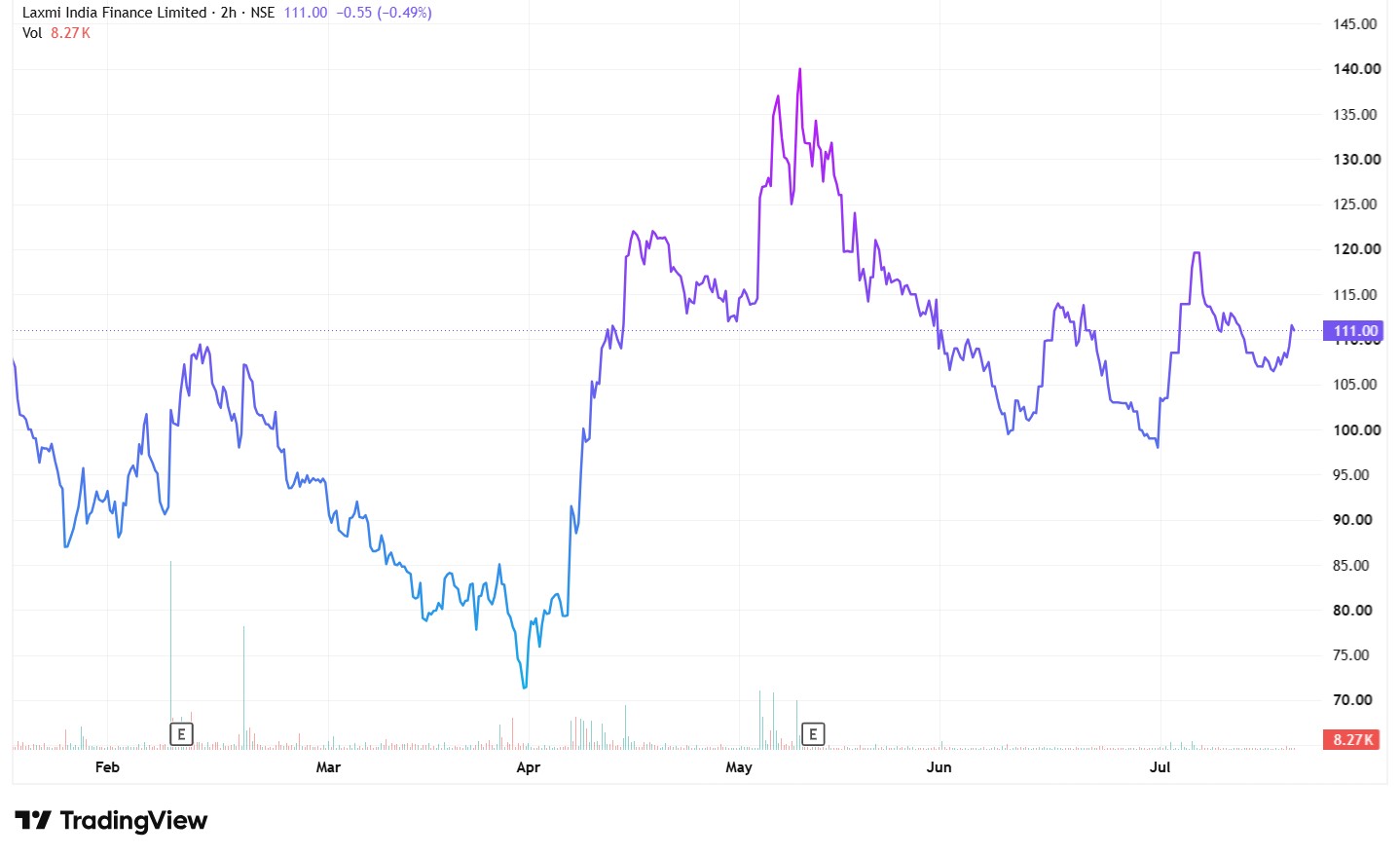
6-month Share Price Performance of Laxmi India Finance Ltd.
Should Investors Keep It on Their Radar?
Mukul Agarwal raising his stake in Laxmi India Finance perhaps indicates his confidence in the company’s long-term prospects, given the solid loan book growth, strong financial growth, and expansion plans. That said, asset quality needs to be closely monitored, as lending to MSMEs and self-employed borrowers can be vulnerable during economic slowdowns; to do so, you can add the stock to your watchlist for now.
Disclaimer:
We have relied on data from www.Screener.in throughout this article. Only in cases where the data was not available have we used an alternate, but widely used and accepted source of information.
The purpose of this article is only to share interesting charts, data points, and thought-provoking opinions. It is NOT a recommendation. If you wish to consider an investment, you are strongly advised to consult your advisor. This article is strictly for educational purposes only.
Maumita Mitra is a seasoned writer specializing in demystifying the world of investment for a broad audience. She has a keen eye for detail and a knack for explaining complex financial concepts in the simplest manner possible.
Disclosure: The writer and her dependents do not hold the stocks discussed in this article.
The website managers, its employee(s), and contributors/writers/authors of articles have or may have an outstanding buy or sell position or holding in the securities, options on securities, or other related investments of issuers and/or companies discussed therein. The content of the articles and the interpretation of data are solely the personal views of the contributors/ writers/authors. Investors must make their own investment decisions based on their specific objectives and resources, and only after consulting such independent advisors as may be necessary.