



Where the ‘Smart Money’ is Flowing
Every quarter, thousands of retail investors wait for one set of documents. Not earnings. Not budgets. Shareholding filings. Because that is where the Super Investors of India, or as we like to call them, the Warren Buffetts of India, quietly show their hand.
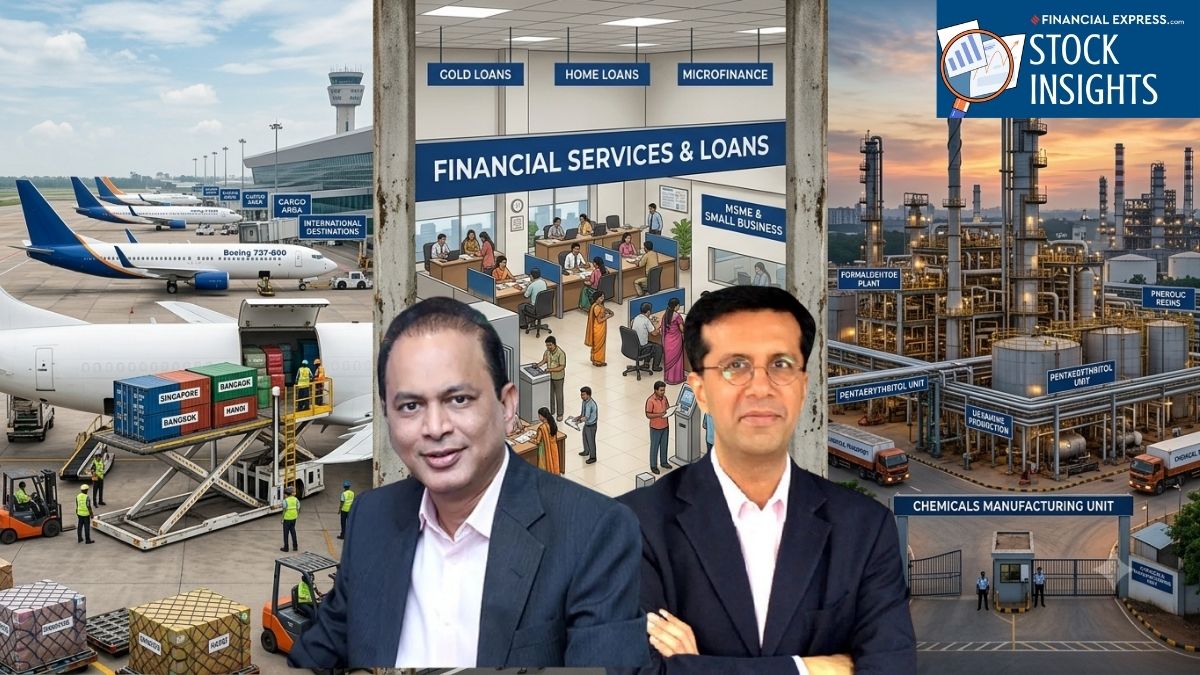
The June 2026 quarter did not disappoint. Sunil Singhania’s Abakkus Fund took a fresh stake in a a Chennai-based cargo airline. Ashish Dhawan, the founder of ChrysCapital, raised his freshly minted position in a diversified NBFC, while Sanjiv Shah, one of the most low-profile names on the superstar shareholder lists, pushed his holdings in a chemical maker.
Three very different businesses. Three very different bets. One common thread: each investor is buying into a company at a turning point. Let us dive in to see what we can find out.
#1 Afcom Holdings: Sunil Singhania’s Cargo Bet Via Fundraise
Incorporated in February 2013, Afcom Holdings is a Chennai-based company that flies cargo on an airport-to-airport basis, mainly to Southeast Asian destinations such as Singapore, Bangkok and Hanoi. It operates Boeing 737-800 freighters, received its Air Operator Certificate in December 2024.
With a market cap of Rs 4,086 cr, the company has interline agreements with Etihad Airways, Turkish Airlines and VietJet. It is the largest handler of transshipment cargo into the Maldives’ Velana International Airport.
Now, before we dig deeper, a fair warning. The stock is listed on the BSE SME platform, and hence comes with a red flag of “Buyer Beware”. The lenient reporting parameters, liquidity issues and restriction of trading in lots make SME listed stocks prone to more detailed scrutiny.
The stock listed on the BSE SME platform in August 2024 at an issue price of Rs 108, with the IPO subscribed over 203 times.
Why Promoters Are Diluting While Funds Accumulate
Per the June 2026 quarter filings, Sunil Singhania’s Abakkus Emerging Opportunities Fund holds a fresh 2% stake in the company. At the current market price, this holding is worth Rs 81 cr.
The timing is not random. In May 2026, Afcom raised fresh equity through a placement with a floor price of around Rs 800 per share. That single event reshaped the shareholder register. Institutional holding jumped from 0.85% in March 2026 to 7.96% in June, with Bandhan Small Cap Fund taking 3.18% alongside the Abakkus position. Promoter holding, meanwhile, settled lower at 35.84%, down from 40.61% in March and 42.59% in December 2025.
That last number deserves attention. When institutions walk in through a fundraise, existing holders get diluted. But a promoter stake that has slipped nearly seven percentage points in six months is something investors should keep on their radar, dilution or not.
144% Sales Surge vs. Mounting Debt: Decoding the Balance Sheet
The growth numbers are the kind that jump off any stock filter. But the base matters as much as the slope, and the balance sheet has changed shape along the way.
| Financial Year | FY21 | FY22 | FY23 | FY24 | FY25 | FY26 | 5Y CAGR |
| Sales (Rs cr) | 14 | 48 | 84 | 148 | 239 | 583 | 111% |
| EBITDA (Rs cr) | -6 | 10 | 18 | 36 | 69 | 234 | NA* |
| Net Profit (Rs cr) | -4 | 5 | 14 | 25 | 48 | 122 | NA* |
EBITDA is operating profit before other income. *FY21 was a loss-making year, so a 5-year CAGR on EBITDA and net profit would be mathematically meaningless.
Sales grew 144% in FY26 alone, from Rs 239 cr to Rs 583 cr, with operating margins of 40%. Return on capital employed (ROCE) stands at 34% and return on equity (ROE) at 36%. The company pays no dividend and is ploughing everything into fleet.
That shows on the balance sheet too. Borrowings jumped from Rs 26 cr in FY25 to Rs 401 cr in FY26 as aircraft came in, and depreciation and interest costs have risen sharply with them.
The Post-IPO Surge: Valuing the Aviation Premium
The share price of Afcom as of closing on 17th July 2026 was Rs 1,424 which is a jump of over 560% in just about 2 years.
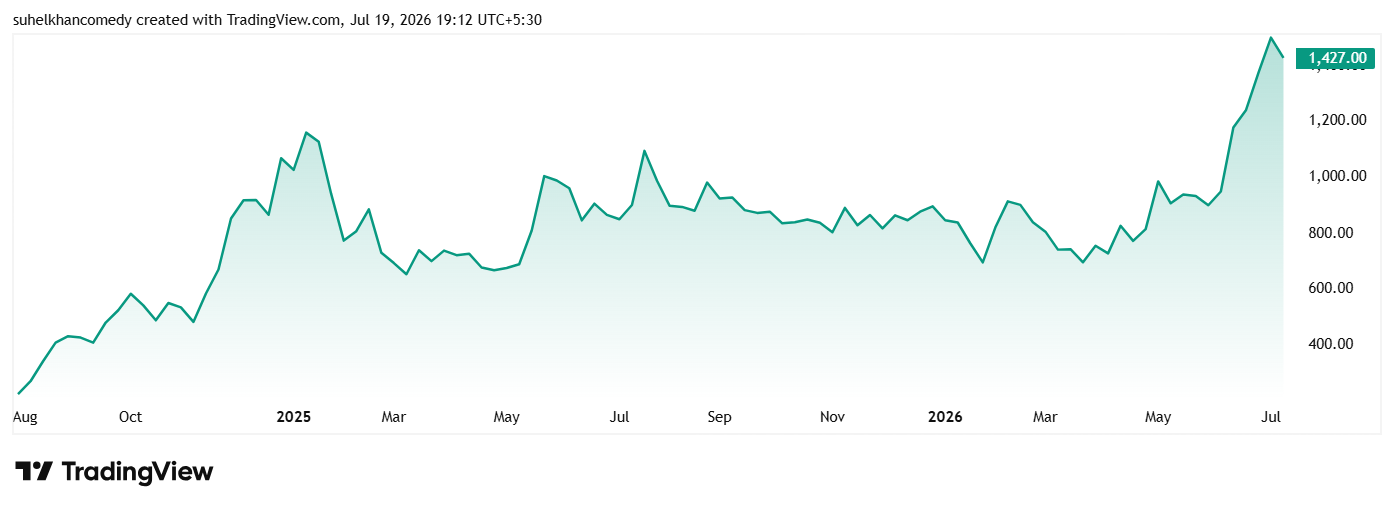
Regarding valuation, the share is trading at a PE of 34x against the industry median of 26x. The 10-year median PE will be too soon to look at, but the 10-year median industry median is 23x. So, the stock is not cheap for a business that now carries real debt and aviation risk. Plus, SME-platform liquidity, is exactly why this one is a professional fund’s bet and not an obvious retail copy trade.
#2 IIFL Finance: Ashish Dhawan’s Contrarian Play Against FII Selling
Incorporated in October 1995, IIFL Finance is a diversified non-banking financial company. It lends against gold, homes, and small businesses, and runs a microfinance book. As of nine months FY26, assets under management stood at around Rs 98,336 cr, up from roughly Rs 71,410 cr a year earlier, spread across 4,761 branches and over 4.6 million customers. Retail loans make up 98% of the book.
With a market cap of Rs 23,617 cr, Ashish Dhawan entered the stock with a 1.09% stake in the March 2026 quarter. Per the June 2026 filings, he has raised it to 1.33 % making the stake worth over Rs 315 cr.
Surviving the RBI Embargo: How the Turnaround is Gathering Pace
Here is the interesting bit. In the same June quarter that Dhawan added, foreign institutional investors (FIIs) cut their holding from 28.16% to 23.86%. Public shareholding rose to 43.80%. When a billion-dollar private equity veteran is buying what foreign funds are selling, it deserves a closer look.
His entry follows the most turbulent stretch in the company’s listed history. In March 2024, the RBI barred IIFL’s gold loan business over process lapses, an embargo lifted later that year. Then came a Rs 586 cr provision on AIF-linked investments, which pushed the September 2024 quarter to a Rs 93 cr loss. FY25 profit collapsed to Rs 578 cr from Rs 1,974 cr.
Q4 Recovery: 38% Loan Book Growth & Improving Asset Quality
| Financial Year | FY21 | FY22 | FY23 | FY24 | FY25 | FY26 | 5Y CAGR |
| Revenue (Rs cr) | 5,968 | 6,991 | 8,444 | 10,472 | 10,234 | 13,351 | 17% |
| Financing Profit (Rs cr) | 1,090 | 1,625 | 2,263 | 2,734 | 1,479 | 2,596 | – |
| Net Profit (Rs cr) | 761 | 1,188 | 1,608 | 1,974 | 578 | 1,817 | 19% |
Financing profit is used in place of EBITDA, as is standard for a lender. The FY25 net profit was dragged down by the one-time AIF provision and the gold loan embargo, so the 5-year CAGR understates the underlying trend.
The recovery has gathered pace through FY26. Net profit climbed every quarter, from Rs 274 cr in June 2025 to Rs 623 cr in March 2026. Gross NPAs improved to 1.46% and net NPAs to 0.73%, the best in three years. The loan book grew 38% year on year.
A 100% 5-Year Return: Why the Stock Still Trades at a Sector Discount
The share price of IIFL Finance was around Rs 275 in July 2021 and as of closing on 17th July 2026 it was Rs 555, which is over a 100% jump in 5 years.
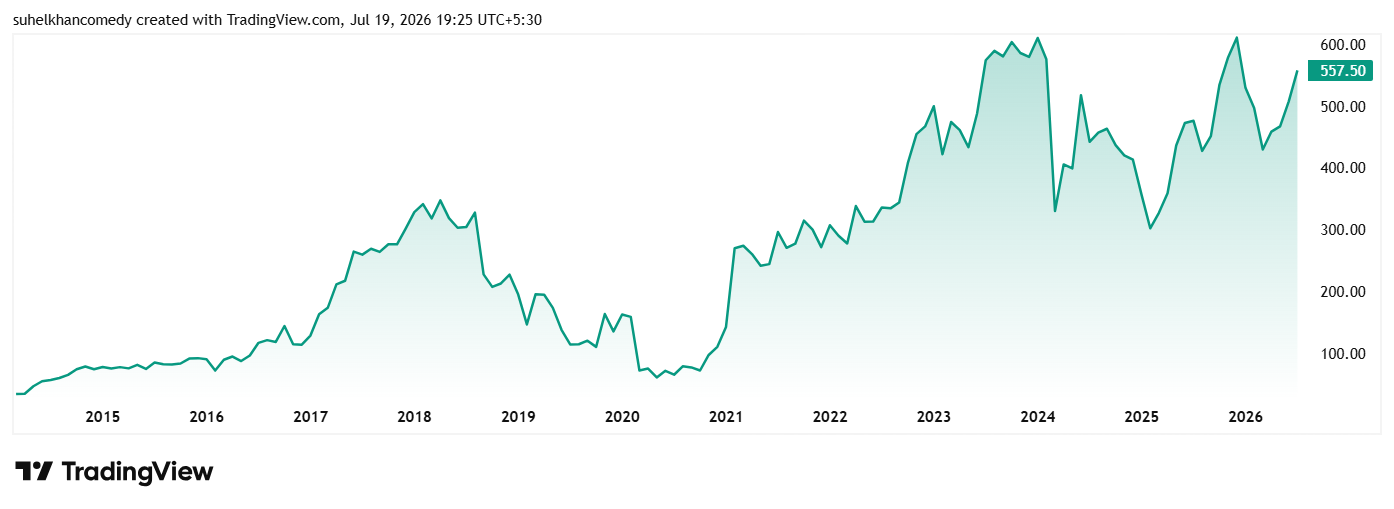
The stock trades at a PE of 14x against an industry median of 22x. The 10-year medina PE of the company is 13x while the industry median for the same period is 22x. The discount exists for a reason. Three-year return on equity is a modest 12%, and its interest coverage runs low, a common trait for lenders but worth noting. The bet here is simple: if IIFL’s post-crisis profitability holds, the valuation gap closes. If another regulatory shock lands, its more trouble.
#3 Kanoria Chemicals: Sanjiv Shah’s Bet on a Debt-Slashing Demerger
Incorporated in 1960, Kanoria Chemicals & Industries is the Kolkata-based flagship of the S. S. Kanoria group. It makes chemical intermediates such as formaldehyde, pentaerythritol, hexamine and phenolic resins, which go into construction, paints, pharma and agrochemicals. Its plants sit at Ankleshwar in Gujarat and Visakhapatnam and Naidupeta in Andhra Pradesh.
With a market cap of Rs 619 cr, the stock has had Sanjiv Dhireshbhai Shah as an investor since March 2021. Now, while Shah is not a household name, he is a fixture on India’s superstar shareholder trackers with a concentrated smallcap book.
He first bought Kanoria in March 2021. He held 1.73% in September 2023, took it to 2.79% by March 2026, and per the June 2026 filings, now holds 3.97%. which is currently worth Rs 25 cr.
What makes this more interesting is the timing. The stock closed at Rs 142 on 17th July 2026, just below its 52-week high and up about 153% from its 52-week low of Rs 56. He is not bottom-fishing. He is adding into strength.
The APAG Exit: Shedding a Decade of Consolidated Losses
The story behind the rally is a painful piece of surgery. For over a decade, Kanoria owned APAG Holding, a Swiss automotive electronics business that bled the consolidated numbers. In July 2025, the board decided to exit APAG entirely, and shareholders approved the divestment in September 2025 with 99.98% of votes in favour.
The effect on the balance sheet was immediate. Consolidated borrowings dropped from Rs 595 cr to Rs 291 cr in FY26. The remaining chemicals business is improving too. The March 2026 quarter delivered sales of Rs 304 cr, operating margins of 9%, and a net profit of Rs 32 cr.
Dissecting the ₹113 Crore Net Profit: The ‘Other Income’ Caveat
| Financial Year | FY21 | FY22 | FY23 | FY24 | FY25 | FY26 | 5Y CAGR |
| Sales (Rs cr) | 1,095 | 1,369 | 1,578 | 1,475 | 1,537 | 981 | -2% |
| EBITDA (Rs cr) | 94 | 68 | 72 | 52 | 31 | 71 | NA* |
| Net Profit (Rs cr) | 16 | 2 | -13 | -55 | -108 | 113 | NA* |
EBITDA is operating profit before other income. *Three loss years and a one-off gain in FY26 make CAGR figures meaningless here; the year-wise numbers tell the real story. The FY26 sales drop reflects the APAG exit leaving the books.
And here is the disclosure that matters most. The FY26 net profit of Rs 113 cr includes other income of Rs 103 cr, largely linked to the APAG divestment. Take that out, and the operating business earned far less. This is a turnaround in progress, not a finished one.
Trading at Book Value: Unpacking the Price Action and Promoter Pledges
The share price of Kanoria Chemicals was about Rs 170 in July 2021 and as of closing on 17th July 2026 it was Rs 142.
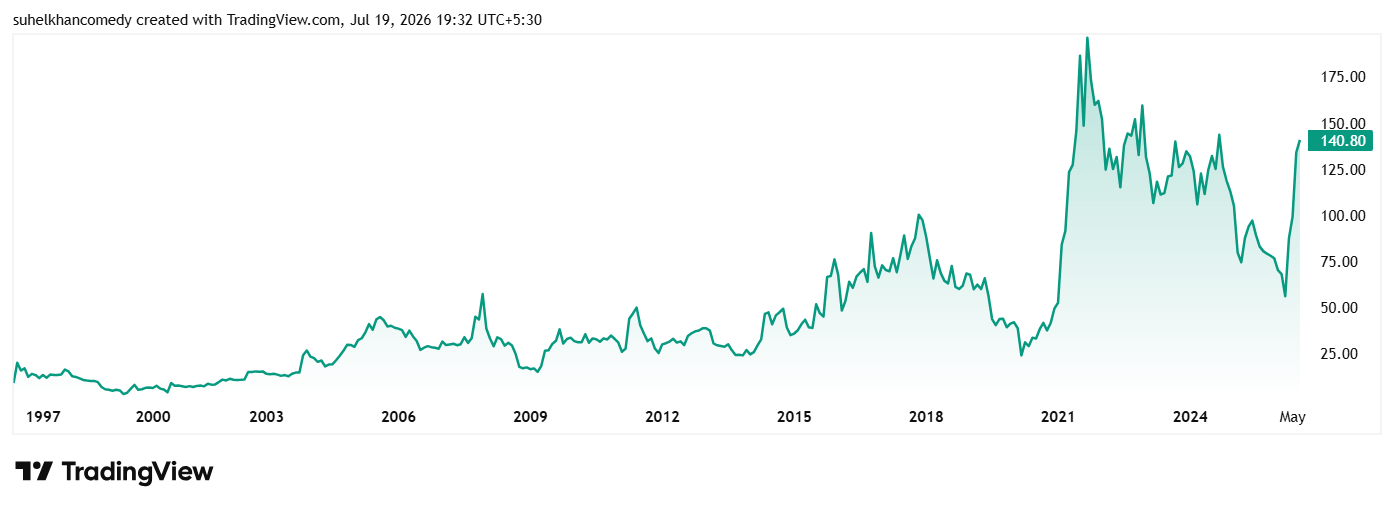
A PE comparison makes little sense when the earnings are one-off driven, and the stock’s own 10-year median PE is unusable because of repeated loss years. The cleaner lens is book value. The stock trades at roughly its book value of Rs 131 per share. Two risks sit on the other side of the ledger: promoters have pledged 29.6% of their 74.39% holding, and the company recently issued Rs 495 cr of preference shares to the promoter group. Both deserve a close read before anyone follows Shah into this one.
Should Retail Investors Copy the Super Investors?
Put the three moves side by side and the pattern is hard to miss. Singhania’s Abakkus bought a young airline right as it raised growth capital. Dhawan is buying a lender at the exact moment the market is still punishing it for old sins. Shah is adding to a chemicals maker just as it sheds the business that held it back for a decade.
None of these is a comfortable buy. One carries aviation risk and promoter selling. One carries regulatory memory. One carries pledged shares and a profit built on a one-time gain. The Super Investors of India know all this and bought anyway, because they are paid to underwrite discomfort.
For retail investors, the lesson is not to copy the trades. It is to study why each was made, and what would have to go right for it to work. A good idea would be to add these stocks to a watchlist and track the next two quarters of filings closely.
Disclaimer:
Note: We have relied on data from http://www.Screener.in and http://www.trendlyne.com throughout this article. Only in cases where the data was not available, have we used an alternate, but widely used and accepted source of information.
The purpose of this article is only to share interesting charts, data points and thought-provoking opinions. It is NOT a recommendation. If you wish to consider an investment, you are strongly advised to consult your advisor. This article is strictly for educative purposes only.
Suhel Khan has been a passionate follower of the markets for over a decade. During this period, he was an integral part of a leading Equity Research organisation based in Mumbai as the Head of Sales & Marketing. Presently, he is spending most of his time dissecting the investments and strategies of the Super Investors of India.
Disclosure: The writer and his dependents do not hold the stocks discussed in this article. The website managers, its employee(s), and contributors/writers/authors of articles have or may have an outstanding buy or sell position or holding in the securities, options on securities or other related investments of issuers and/or companies discussed therein.