



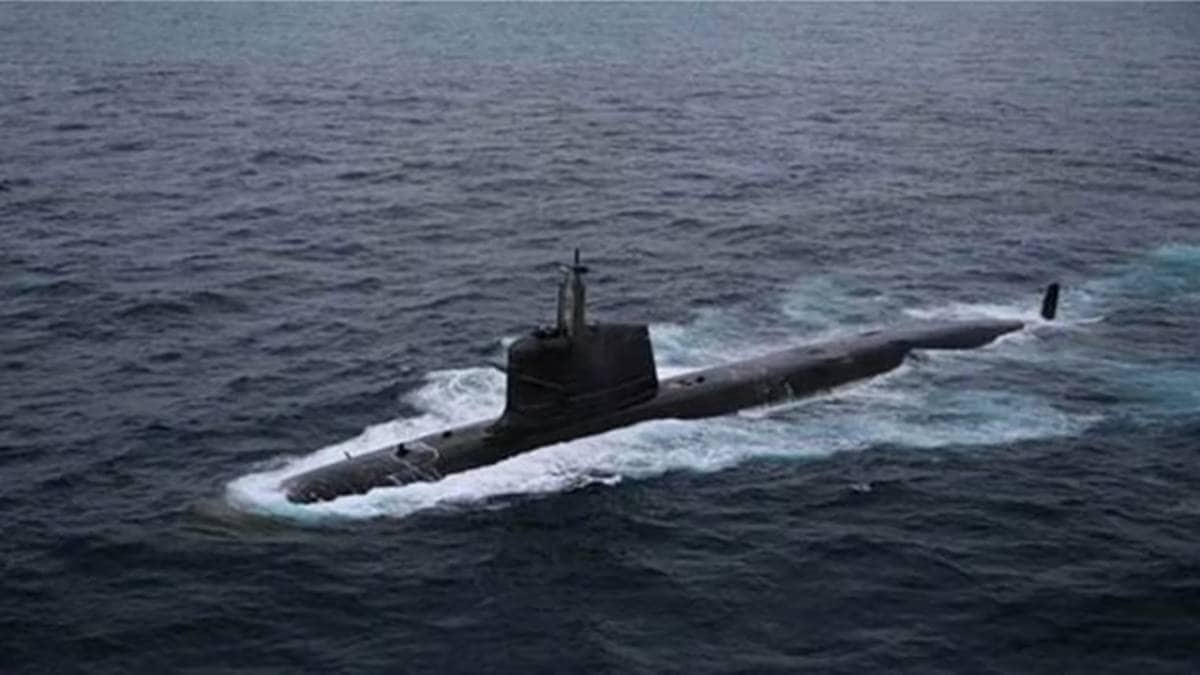
India’s nuclear submarine programme is in focus after media reports that point to ongoing construction, domestic execution, and supplier participation. Against this backdrop, attention turns to listed companies exposed to the nuclear submarine effort through their roles in materials, systems, and shipyard-linked supply chains that support these platforms.
According to recent remarks by Admiral Dinesh K. Tripathi, Chief of the Naval Staff at an industry interaction, he said the Navy “has delivered over 40 indigenous warships and submarines and is inducting a new platform, on average, every 40 days”, as per a report by The Indian Express.
Expanding India’s under-sea reach
The report further stated that INS Arihant is operational, INS Arighaat was commissioned in August 2024, and a third nuclear-powered ballistic missile submarine, INS Aridhaman, is in the final stages of trials and is expected to be commissioned soon. It added that Aridhaman is expected to be commissioned around 2026–27 and will carry longer-range K-4 submarine-launched ballistic missiles, according to The Indian Express.
The report also noted that additional nuclear submarines are under construction under a long-approved programme, and that India is pursuing a nuclear-powered attack submarine (SSN) programme, with plans to build two SSNs indigenously and acquire one on lease from Russia, as quoted by Admiral Tripathi in The Indian Express.
Within this framework, nuclear submarines appear alongside other high-value naval platforms rather than outside the system. If the direction continues, the implications extend beyond fleet strength to the companies supplying metals, castings, pumps, valves, and shipyard capacity that support submarine construction, including nuclear-powered boats.
The Submarine track record
A Press Information Bureau backgrounder released on 3 December 2025 from PIB Delhi, titled “Sailing Towards Self-Reliance: The Indian Navy’s Aatmanirbhar Bharat Journey.” The document states that “51 large ships are under construction in the country, valued at approximately Rs 90,000 crore”, with submarines forming part of this pipeline alongside surface combatants. It further records that “since 2014, Indian shipyards have delivered over 40 indigenous warships and submarines”, adding that “a new platform has been inducted on average every 40 days”.
The same release links output to funding patterns. It notes that naval capital acquisition spending increased from Rs 49,623 crore in 2020–21 to Rs 1,03,548 crore in 2025–26, with capital expenditure directed toward “high-end platforms such as submarines and underwater systems”.
Nuclear submarines are explicitly named among the platforms already built and commissioned in India, although class-wise quantities and construction schedules are not disclosed.
This production framework is reinforced by a separate PIB backgrounder dated 24 October 2025 on INS Vikrant, India’s first indigenous aircraft carrier. While focused on a surface platform, the document details the industrial structure now underpinning complex naval construction.
It states that INS Vikrant was built with “76% indigenous content, including about 30,000 tonnes of specialty steel supplied by SAIL”, and that the project “involved over 550 OEMs and more than 100 MSMEs, generating around 2,000 direct and 12,500 indirect jobs”. The document adds that “the development and production of indigenous warship-grade steel was achieved through a partnership between the Navy, DRDO and SAIL.”
The same PIB note states that “as of December 2024, 63 of the 64 warships planned to be inducted in the Navy are being built in India, including nuclear submarines like INS Arihant and INS Arighaat”, placing nuclear platforms within the same production system as other major naval assets.
Nuclear Submarines: Commissioning and continuity
The PIB statement read, “the construction of INS Arighaat involved the use of advanced design and manufacturing technology, detailed research and development, utilisation of special materials, complex engineering and highly skilled workmanship”.
It added “the submarine has the distinction of having indigenous systems and equipment which were conceptualised, designed, manufactured and integrated by Indian scientists, industry and naval personnel”, and notes that “the technological advancements undertaken indigenously on this submarine make it significantly more advanced than its predecessor Arihant”.
Here are some companies that are exposed to this defence theme in India:
Mishra Dhatu Nigam
Mishra Dhatu Nigam sits at the base of the submarine supply chain through its role as a producer of special steels, maraging steels, titanium alloys, and non-magnetic materials used in defence and nuclear applications. Company disclosures list naval and atomic energy establishments among its customers, while PIB documentation repeatedly links indigenous metallurgy to submarine pressure hulls and reactor-associated components.
At the time of writing this report, Mishra Dhatu Nigam was trading at Rs 386.35. The stock had moved up 13.05% so far in 2026, delivered a gain of 20.77% over the past one year, and risen 104.58% over five years, while recording a 4.36% decline over the past six months.
PTC Industries
PTC Industries operates in precision castings using titanium and superalloys suited to corrosive and high-stress marine environments. While the company does not disclose submarine-specific contracts, its stated capabilities align with the material requirements described in PIB documentation covering submarines and underwater systems.
At the time of writing this report, PTC Industries was trading at Rs 18,231. The stock had risen 32.04% over the past one year, gained 23.57% over six months, and moved up 493.81% over five years, while remaining marginally lower on a year-to-date basis.
CFF Fluid Control
CFF Fluid Control has disclosed participation in submarine programmes, including supplies under Project-75, according to its prospectus and subsequent filings. While Project-75 involves conventional submarines, PIB releases treat submarine systems and underwater equipment as shared capability areas across classes.
At the time of writing this report, CFF Fluid Control was trading at Rs 530.90. The stock had declined 11.81% over the past one year and 16.10% over six months, while remaining higher by 219.53% over five years.
Lloyds Engineering Works
Lloyds Engineering Works has disclosed naval equipment orders and collaborations related to marine systems such as steering gear and stabilisation equipment, with filings confirming defence-linked activity.
At the time of writing this report, the stock was trading at Rs 44.34. It had declined 34.56% over one year and 39.43% over six months, while remaining modestly higher over a five-year period.
Quest Flow Controls
Quest Flow Controls has disclosed purchase orders from Indian shipyards for hull valves used on submarines and warships, including an order from Mazagon Dock Shipbuilders disclosed in January 2026.
At the time of writing this report, the stock was trading at Rs 178.25. It had declined 63.39% over the past one year and 53.56% over six months, while remaining lower by 16.55% over five years.
Garden Reach Shipbuilders & Engineers
Garden Reach Shipbuilders & Engineers does not construct nuclear submarines, but PIB documentation lists it among major Indian shipyards executing indigenous naval construction. Its work on surface combatants and anti-submarine platforms places it within the same operational system that supports sustained underwater capability.
At the time of writing this report, GRSE was trading at Rs 2,590. The stock had moved up 68.48% over the past one year, gained 3.90% over six months, and risen 1,334.90% over five years.
Kirloskar Brothers
Kirloskar Brothers supplies pumps and valves for marine and nuclear applications and is named in the PIB backgrounder on INS Vikrant as an indigenous supplier. The overlap between civil nuclear standards and naval propulsion places the company among a limited group qualified across both domains.
At the time of writing this report, the stock was trading at Rs 1,490. It had declined 17.04% over the past one year and 23.13% over six months, while rising 968.10% over five years.
India’s growing naval assets
These stocks continue in focus given the massive pipeline. The PIB note states that “as of December 2024, 63 of the 64 warships planned to be inducted in the Navy are being built in India, including nuclear submarines like INS Arihant and INS Arighaat”. Indian Navy’s Aatmanirbhar journey sets out the scale of ongoing naval construction.