



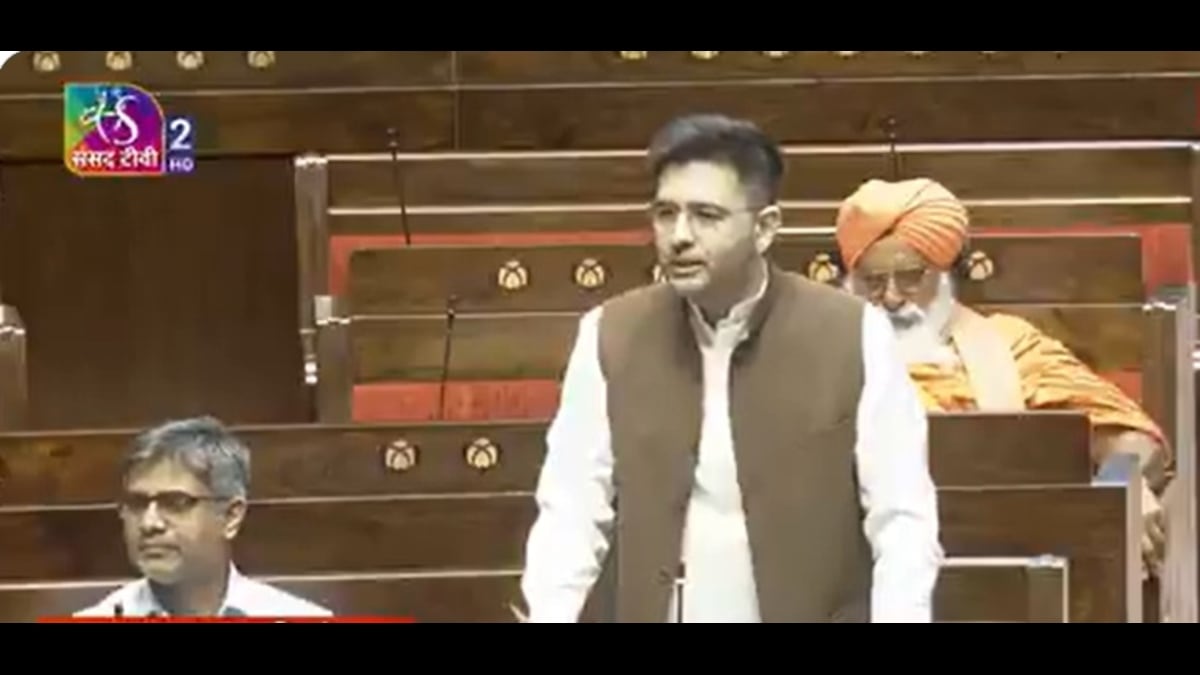
Aam Aadmi Party (AAP) MP Raghav Chadha on Friday used the dias of Rajya Sabha to deliver a thinly veiled critique of shifting roles within his own party, just after he was formally replaced as the AAP’s Deputy Leader in the Upper House. In a brief speech, Raghav Chadha said, “The leader of the party I belong to is not present in the House. The newly appointed deputy leader of the party I belong to is also not present in the House. I am the recently removed deputy leader, and I am present in the House. Thank you so much for giving me the opportunity to speak.”
The statement, delivered in a calm tone, drew attention for its layered subtext: that while the party’s new leadership pairing in the Rajya Sabha remains absent from proceedings, he- the recently sidelined figure-continues to be present and engaged in parliamentary work. The line quickly went viral, with many interpreting it as a quiet protest against how the party has chosen to handle his position and public image in the wake of his removal.
VIDEO | AAP MP Raghav Chadha (@raghav_chadha), speaking in Rajya Sabha, said,
"The leader of the party I belong to is not present in the House. The newly appointed deputy leader of the party I belong to is also not present in the House. I am the recently removed deputy leader,… pic.twitter.com/OP4ltN8EfG
— Press Trust of India (@PTI_News) April 17, 2026
Denial of ‘walkout and impeachment’ allegations
Raghav Chadha’s remarks in the House came amid a broader political row triggered by AAP’s decision to remove him as the party’s Deputy Leader in the Rajya Sabha and replace him with Ashok Kumar Mittal. Following the leadership change, reports and social‑media narratives had surfaced claiming that Chadha had refused to walk out of Parliament with the party and had also declined to sign an impeachment motion against the Chief Election Commissioner.
In a detailed post on X earlier, Chadha hit back at what he called a scripted campaign and a coordinated attack against him. He said the same language and nearly identical wording were being recycled across multiple accounts, which he argued could not be a coincidence. He specifically denied two key allegations: one that he had stayed back in the House while the party’s Opposition colleagues walked out, and the other that he had refused to sign the impeachment motion against the CEC. He called both charges “blatant lies” and insisted that no AAP leader, formally or informally, had asked him to sign the motion.
Chadha also sought to put the impeachment‑motion issue in context, noting that out of AAP’s 10 Rajya Sabha members, between six and seven had not signed the motion either. “So what is my fault in this? Why is all the blame being placed on me?” he asked. By highlighting that the refusal- or non‑participation- was not his alone, he sought to rebut the narrative that he personally sabotaged or weakened the party’s collective stance inside the House.
Breaking down the optics, Chadha argued that the party leadership’s attempt to single him out for alleged non‑cooperation did not align with the broader pattern of AAP’s own MPs. The line turned the focus back onto the party’s internal coordination rather than his individual conduct, implicitly questioning why he was made the public face of the discipline issue.
Beyond the immediate controversy, Chadha defended his overall conduct in Parliament, saying he came to the House not to “create noise, shout, break the microphone, or abuse” but to raise public issues. He listed a range of subjects he has raised over the last four years, from GST and income tax to Punjab’s water crisis and Delhi’s air pollution, and from the dilapidated state of government schools to the need to strengthen public healthcare institutions.
He also highlighted issues such as the condition of Indian Railways passengers and menstrual‑health awareness, subjects that have frequently brought him into the national spotlight. Chadha added that he entered Parliament to “create an impact, not a ruckus,” underscoring his preference for issue‑based debate over theatrics. His remarks were widely read as a rebuttal not only to the specific charges tied to the walkout and impeachment motion but also to any broader attempt to portray him as a weak or undisciplined parliamentarian.
Internal rift and the leadership reshuffle
The controversy over Raghav Chadha’s role stems from AAP’s notification to the Rajya Sabha Secretariat, formally replacing him as Deputy Leader with Ashok Kumar Mittal. The move was seen as a significant internal reorganisation, especially as Chadha- who has served as an MP since April 2022- has often been at the forefront of the party’s narrative on emerging social and economic issues. His focus on gig‑economy workers, menstrual hygiene, mental health and urban public‑service crises had earned him a distinct profile within the larger Opposition ecosystem.
The reshuffle, however, has sparked speculation about internal tensions within AAP, with some observers reading Chadha’s floor statement as a signal that he is unwilling to be quietly sidelined. Others have interpreted his toned‑down criticism as a bid to maintain a constructive image while still underlining the irony of his situation- the only party member physically present in the House at that moment was the one who had just been formally downgraded in the party hierarchy.