



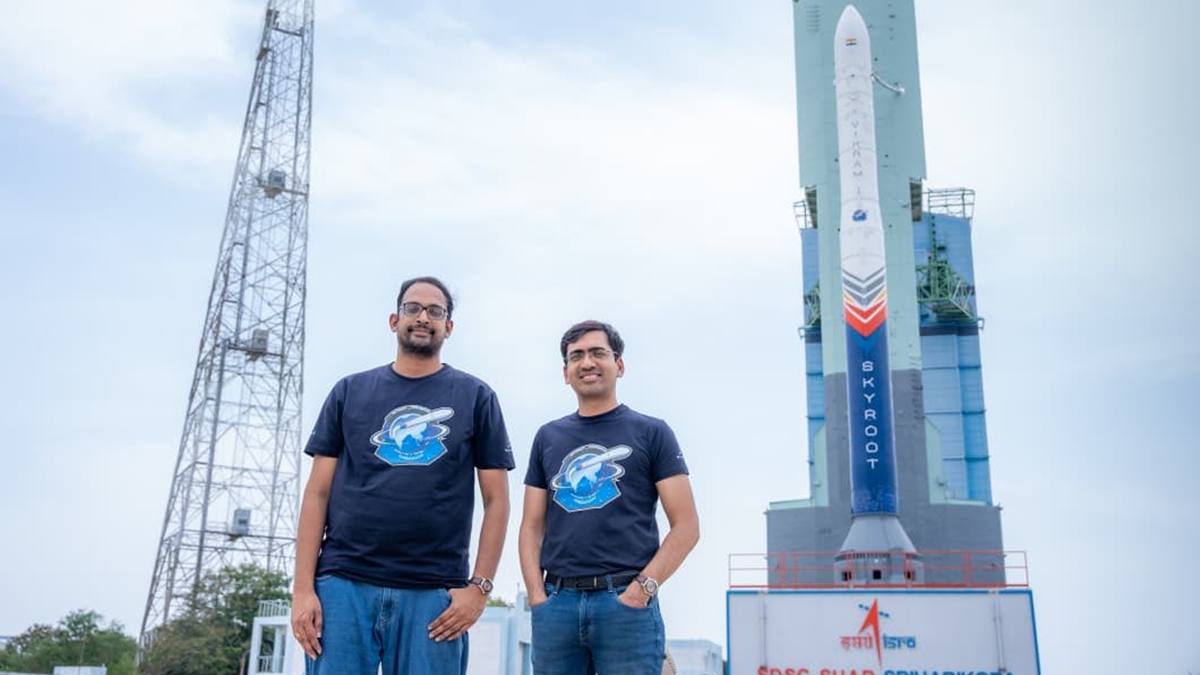
When Skyroot Aerospace’s Vikram-1 lifts off from Sriharikota, all eyes will naturally be on the rocket. But the more significant test may be for the two former Isro scientists who chose to build it. For founders Pawan Kumar Chandana and Naga Bharath Daka, the mission — named Aagaman (arrival) — represents the moment when years of engineering, fundraising and policy advocacy converge into a single question: can an Indian private company build a sustainable launch business? Their journey has mirrored the evolution of India’s private space sector, from an idea viewed with scepticism to one attracting billion-dollar valuations and global investors. Vikram-1 now has the task of validating that promise.
Unlike many of India’s celebrated startup founders, Chandana and Daka did not emerge from the consumer internet boom or enterprise software industry. They came from India’s space programme. Both spent years at Isro working on launch vehicle technologies before deciding in 2018 to start Skyroot in Hyderabad. At the time, the country’s space ecosystem remained overwhelmingly state-led and private participation was largely confined to supplying components and engineering services. The government decision to open the sector through reforms in 2020 was still some distance away.
Engineers steering Skyroot’s growth
The two founders are engineers from the Indian Institute of Technology, Kharagpur, who have remained closely involved with the company’s technology even as it expanded into a venture-backed startup. Chandana, as CEO and CTO, has largely become the company’s public face, engaging with investors, customers and policymakers. Daka has focused more on operations and execution, overseeing the complex task of translating engineering designs into manufacturable launch systems. The division reflects the reality of building rocket companies, where technological capability and manufacturing discipline are as important as raising capital.
That distinction has become increasingly relevant as India’s startup ecosystem begins to broaden beyond software-led businesses. Consumer internet companies could launch products, acquire users and refine their offerings within months. Space ventures operate on a different timeline. Years of research, testing, manufacturing and regulatory approvals precede commercial revenues. Success depends less on rapid customer acquisition than on reliability, precision and repeatability. Investors, in turn, are backing engineering capability rather than user growth, accepting longer development cycles in
anticipation of durable competitive advantages.
Skyroot’s own trajectory reflects that shift. Its successful Vikram-S mission in 2022 established its technical credentials by becoming the first private Indian rocket to reach space. Since then, it has steadily expanded its manufacturing capabilities, developed the Vikram launch vehicle family and attracted global investors. Earlier this year, it became India’s first space-tech unicorn after raising $60 million. The funding underscored growing investor confidence in deep-tech businesses at a time when capital has become more selective across the startup ecosystem.
Yet valuations alone cannot build a launch business. Unlike software firms, where scale can often be achieved before profitability, commercial space ventures are judged by their ability to execute repeatedly. Launch reliability, customer confidence and the ability to deploy satellites on schedule determine whether a rocket company can build a sustainable business. That is why Vikram-1 carries significance beyond being another technology demonstration. It represents Skyroot’s first bid to enter the orbital launch market.
Space startups face the execution test
The founders also arrive at a time when India’s policy priorities are increasingly aligned with their ambitions. The creation of IN-SPACe, greater access to Isro infrastructure and a more enabling regulatory framework have encouraged private participation in launch vehicles, satellite manufacturing and downstream space applications. A broader ecosystem of startups has emerged across propulsion, satellite imaging and space-based communications. But the next phase of growth will depend less on policy announcements and more on whether companies can execute complex missions and build commercially viable businesses.
That is where Chandana and Daka’s story becomes larger than Skyroot itself. They represent a new generation of Indian founders emerging from laboratories, research institutions and advanced engineering disciplines rather than digital platforms. Their businesses demand greater patience from investors and longer timelines for returns, but they also operate in sectors with strategic and economic significance.
Regardless of whether Vikram-1 succeeds or encounters setbacks, Skyroot’s founders have already helped change perceptions about what Indian startups can aspire to build. Their next challenge is considerably harder. Building India’s first space-tech unicorn was an important milestone. Building a globally competitive launch company will require repeated execution over many years. Chandana and Daka are not simply testing a rocket, they are testing whether India’s private space sector is ready to move from technological promise to commercial reality.
It is a fitting test for a founder (Chandana) who once scored just 51 out of 100 in school mathematics. The boy from Visakhapatnam who struggled with numbers now works the equations that could carry India’s private sector into orbit — an arrival, in every sense.