



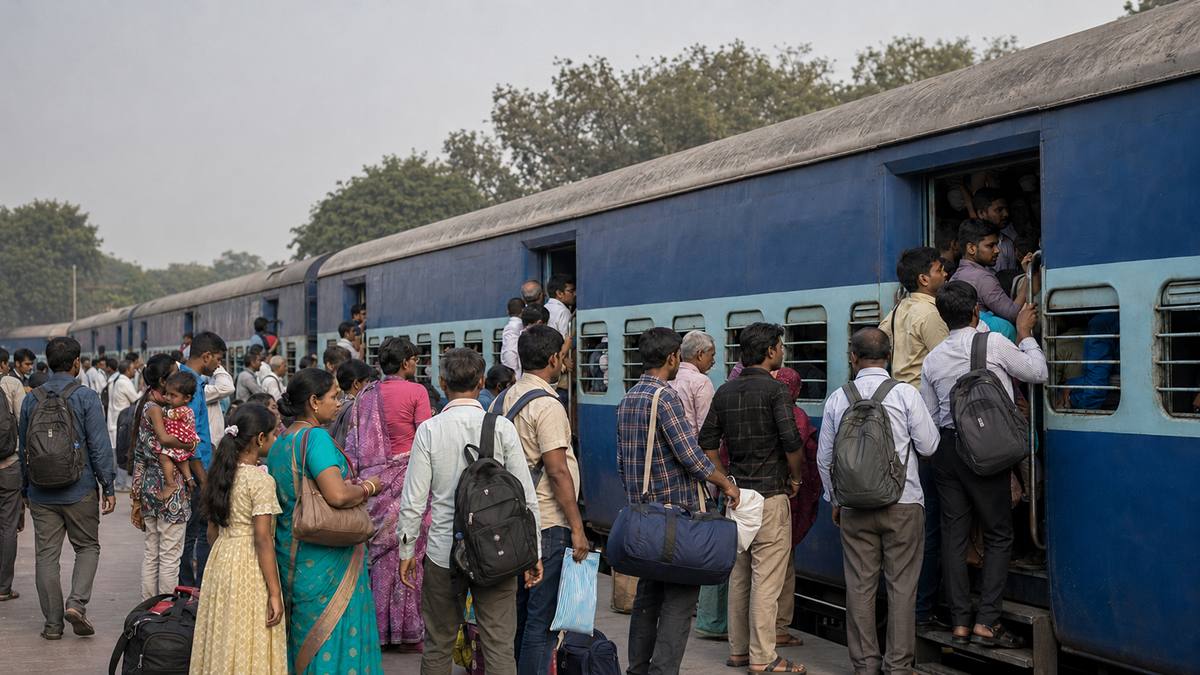
The Supreme Court has urged Indian Railways to stop using the term “second class passengers” in its manuals — observing that the moniker should describe the train compartment and not the passenger travelling within it. The apex court also addressed persistent overcrowding and pointed to multiple mishaps in which people fell from the train.
According to a LiveLaw report, a Bench of Justice Sanjay Karol and Justice Nongmeikapam Kotiswar Singh stated that the terminology should be reconsidered in view of India’s history of class divisions and its constitutional values.
The court made this statement while awarding Rs 8 lakh compensation to the widow of a man who died after falling from a running train in 2015.
Why did the court object to ‘second class passenger’?
The Bench acknowledged that the term was being used in the context of an amount paid by the passenger for his journey. However, it stated that attaching a class label to a passenger was inappropriate.
“We may suggest that the class connotation be attached to the coach and not to the passenger,” the Bench mentioned, as quoted by Live Law. It also described the existing terminology as “offensive to the spirit of the Constitution of India.”
In simple terms, the court stated that “second class” could continue to describe a coach or travel facility, but a person using it should not be called a “second class passenger.”
The observation was a suggestion to reconsider railway terminology, not an immediate instruction changing the existing travel categories.
Court raises risks posed by overcrowded trains
The Supreme Court also appealed to Indian Railways to take effective measures to prevent overcrowding. The bench also observed that passengers falling from crowded trains and losing their lives was “not a rare occurrence.”
It referred to the June 2025 Mumbai suburban train accident, in which four commuters lost their lives after falling from overcrowded local trains. The Bench also mentioned the New Delhi railway station stampede during the Maha Kumbh rush and other accidents across India.
The Indian Railway Commercial Manual already requires railway officials to distribute passengers among coaches, alert stations ahead about the overcrowded trains and arrange additional coaches when required.
“The forethought is clearly visible, but the execution leaves much to be desired,” the court mentioned, as reported by LiveLaw.
More staff needed, but passengers also responsible
The Bench said imposing the existing crowd-control measures would require considerably more manpower. It is also suggested that the Railways consider employing more young people, providing them with stable livelihoods while boosting passenger safety.
However, it clarified that responsibility does not rest solely with the railways.
“It would be entirely unfair to cast sole responsibility upon the Railways. The passengers themselves have an equal responsibility,” the court said.
A missing ticket cannot defeat a genuine compensation claim
The Railway Claims Tribunal and the Madhya Pradesh High Court had rejected the widow’s claim because her husband’s ticket was not found. She maintained that it was inside his travel bag, which went missing after the accident.
The Supreme Court ruled that the missing ticket alone could not invalidate a genuine claim. It also stated her affidavit mentioning her husband had a valid ticket met the initial requirement under the Railways Act’s “no-fault liability” framework.
The Railways must pay Rs 8 lakh within four week; failing to do so, the amount will carry 8% interest from the date the claim was registered.