



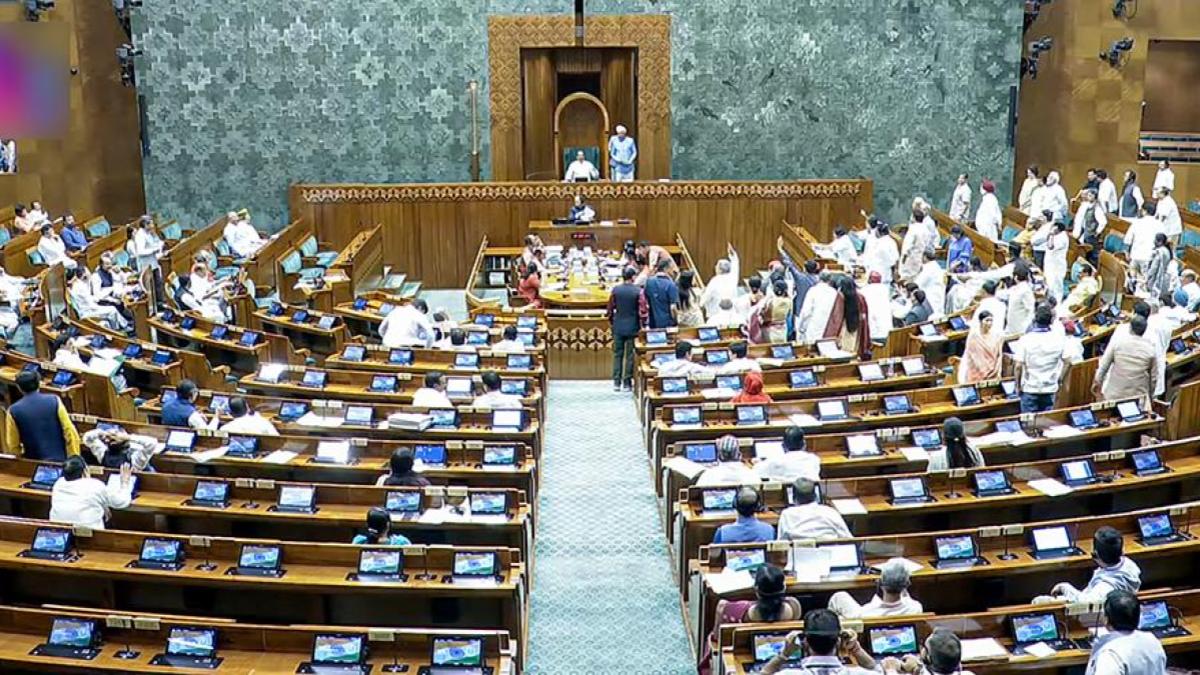
A meeting of the Joint Parliamentary Committee examining the Viksit Bharat Shiksha Adhishthan Bill, 2025, scheduled for Monday, has been called off, The Indian Express reported on Saturday, citing sources familiar with the matter.
The development comes a day after the Joint Committee examining the 130th Constitution Amendment Bill deferred the adoption of its report on a proposal to remove ministers arrested in serious criminal cases if they remain in custody for 30 consecutive days.
The development is reportedly being viewed against the backdrop of the Centre’s efforts to secure the support of regional and smaller parties for the proposed rollout of the women’s reservation law and the Delimitation Bill, according to the report.
Focus shifts to delimitation legislation
The Joint Committee on the 130th Constitution Amendment Bill had already completed voting on its first two recommendations when the process was halted during discussions on the third. Earlier, committee chairperson and BJP MP Aparajita Sarangi told reporters that the panel had unanimously felt that further consultations with stakeholders were necessary.
The delay is also being seen as a possible attempt by the government to avoid pushing two politically contentious constitutional amendments through Parliament during the same session.
A BJP MP cited in the report said the delay could be linked to differences within the committee, but added that the government’s immediate priority was the Delimitation Bill, for which support from the Opposition and regional parties would be important.
The Delimitation Bill would also require a two-thirds majority in Parliament, making support from parties outside the ruling coalition crucial.
What is the Viksit Bharat Shiksha Adhishthan Bill?
The Viksit Bharat Shiksha Adhishthan Bill, 2025 seeks to overhaul India’s higher education regulatory structure. The proposed legislation would dissolve three existing bodies — the University Grants Commission (UGC), the All India Council for Technical Education (AICTE) and the National Council for Teacher Education (NCTE) — and replace them with a unified regulatory framework.
The Bill faced criticism from Opposition parties, several universities and even some NDA-ruled states over provisions that critics say could lead to excessive centralisation of higher education governance.
JPC recommends safeguards against centralization
A draft report circulated among committee members reportedly recommends several changes to protect institutional autonomy and strengthen consultation with states. The panel has also sought safeguards against provisions that would give the Centre extensive powers to override policy decisions, supersede regulatory bodies and exercise greater control over funding.
One of the most contentious provisions is Clause 47, which allows the Centre to supersede the proposed Commission or any of its councils with the approval of the President.
The committee has recommended that such supersession should be permitted only under extraordinary circumstances, for a limited period, and as a measure of last resort.
Concerns over Centre’s power to dissolve regulator
The provision has been described as a “critical vulnerability” by the NDA-ruled Andhra Pradesh government, several universities, Opposition parties, and other stakeholders. Critics have argued that the clause could give the Centre sweeping authority to dissolve or take over the higher education regulator without sufficient institutional safeguards.
The Joint Committee’s recommendations seek to address these concerns by limiting the circumstances under which the Centre could exercise such powers.