



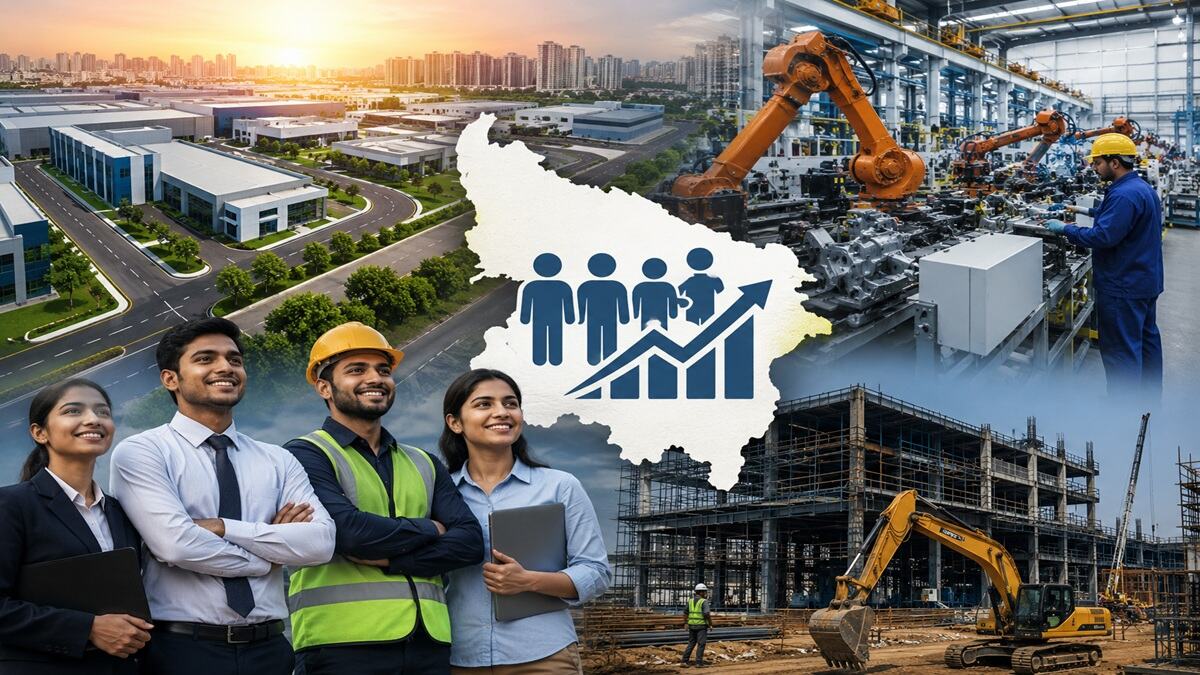
The Uttar Pradesh government on Wednesday (July 15) finalised plans to roll out 16 Sardar Vallabhbhai Patel Employment and Industrial Zones (SVPEIZ) in the first phase of a wide-ranging initiative to integrate skill development, employment generation, industry and entrepreneurship on a single platform. The project will be implemented through a nine-region hub-and-spoke model designed to knit together the state’s industrial strengths, available resources and investment potential into a coordinated network that can deliver plug-and-play infrastructure alongside training and employment support.
“The idea is to create a one-stop employment ecosystem where youth can move seamlessly from training to jobs or entrepreneurship,” Principal Secretary, MSME, Shashi Bhushan Lal Sushil said. Each SVPEIZ campus will offer skill-training centres, plug-and-play industrial plots and flatted factories, common facility centres, tool rooms, testing facilities, display and design centres, and effluent treatment systems. The zones will also host entrepreneurship mentoring, loan information desks and support for start-ups, ensuring that capacity building and industry growth occur together rather than in separate, disconnected silos.
Under Phase I, the state will establish 16 centres distributed across the nine-region model. The Micro, Small and Medium Enterprises (MSME) Department and the Uttar Pradesh State Industrial Development Authority (UPSIDA) will each develop five centres. The Uttar Pradesh Expressways Industrial Development Authority (UPEIDA) and the Yamuna Expressway Industrial Development Authority (YEIDA) will develop two centres apiece, while Greater Noida Industrial Development Authority and Gorakhpur Industrial Development Authority (GIDA) will each develop one centre.
Construction is slated to begin immediately at locations where land is already available; land for other centres will be provided through industrial development authorities in a phased manner.
Skill is the greatest power of the future.
Under the leadership of HCM Yogi Government, the youth of Uttar Pradesh are becoming Future Ready with modern skills, new technology, and abundant employment opportunities.#YogiAdityanath #SkillDevelopment #FutureReadyYouth… pic.twitter.com/Yl3j10l7Ve
\— Transforming UP (@transforming\_up) July 15, 2026
Nine-region hub-and-spoke design in Uttar Pradesh
The hub-and-spoke model divides the state into nine industrial regions tailored to local competitive advantages and logistics.
These regions are:
- Gautam Buddh Nagar
- A cluster covering Ghaziabad, Hapur, Saharanpur, Meerut, Baghpat and Bulandshahr
- Moradabad and Bareilly divisions
- Agra and Aligarh divisions
- Lucknow and Ayodhya divisions
- Kanpur and Prayagraj divisions
- Chitrakoot, Jhansi and Vindhyachal divisions
- Varanasi and Azamgarh divisions
- Gorakhpur, Basti and Devipatan divisions
The state government officials say this geographic segmentation will allow each hub to prioritise sectors aligned with its resource base and market access, while spokes extending from each hub will link smaller towns, skill providers and ancillary units into a coherent value chain.
हर युवा को कौशल, हर हाथ को अवसर
यही है विकसित भारत के विकसित उत्तर प्रदेश की मजबूत नींव। pic.twitter.com/zU2GuMZrGk
— Government of UP (@UPGovt) July 15, 2026
Industry participation and governance through SPVs
In order to ensure robust industry participation and efficient project execution, the government will constitute a Special Purpose Vehicle (SPV) for each hub. “Each SPV will have the lead investor as its chairman,” an official UP government release said, adding that reputed industrial institutions will be associated with both development and ongoing operations. This governance model aims to combine public-sector land and policy support with private-sector capital, management capacity and market linkages — a hybrid approach that the state’s senior officers studied in models across Gujarat and Maharashtra before finalising the Uttar Pradesh-specific design.
PHOTO | Uttar Pradesh Chief Minister Yogi Adityanath has approved the development of Sardar Patel Employment & Industrial Zones (SVPEIZ) on a Hub-and-Spoke model across 09 zones.
In Phase I, 16 SVPEIZ centres will be established. MSME and UPSIDA will develop 05 centres each,… pic.twitter.com/LTi9Ryfp8t
— Press Trust of India (@PTI_News) July 15, 2026
Skill training alongside construction work
A central plank of the SVPEIZ is that skill development and training programmes will start in tandem with infrastructure creation. The official statement from the UP govt emphasised that having a ready-trained workforce is critical to ensuring that industrial units and service providers can begin operations soon after infrastructure is completed.
“Skill is the greatest power of the future,” the state government said in its release, adding: “Under the leadership of Chief Minister Yogi Adityanath, the youth of Uttar Pradesh are becoming future ready with modern skills, new technology, and abundant employment opportunities.” Training will be tailored to the sectoral focus of each hub, with emphasis on hands-on, industry-relevant curricula.
Plug-and-play infrastructure to reduce time-to-market
The SVPEIZ concept stresses plug-and-play readiness to lower the entry barrier for manufacturers and service firms. Common facilities, standardised factory shells, effluent treatment and testing labs are intended to cut lead times and capital expenditure for firms setting up operations. This, in turn, should boost the attractiveness of Uttar Pradesh for both domestic investors and anchored large-scale employers who might anchor supply chains, thereby creating opportunities for smaller vendors and MSMEs within each hub’s spoke network.
Empowering Uttar Pradesh\'s youth with world-class skills and real opportunities. Under the Yogi Government, lakhs of young people including women and artisans are being trained in industry-ready, future-focused skills from AI to advanced technical education.
Sabko Hunar, Sabko… pic.twitter.com/P3ZmuWOfDa
\— Transforming UP (@transforming\_up) July 15, 2026
UP’s cluster-driven industrial ecosystem set to boost jobs and investor confidence
The UP govt officials say each hub will be developed according to local industrial strengths and investment potential. That sector-sensitive approach means hubs in textile-oriented regions, for example, can prioritise garment clusters and allied training, while those located along expressways can focus on logistics, electronics assembly or auto ancillary units. The planned involvement of industrial institutions and private lead investors in SPVs is intended to ensure that hub offerings—training modules, infrastructure parcels and support services—match real industry requirements, improving employability and lowering vacancy-to-skill mismatch.
With land available at some locations, construction work will begin immediately, while land for remaining centres will be transferred by industrial development authorities in a phased schedule. The state has also signalled that teams will fast-track clearances, set up SPVs, and finalise partnerships with training providers and industrial institutions. Senior officers have indicated that the state will monitor implementation closely and replicate successful practices across subsequent phases as more hubs and spokes become operational.
By combining industry-ready infrastructure with simultaneous skill training and a governance model that invites private-sector leadership, Uttar Pradesh aims to create a durable ecosystem that converts its demographic dividend into productive employment. The SVPEIZ rollout represents a strategic attempt to align state resources, investor appetite and workforce capability — turning a cluster-based industrial approach into a coordinated employment strategy across an economically diverse state.