



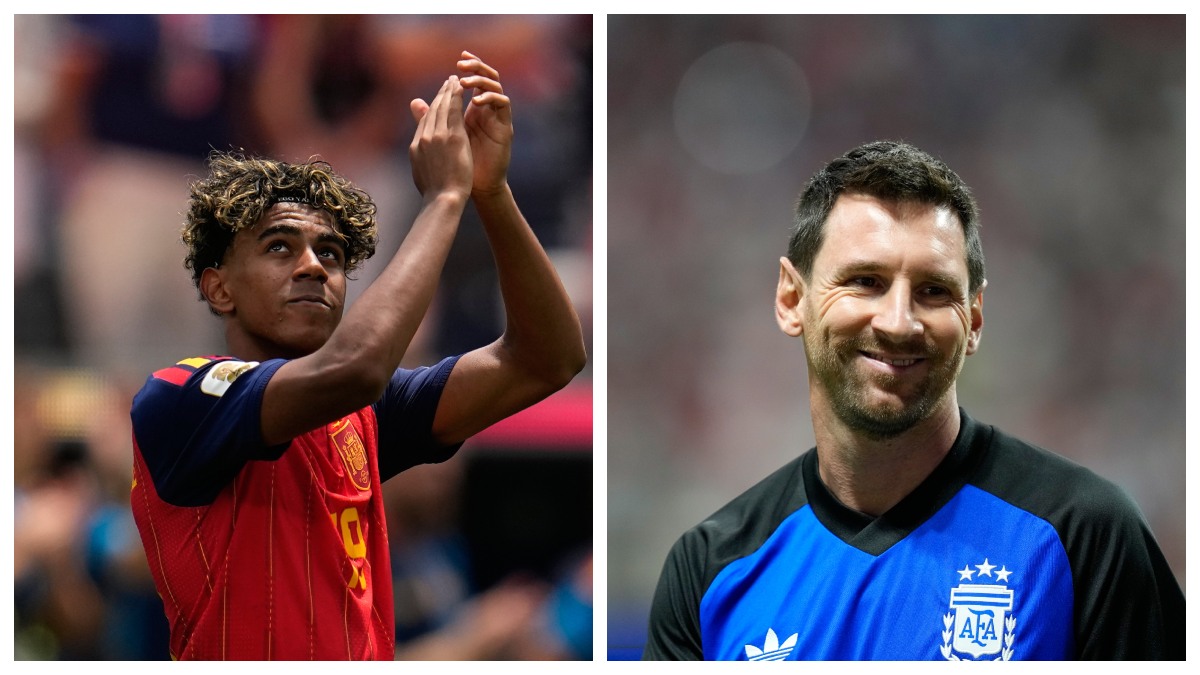
For nearly two decades, Lionel Messi has been football’s reference point. Every gifted left-footed playmaker, every dazzling teenager emerging from Barcelona’s famed La Masia academy, has inevitably been compared with him.
On Sunday night in New Jersey, those comparisons will no longer exist only in theory. When Argentina meet Spain in the FIFA World Cup 2026 final, Messi will share the field with Lamine Yamal for the first time in international football. One arrives as perhaps the greatest player of the modern era, chasing what could be the final major title of his extraordinary career. The other is only 19 but has already become the face of football’s next generation.
It is a final rich in narratives, but none is more compelling than watching two players separated by 20 years, yet connected by the same footballing lineage, stand on opposite sides of the world’s biggest stage.
The image that captured two generations
Long before either of them could have imagined this meeting, a photograph quietly documented what now feels like football destiny. In 2007, Lionel Messi took part in a UNICEF charity calendar photo shoot organised by Catalan newspaper Diario Sport. One of the children featured in the campaign was a baby named Lamine Yamal, who had been selected through a local family raffle. One now-iconic photograph shows Messi gently bathing the infant in a small plastic tub- an image that has resurfaced repeatedly since Yamal’s emergence as one of world football’s brightest talents.

The photograph remained largely forgotten until Yamal burst onto the global stage with Barcelona and Spain. Since then, it has become one of football’s most widely shared images, symbolising one generation literally handing the game to the next.
Now, nearly 20 years later, that symbolic photograph has acquired an entirely new meaning.
Instead of sharing a photoshoot, Messi and Yamal will share a World Cup final. The timing feels almost surreal.
Messi is attempting to complete one final chapter in a career that has already delivered virtually every honour available. Yamal, meanwhile, is preparing for what feels less like the pinnacle of his career than its beginning.
The age gap itself tells the story. When Messi lifted his first Champions League trophy with Barcelona in 2006, Yamal had not yet been born. When Messi won his first Ballon d’Or in 2009, Yamal was still a toddler. Yet on Sunday, the teenager will walk alongside the player whose career shaped modern football.
Two careers, one stage
While comparisons between Messi and Yamal have become increasingly common, their journeys to the top could hardly have been more different. Messi entered Barcelona’s first team gradually.
Frank Rijkaard carefully managed his development, surrounding him with experienced players including Ronaldinho, Samuel Eto’o and Xavi before slowly increasing his responsibilities. At 19, Messi remained one of Europe’s brightest prospects rather than its biggest attraction.
Modern football rarely allows that luxury. Elite clubs now promote exceptional teenagers far earlier, partly because of greater physical preparation and partly because the game’s financial ecosystem rewards early breakthroughs. Yamal has become perhaps the biggest beneficiary of that shift.
Before turning 20, he has already accumulated more than 180 senior appearances for club and country, establishing himself as one of Barcelona’s central attacking figures while becoming indispensable for Spain.
The numbers underline just how different football’s developmental pathways have become. By the age of 19, Yamal had already registered over 120 direct goal involvements across senior football. Messi reached similar levels only after spending considerably longer easing into Barcelona’s first team.
That difference says as much about football’s evolution as it does about either player. Messi belonged to an era that protected exceptional talent. Yamal belongs to one that accelerates it. Despite those contrasting routes, both players now find themselves carrying remarkably similar responsibilities. Everything Argentina create flows through Messi. Everything Spain imagine begins with Yamal.
Different routes to the World Cup final
If their careers have followed different trajectories, so too have their performances at this tournament. Messi arrives in the final as the competition’s leading scorer with eight goals, but his influence extends far beyond the numbers.
The Argentina captain no longer overwhelms opponents with the relentless acceleration that defined his younger years. Instead, he controls matches through timing, positioning and an almost unmatched understanding of space. Against England in the semi-final, his two assists summed up the evolution of his game. Messi once again dictated Argentina’s attack against England, setting up both second-half goals with moments of vision that shifted the momentum of the contest.
His brilliance today lies as much in what he sees as what he does. Yamal represents almost the opposite. Spain’s teenager has injected pace, unpredictability and constant width into Luis de la Fuente’s system. Stationed predominantly on the right flank, he has repeatedly stretched opposition defences before driving inside or delivering crosses into dangerous areas.
His contribution cannot be measured solely through goals. Spain’s attacking rhythm frequently begins with Yamal receiving possession, committing defenders and forcing defensive structures to shift before the midfield exploits the resulting spaces.
It is a responsibility few players his age have ever carried at a World Cup. Yet he has looked remarkably comfortable doing so. That contrast also reflects the tactical identities of the two finalists.
Argentina remain a side built around moments of individual inspiration, resilience and experience. Spain, meanwhile, have reached the final through collective organisation, patient possession and relentless pressing.
Both systems, however, rely heavily on their biggest star. Messi remains Argentina’s heartbeat. Yamal, meanwhile, has not even produced what many believe is his finest performance of the tournament and yet he has already helped Spain reach the World Cup final.
The business of two global icons
The contrast between the two players extends well beyond the football pitch. Messi enters the final not only as one of the greatest players in history but also as one of the sport’s most valuable commercial brands.
According to Forbes, his personal fortune has crossed the billion-dollar mark, fuelled by decades of elite salaries, endorsement agreements and investments. His partnerships with Adidas, Apple and Inter Miami have transformed him into far more than an athlete.
His business interests span luxury hotels through the MiM Hotels chain, significant real estate investments across Europe and the United States, and equity-linked arrangements that have helped reshape Major League Soccer’s commercial profile. Even at 39, Messi remains one of the world’s most marketable athletes.
Yamal occupies a very different position. He is not yet football’s richest young player, but he is arguably its most valuable long-term asset. Barcelona recently secured his future with a contract running until 2031, reportedly protected by a €1 billion release clause that underlines just how highly the club values him.
Off the pitch, Adidas has already positioned him as one of the faces of its next generation of football marketing, while global brands have begun competing for partnerships with a player expected to dominate the sport for the next decade.
His social media following has exploded despite his age, giving sponsors direct access to one of football’s youngest and most engaged global audiences. For brands, Messi represents certainty. For investors, Yamal represents potential. Few World Cup finals have featured two players whose commercial trajectories are so dramatically different yet equally significant.
More than a battle for the trophy
Sunday’s final will also place two very different international careers side by side. Messi spent much of his career carrying the burden of expectation.
For years, his achievements with Barcelona were routinely contrasted with Argentina’s repeated failures in major tournaments. Defeats in three Copa América finals and the 2014 World Cup final prompted relentless debate over whether he could ever emulate Diego Maradona on the international stage.
That narrative has long since disappeared. Since 2021, Messi has transformed Argentina’s fortunes, leading them to successive Copa América titles and the 2022 World Cup before guiding them back to another final in North America.
If Argentina beat Spain, Messi would become the first player since Brazil retained the trophy in 1962 to captain a nation to consecutive World Cup titles.
He announced himself during Spain’s victorious UEFA Euro 2024 campaign before becoming one of the standout performers of the 2026 World Cup. At an age when many elite footballers are still learning their trade, he already finds himself preparing for the biggest match in the sport.
Victory would place him among the youngest players ever to win both a European Championship and a World Cup. Yet reducing Sunday’s contest to a simple comparison between the two would miss the broader picture.
Football has repeatedly searched for “the next Messi”. It happened with Neymar. Then with Paulo Dybala. Later with Joao Felix, Ansu Fati and countless others. Most comparisons have ultimately proved unfair. No player follows another’s path exactly.
Yamal himself has never tried to become a copy of Messi. While both emerged from La Masia and favour their left foot, their football is built on different strengths. Messi evolved into perhaps the greatest playmaker and goalscorer of his generation. Yamal is an explosive winger whose creativity comes through direct running, relentless movement and fearless decision-making in one-on-one situations.
Their similarities lie more in temperament than style. Neither appears intimidated by expectation or weighed down by occasion. That perhaps explains why this meeting feels so significant. For the first time, football’s most influential player of the last 20 years will face the teenager many believe could shape the next 20.
A final that transcends generations
World Cup finals often become remembered through a single image. Pele lifted by teammates in 1970. Zinedine Zidane walking past the trophy in Berlin. Andres Iniesta disappearing beneath a sea of Spanish shirts in Johannesburg. Messi standing atop the podium in Lusail four years ago.
Sunday offers the possibility of another. It could be Messi lifting the World Cup one final time before walking away from football’s biggest stage, completing one of the greatest careers the game has known.
Or it could be Yamal announcing himself as the sport’s next global superstar, beginning a journey that may define the next generation. Whatever the outcome, the match represents something larger than a battle between Argentina and Spain.
It is a rare moment when football’s past and future occupy the same pitch, wearing different shirts but connected by the same academy, the same philosophy and, in many ways, the same dream.
The result will decide who lifts the trophy. History, however, is also likely to remember something else. The night Lionel Messi and Lamine Yamal finally shared the world’s biggest stage.