



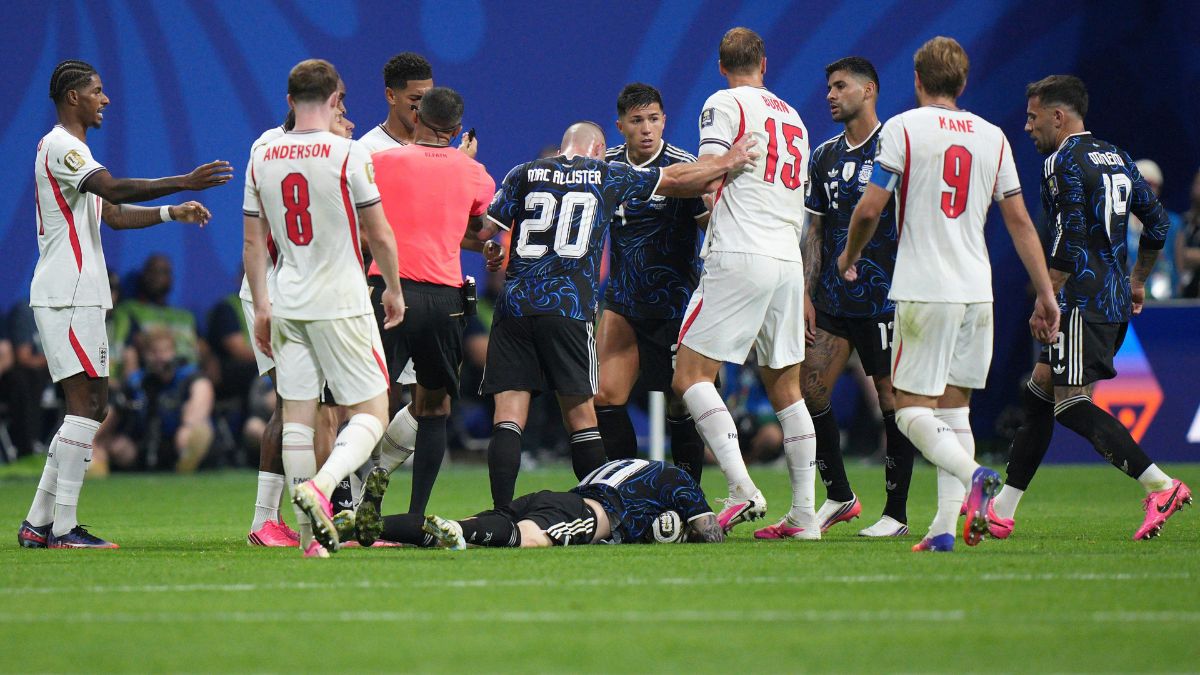
The FIFA World Cup 2026 semi-final between Argentina and England delivered plenty of drama even before Lionel Messi inspired a stirring comeback. Though the defending champions ultimately prevailed 2-1 to book their place in a second successive final, much of the post-match conversation focused not on the result, but on referee Ismail Elfath’s handling of the contest.
Argentina committed 12 fouls in the first half alone yet received only one yellow card before the break, a disciplinary leniency that left England players, coaching staff and supporters deeply frustrated and sparked widespread criticism of the officiating.
Here are some of the biggest flashpoints from a contentious evening in Atlanta:
Enzo Fernandez escapes early booking after Anderson challenge
The first major talking point arrived just three minutes into the match.
After England midfielder Elliot Anderson challenged Lionel Messi, Argentina’s Enzo Fernández responded with a heavy tackle on Anderson. Television replays appeared to show Fernández making contact with Anderson’s head during the follow-through.
So this challenge by the Tattoo maker rogue Enzo Fernandes is not even a foul or no yellow card from the Referee Ismail Elfath…..Infantino in action… pic.twitter.com/3kp32AL7ak
— ArunmozhiVarman 🇮🇳 🕉🚩🛕🎻🎧🎙🎶 (@Arunmozhi_Raaja) July 15, 2026
England players immediately appealed for a yellow card, but referee Ismail Elfath allowed play to continue without any disciplinary action.
Giuliano Simeone avoids caution despite repeated fouls
Argentina winger Giuliano Simeone repeatedly tested the referee’s patience during the opening half. Simeone committed several fouls while pressing England’s defenders, including one challenge on Djed Spence that saw his arm catch the England full-back in the face. Despite persistent infringements, the Atletico Madrid forward was not shown a yellow card.
Simeone has committed FIVE fouls in the opening 40 minutes of the game and hasn't been carded. Elliot Anderson committed 1 foul and got carded..
— Football Away Days (@AwayDaysFB) July 15, 2026
Make it make sense 🤦🏼♂️ pic.twitter.com/w5MkWW6ICK
Nahuel Molina’s foul on Jude Bellingham
Another contentious moment came when Jude Bellingham was brought down by Nahuel Molina just outside Argentina’s penalty area. England were awarded a free-kick in a promising position, but Molina escaped without a booking despite halting a dangerous attacking move. The decision added to England’s growing frustration with the referee’s disciplinary threshold.
Sale la noticia que Bellingham tiene molestia en el hombro
— Fran Fijap (@FranFijap) July 15, 2026
*PAREDES EN LA PRIMERA JUGADA DEL PARTIDO* pic.twitter.com/oq9IkvEzFu
Leandro Paredes’ off-the-ball shove goes unpunished
England also felt they were denied protection after an off-the-ball incident involving Leandro Paredes. During the first half, Paredes appeared to push Bellingham away from the ball, but neither the referee nor his assistants intervened. The incident drew little attention during the game but was widely circulated on social media after the final whistle.
Argentina rack up 12 first-half fouls but see only one yellow card
Perhaps the biggest source of frustration was the overall foul count.
Argentina committed 12 fouls before half-time, the highest by any team in the opening half of a match at the 2026 World Cup- yet their first booking arrived only when Lisandro Martínez cynically stopped an England counter-attack late in the half.
Enzo Fernandez, despite committing three fouls, finished the first half without a caution.
England’s complaints continue after final whistle
England players repeatedly surrounded the referee during the match, questioning several decisions that they believed disrupted their momentum.
The officiating quickly became one of the dominant talking points online, with clips of the incidents circulating widely across social media and sparking fresh debate over consistency in refereeing standards at the World Cup.
In the end, however, Argentina made the moments that mattered count. Enzo Fernández scored the equaliser before Lautaro Martínez completed the turnaround, sending Lionel Scaloni’s side into a second successive FIFA World Cup final while England were left to reflect on both the result and the refereeing decisions that shaped an eventful semi-final.
Social media splits into two camps
Many users claimed the officiating was favouring Messi’s Argentina.
One widely shared post read. One user wrote-
“Refereeing consistency shouldn’t depend on the badge on the shirt. If those challenges aren’t punished early, the match just turns into a free-for-all.”
Refereeing consistency shouldn’t depend on the badge on the shirt. If those challenges aren’t punished early, the match just turns into a free-for-all.
— Backless Celebs (@backlesscelebs) July 16, 2026
Another wrote:
“Now with slow motion and social media, entire world is watching how corrupt @FIFAcom is, everything is fixed.”
Now with slow motion and social media, entire world is watching how corrupt @FIFAcom is, everything is fixed 😔😰😥
— Adhokshaj (@Adhokshaj2027) July 16, 2026
Others defended Elfath’s performance, arguing the referee maintained the same standard for both sides throughout an intense knockout fixture.
Several users pointed out that physical contests are common in World Cup semi-finals and that Argentina’s pressing style naturally produces more fouls.
One supporter posted:
“Stop crying. Messi silence all the haters once again he proved that he is goat.”
Stop crying 😭 Messi silence all the haters once again he proved that he is goat
— Alexander (@KhanSulaim50105) July 16, 2026
Another added:
“There may have been fouls not called against Argentina but they were by far the better team tonight and England played quite dirty too towards the end.”
There may have been fouls not called against Argentina but they were by far the better team tonight and England played quite dirty too towards the end… Regardless, the reigning world champions scored 2 amazing goals for a huge comeback win!
— QuantumTrader (@quantum_trader) July 16, 2026
Cheering for Spain 🇪🇸 my second…
Referee decisions being debated online
Whether Ismail Elfath’s approach affected the outcome remains open to interpretation. England supporters believe stricter early officiating may have limited Argentina’s aggressive press and altered the match’s rhythm.
Others argue Argentina’s victory ultimately came from football rather than refereeing. Lionel Messi created both Argentine goals, while England struggled to regain control after taking an early lead.
FIFA has not commented on the online criticism, and there is no indication that Elfath’s performance is under formal review. Clips of the key incidents continue to circulate widely on social media, where supporters and pundits are scrutinising each decision frame by frame, adding another layer of controversy to Argentina’s march into the World Cup final.