



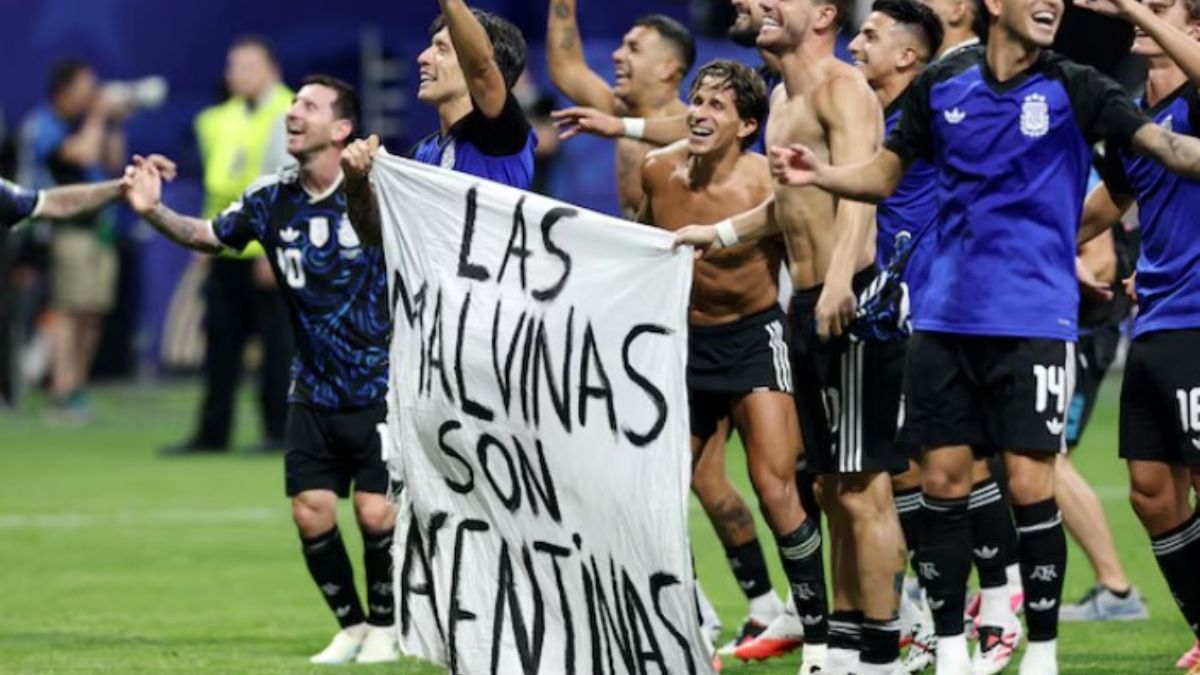
Argentina’s place in the FIFA World Cup 2026 final was sealed with a dramatic 2-1 comeback win over England. But the post-match celebrations have also drawn attention for a reason unrelated to football.
Shortly after the final whistle in Atlanta, Argentina defenders Lisandro Martínez and Giovani Lo Celso were photographed holding a banner reading “Las Malvinas Son Argentinas (“The Malvinas are Argentine”), referring to the Falkland Islands, a long-running point of dispute between Argentina and the United Kingdom.
The images have prompted questions over whether the display could breach FIFA’s rules on political messaging at World Cup venues.
What exactly happened after Argentina’s win?
As Argentina celebrated reaching a second successive World Cup final, several players acknowledged supporters with flags and banners.
Among them was a banner carrying the words “Las Malvinas Son Argentinas”, the slogan widely used in Argentina to assert the country’s claim over the Falkland Islands, known there as Las Malvinas.
Photographs of the celebration, including images published by Reuters, quickly circulated on social media, shifting attention from the match itself to whether the gesture crossed FIFA’s disciplinary line.
Why is the message significant?
The Falkland Islands remain one of the most sensitive issues in relations between Argentina and Britain.
The two countries fought a 10-week war over the South Atlantic islands in 1982 after Argentine forces invaded the British overseas territory. Britain regained control of the islands after the conflict, which claimed the lives of hundreds of British and Argentine service personnel.
Argentina has continued to claim sovereignty over the islands, while Britain maintains control. Residents of the Falkland Islands have repeatedly voted to remain a British Overseas Territory.
The slogan displayed by Argentina’s players reflects Argentina’s long-standing official position on the issue.
Could FIFA take action?
Potentially. FIFA’s regulations prohibit political, discriminatory or offensive messages from being displayed inside World Cup stadiums.
The governing body’s Stadium Code of Conduct states that banners, flags, clothing or other materials of a political nature are not permitted during FIFA competitions. Whether Argentina’s banner falls within that definition is ultimately a matter for FIFA to determine.
As of now, FIFA has not announced any disciplinary proceedings or confirmed that an investigation has been opened.
Has something similar happened before?
Political messaging has surfaced at previous FIFA tournaments, although disciplinary responses have varied depending on the circumstances.
During the 2026 World Cup group stage, supporters attending Iran’s matches displayed pre-revolutionary Iranian flags, symbols associated with opposition to the current government in Tehran. Those incidents did not result in any publicly announced FIFA sanctions.
FIFA has consistently maintained that international football should remain politically neutral and has regularly reminded teams, players and supporters that political demonstrations are prohibited inside official venues.
What happens next?
For now, Argentina’s focus remains on Sunday’s World Cup final against Spain.
Whether the banner becomes a disciplinary issue depends entirely on FIFA’s assessment of the incident and whether it considers the display to have breached its tournament regulations.
Until FIFA comments officially, the episode remains another example of how football’s biggest stage can sometimes intersect with long-standing political and historical disputes.