




India’s fast moving consumer goods (FMCG) sector shows signs of recovery, supported by favourable macros like low inflation and rural demand resurgence.
Projections indicate high single-digit volume growth for 2026 overall, with long-term compounded annual growth rates (CAGRs) in the double digits through 2030.
Growing disposable incomes — especially among the urban middle class and expanding rural consumers — drive demand for both staples and discretionary categories (e.g., personal care, hygiene, packaged foods).
Despite the growth outlook being positive, a few stocks have fallen substantially from 52-week highs. Here we present five such stocks. Please note, this is not a recommendation on any of these stocks.
#1 Jyothy Labs
First on the list is Jyothy Labs.
Jyothy Labs is a FMCG company specialising in household and personal care products.
Major brands of the company include Ujala, Henko, and Exo detergents, Pril dishwash, Margo soaps, and Maxo insecticides. The company operates 23 manufacturing facilities and reaches nearly 2.8 million (m) outlets pan-India.
| 52-week High | Rs 422.6 |
| 52-week Low | Rs 267.9 |
| Current Market Price (7 Jan, 2026) | Rs 276.9 |
| Fall from 52-week highs (%) | 35% |
Source: BSE
The shares of Jyothy Labs have fallen as much as 35% from 52-week highs.
On the financial front, Jyothy Labs saw revenues of Rs 7,361 m in Q2 FY26 vs Rs 7,338 m YoY. For the September quarter, the company reported a net profit of Rs 878 m vs Rs 1,050 m YoY. The gross profit margin fell to 16.1% from 18.9%, largely due to rising costs.
According to the management, growth in the September quarter was nearly flat as the distribution network adjusted to the new GST structure.
In Q2 FY26, across channels, general trade remained subdued for the company, while modern trade e-commerce and quick commerce maintained double-digit growth led by strong performance in fabric care and dish wash.
Moving ahead, Jyothy Labs is expanding pan-India from a strong presence in the South. In fact, revenues from Southern India have come down from about 40% to 33% over the past few years.
The management believes a broad-based consumption recovery is underway aided by supportive fiscal measures, tax rationalisation, and stable macroeconomic conditions.
It expects the demand environment to strengthen gradually through the second half of the year. With a strong cash balance of Rs 8,010 m and zero debt, Jyothy Labs is well positioned to fund growth and invest in innovation.
The main focus of the company is to remain profitable, maintain organic growth, strengthen its core categories, investment in innovation, and launch new products.
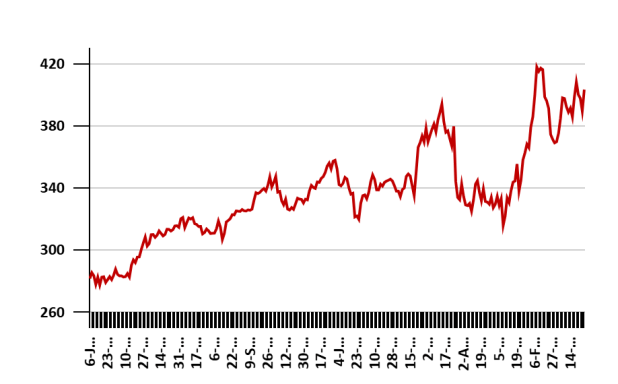
Jyothy Labs Share Price – 1 Year
Source: BSE
In the past five trading sessions, Jyothy Labs’ shares moved lower from Rs 282 to Rs 276.4.
The stock touched its 52-week high of Rs 422.6 on 5 February 2025 and its 52-week low of Rs 267.9 on 3 October 2025. The stock is trading very close to its 52-week lows.
#2 Tasty Bite Eatables
Next on our list is the stock of Tasty Bite Eatables.
Tasty Bite Eatables manufactures ready-to-eat Indian and pan-Asian foods, focusing on natural, organic, preservative-free vegetarian products using retort pouch technology for long shelf life.
The company exports to the US, Canada, UK, Australia, and others, with segments in consumer retail, foodservice for QSRs and HoReCa, and Xclusive products for pubs and lounges.
| 52-week High | Rs 11,888 |
| 52-week Low | Rs 7,311 |
| Current Market Price (7 Jan, 2025) | Rs 7,808.35 |
| Fall from 52-week highs (%) | 34% |
Source: BSE
The stock has fallen 34% from its 52-week high.
On the financial front, revenue in Q2 FY26 dropped to Rs 1,329 m vs Rs 1,567 m YoY. The net profits were Rs 36 m vs Rs 101 m YoY.
In Q2 FY26, the export-led consumer business remained stable, with strong growth of 145% in affiliate markets excluding Preferred Brands International (PBI). The growth was supported by successful new product launches.
While Preferred Brands International faced a temporary slowdown due to macroeconomic challenges in the US, the company remains confident in its long-term potential.
The food service business continues to be a key pillar of the company’s growth strategy. It reported Rs 963 m in revenue, a healthy 16% increase in H1 FY26 (18% growth in Q1 and 13% growth in Q2).
This marked the 8th consecutive quarter of growth. The growth was driven by the formed frozen products range as well as expansion into the HoReCA Distribution business.
The company has launched Cheffin on Amazon and Amazon Fresh which is its entry into the B2C digital business.
Looking ahead, the company will prioritise SKUs which have shown strong consumer traction, while optimising its portfolio for better relevance.
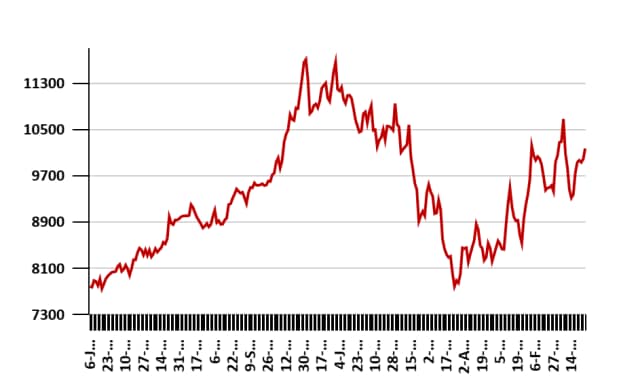
Tasty Bite Eatables Share Price – 1 Year
Source: BSE
In the past five trading sessions, Tasty Bite Eatables’ shares moved lower from Rs 7,875 to Rs 7,808.35. The stock touched its 52-week high of Rs 11,888 on 7 August 2025 and its 52-week low of Rs 7,311 on 7 April 2025.
#3 AWL Agri Business
Next on our list is the stock of AWL Agri Business.
AWL Agri Business, formerly Adani Wilmar, is a major Indian FMCG company focused on edible oils and food products. It originated as a joint venture between Adani Group and Wilmar International in 1999 and rebranded in 2025 after Adani’s exit.
The flagship brand, ‘Fortune’, commands trust of more than 123 m households, reaching 1 in 3 Indian families.
With more than 70 manufacturing units, including India’s largest integrated food complex at Gohana in Haryana and largest port-based edible oil refinery at Mundra in Gujarat, the company ensures seamless production and distribution.
| 52-week High | Rs 329.75 |
| 52-week Low | Rs 228.5 |
| Current Market Price (7 Jan, 2025) | Rs 229.2 |
| Fall from 52-week highs (%) | 30% |
Source: BSE
The shares of AWL Agri Business have fallen as much as 30% from 52-week highs. The stock did see a significant fall following reports of complete exit by the Adani group.
On the financial front, AWL Agri Business saw revenues of Rs 176,046 m in Q2 FY26 vs Rs 144,499 m YoY. For the quarter ending 30 September 2025, the company reported a net profit of Rs 2,276 m vs Rs 2,819 m YoY.
Moving ahead, the company has recently released business update for the third quarter ending 31 December 2025.
During the period, the company recorded a low single digit growth on volumes. Growth during the quarter was primarily led by uptick in both edible oil and food & FMCG segment.
However, the overall volumes were dragged by de-growth in castor and de-oiled cakes classified under the industry essentials segment.
Festive demand for AWL Agri Business was relatively subdued during the quarter as trade continued to operate with lean inventory levels.
The Food & FMCG business saw a gradual recovery over recent quarters with improved offtake, on the back of multiple interventions and improvements in the rice business.
However, wheat flour & refined flour business catering to HORECA segment recorded strong double-digit growth during the quarter.
Moving forward, the management says it will continue to lay emphasis on expansion and acquisitions where necessary. Despite competitive pressures, the wide reach, strong brand equity, and rural growth outlook work as positives for AWL Agri Business.
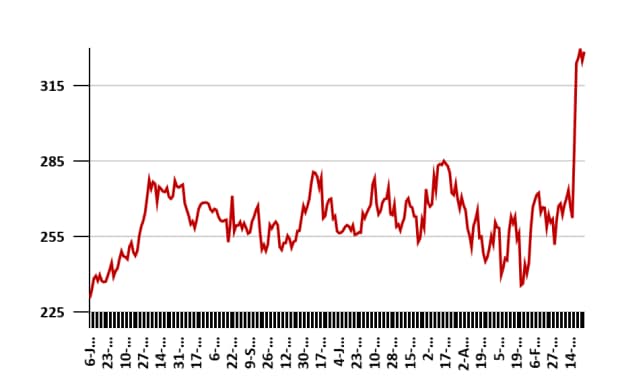
AWL Agri Business Share Price – 1 Year
Source: BSE
In the past five trading sessions, AWL Agri Business’ shares moved lower from Rs 237.9 to Rs 229.2.
The stock touched its 52-week high of Rs 329.75 on 7 January 2025 and a 52-week low of Rs 228.5 on 7 January 2025.
#4 ITC
Next on our list is the stock of ITC.
Though the company is diversified, it’s a part of the NSE FMCG index, due to its strong presence in the FMCG space.
ITC is present in a variety of industries, including FMCG, packaging, paperboards and speciality papers, tobacco, and agribusiness.
Aashirvaad (staples like atta and spices), Sunfeast (biscuits), Bingo! (snacks), YiPPee! (noodles and pasta), Candyman and mint-o (confectionery), Kitchens of India (ready-to-eat), B Natural (beverages), Fabelle (chocolates), Savlon (antiseptics and soaps), Vivel (soaps and body wash), and Fiama (shower gels and soaps) are some of the company’s brands.
| 52-week High | Rs 471.3 |
| 52-week Low | Rs 337.9 |
| Current Market Price (7 Jan, 2025) | Rs 341.3 |
| Fall from 52-week highs (%) | 28% |
Source: BSE
The stock of ITC has fallen 28% from 52-week highs. A large part of the fall in the stock has come since the start of 2026.
ITC shares dropped sharply in early January 2026 due to the government’s excise duty hike on cigarettes, a key profit driver for the company. This led to heavy selling in the stock.
The finance ministry notified that an excise duty of Rs 2,050–8,500 per 1,000 sticks, depending on cigarette length, will take effect from 1 February 2026. The excise duty would be imposed on cigarettes in addition to a 40% GST.
On the financial front, in Q2 FY26, ITC reported revenues of Rs 212,559 m, compared to Rs 215,364 m in the same period last year. The consolidated net profits was Rs 51,202 m compared to Rs 49,750 m in the same period last year.
Moving ahead, ITC’s growth will be driven by its reputable brands. Its FMCG and hotel businesses have plenty of room to grow.
The stock offers a good dividend yield of 4.2%.
However, the recent increase in cigarette duties may have a negative effect on volumes and margins.
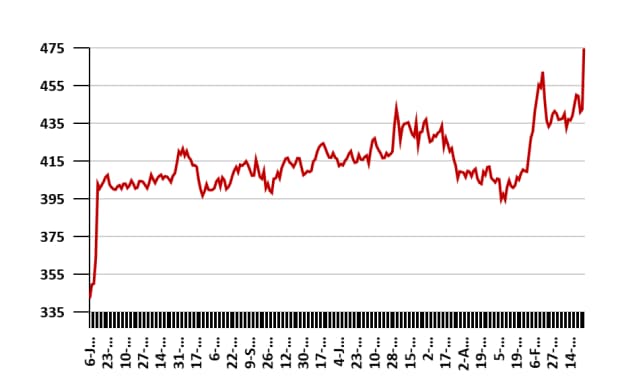
ITC Share Price – 1 Year
Source: BSE
In the past five trading sessions, ITC’s shares moved lower from Rs 402.25 to Rs 341.3. The stock touched its 52-week high of Rs 471.3 on 1 February 2025 and its 52-week low of Rs 337.9 on 6 January 2026.
#5 Varun Beverages
Next on the list is the stock of Varun Beverages.
The company is a significant player in the beverage industry and one of the largest PepsiCo franchisees outside of the US.
Varun Beverages produces and markets a range of carbonated soft drinks (CSDs) and non-carbonated beverages (NCBs), including packaged drinking water sold under PepsiCo’s trademarks.
| 52-week High | Rs 635.2 |
| 52-week Low | Rs 419.4 |
| Current Market Price (7 Jan, 2025) | Rs 509.85 |
| Fall from 52-week highs (%) | 20% |
Source: BSE
The stock of Varun Beverages has fallen 20% from 52-week highs.
On the financial front, while the company reported flat revenues for Q3 2025 (third quarter ending September 2025), the net profits grew. The company follows a calendar year reporting.
Revenue from operations increased 1.9% YoY to Rs 48,966.5 m in the September quarter compared to Rs 48,046.8 m in the same quarter last year.
Net profits increased 18.5% to Rs 7,451.9 m from Rs 6,288.3 m. This was driven by lower finance cost and higher other income which includes interest on deposits in India and favourable currency movement in the international territories.
In keeping with its expansion plan, the company is establishing a wholly-owned subsidiary in Kenya under Varun Beverages Ltd to produce, distribute, and sell dairy and beverages.
The company is also diversifying its product offerings. Certain African subsidiaries of the company will test market beer in their territories through an exclusive distribution agreement with Carlsberg Breweries A/S for the Carlsberg brand.
Meanwhile, the company’s snacks facility in Morocco has ramped up to full-scale operations and the upcoming Zimbabwe plant is progressing towards commissioning, marking continued progress in diversifying the portfolio beyond beverages.
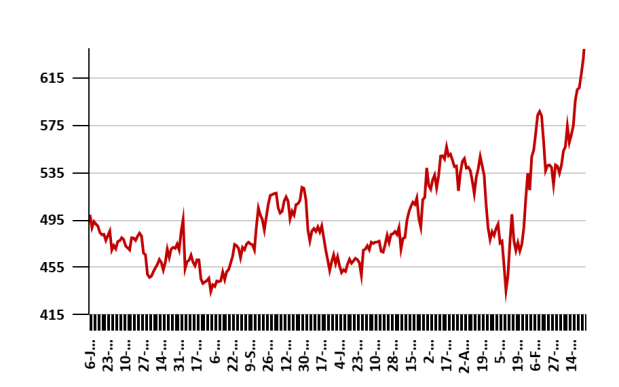
Varun Beverages Share Price – 1 Year
Source: BSE
In the past five trading sessions, Varun Beverages’ shares moved higher from Rs 491 to Rs 509.85. The stock touched its 52-week high of Rs 635.2 on 7 January 2025 and its 52-week low of Rs 419.4 on 3 March 2025.
Should You Consider FMCG Stocks that Have Fallen Sharply?
FMCG stocks in India have in the past offered a defensive appeal. Most companies could deliver volume growth during the year which can be built around low inflation and rural recovery. Some of the stocks from the sector have always commanded higher price to earnings multiples.
Investing in FMCG stocks at this point calls for a careful assessment of potential sector growth amid ongoing challenges like rising input costs.
While some of these stocks may present value opportunities, it’s vital for investors to proceed cautiously and conduct thorough, independent research before making any decisions.
Disclaimer: This article is for information purposes only. It is not a stock recommendation and should not be treated as such. Learn more about our recommendation services here…
The website managers, its employee(s), and contributors/writers/authors of articles have or may have an outstanding buy or sell position or holding in the securities, options on securities or other related investments of issuers and/or companies discussed therein. The content of the articles and the interpretation of data are solely the personal views of the contributors/ writers/authors. Investors must make their own investment decisions based on their specific objectives, resources and only after consulting such independent advisors as may be necessary