The global partnership between Toyota and Suzuki was a masterstroke—Toyota got access to Suzuki’s expertise in building small cars (via Maruti Suzuki), and Suzuki got access to Toyota’s hybrid and electrification technology.
Since the launch of the alliance’s first car in 2019—Toyota Glanza, a rebadged Suzuki Baleno—both have shared six models in India, but despite this model onslaught, the combined dominance of the two Japanese giants is shrinking, and the benefits appear to be flowing largely in one direction, from Maruti Suzuki to Toyota. In 2020, Maruti Suzuki and Toyota’s combined market share stood at 53%—Maruti Suzuki’s share was 49.9%, and Toyota’s was 3.1%—but in 2021, it dropped to 48.5%, in 2022 to 45.8%, in 2023 it rose marginally to 47%, in 2024 to 48.1%, and in 2025 it dropped again, to 48%.
All along, the benefits seem to be flowing in one direction – from Maruti Suzuki to Toyota. While Maruti Suzuki’s market share has dropped from 49.9% in 2020 to 40.2% in 2025, Toyota’s share has more than doubled from 3.1% to 7.8% (see chart).
Automotive analysts and dealers told FE that despite the launch of several shared models – from rebadged hatchbacks to codeveloped SUVs – the alliance has failed to recapture its 2020 peak. “Reasons include cannibalisation of models – customers who want a stronger badge tend to shift from Maruti Suzuki to Toyota – and rising competition from local players such as Tata Motors and Mahindra,” they said.
Cannibalization Effect
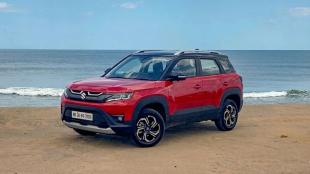
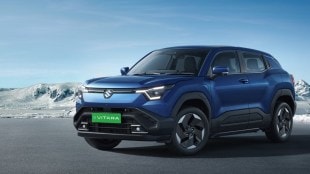
A Delhi-based Toyota dealer told FE that most inquiries for the Hyryder are from people who want a hybrid car but don’t want the Maruti Suzuki badge (Grand Vitara). “Toyota has been able to position the Hyryder as the more premium choice despite it being mechanically identical to the Grand Vitara,” he said. “By standardising better safety features – such as six airbags – earlier than Maruti Suzuki, Toyota possibly poached customers who would have otherwise walked into a Nexa showroom.”
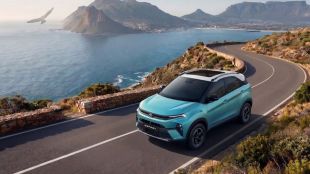
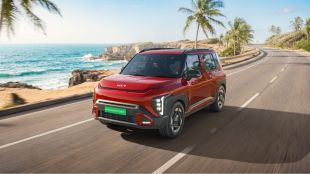
“Maruti Suzuki has lost nearly 10% of the Indian market in five years,” said an analyst. “While the carmaker has seen volume growth – from 1,213,660 units in 2020 to 1,806,514 units in 2025 – it has failed to keep pace with the market’s shift towards premium SUVs, a segment where its partnership with Toyota was supposed to provide an edge. Meanwhile, Tata Motors, Mahindra, Hyundai, and Kia have launched premium SUVs that are taking away share from both partners.”
Toyota, however, is winning. By putting its badge on Maruti Suzuki models such as the Baleno (Glanza), Ertiga (Rumion), and Fronx (Taisor), Toyota got high-volume cars without the huge capital expenditure required for new car development, and its volumes have almost grown fivefold in five years – from 76,111 units in 2020 to 351,244 units in 2025.
In the codeveloped product – Maruti Suzuki Grand Vitara and Toyota Hyryder – the former is selling more, but Toyota is catching up. For instance, in 2025, Maruti Suzuki sold 104,209 units of the Grand Vitara, and Toyota did 85,710 units of the Hyryder.
Premium Shift
In the high-end segment – where Toyota Innova Hycross is sold as a rebadged Maruti Suzuki Invicto – the latter is struggling, and sold just 3,946 units in 2025, as compared to almost 50,000 units of the Innova Hycross.