



In order to build a younger and more efficient workforce, which is expected to help the company save on employee costs in the long run, Tata Motors announced a voluntary retirement scheme (VRS) for employees engaged in operations at all five of its plants in India.
Tata Motors said in a statement that the VRS was “in continuation of its steps to respond to an increasingly competitive business environment and macroeconomic pressures that have resulted in depressed growth of the commercial and passenger car business in India.”
The VRS, which is first intended for workmen and will subequently be extended to management cadre personnel as well, is targeted at all employees aged 40 and above. The scheme entails a monthly payout (including basic salary and dearness allowance) that begins at the date of separation and continues till the employee turns 60. Employees opting for the scheme will also be eligible for medical insurance for a period of 10 years after the separation.
The unique structuring of the VRS pacakge ensures that the carmaker will not have to take a big hit on its profit and loss account in the next few quarters due to provisioning of funds to pay those opting for VRS.
Tata Motors has around 27,000 employees at present, out of which 16,000 are workmen. According to sources, around 11% of the company’s overall workforce could be eligible to opt for this scheme.
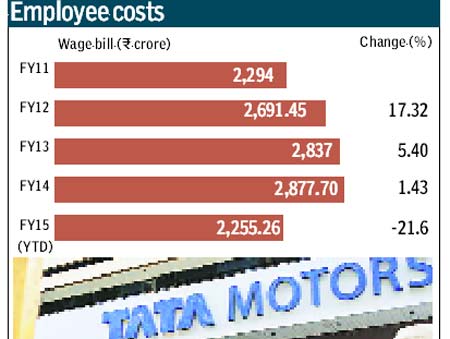
The company, part of the $103-billion Tata Group, had a standalone wage bill of Rs 765 crore in the quarter ended December 31. In FY14, its employee costs stood at Rs 2,878 crore. Employee costs on account of Indian operations were around around 8.5% of the company’s standalone revenues.
A Tata Motors spokesperson refused to comment on the quantum of savings in the wage bill that the company expects due to the scheme.
The company also indicated that it will be introducing new performance measurement methods once the VRS is implemented.
“Key focus areas will include productivity benchmarking, cost optimisation and job enrichment, for a more effective and efficient organisational structure, aligned to market demand,” the company said in its statement.
“The underperformance of the domestic business has led Tata Motors to take the VRS route to bring down employee costs,”said a Mumbai-based auto sector analyst with a domestic brokerage. He declined to be identified as he is not authorised to speak to the media.
The initiative comes at a tome when Tata Motors has revamped its domestic passenger car business, which has been losing market share to rivals over the last couple of years. It has launched cars like the Zest (a compact sedan) and the Bolt (a hatchback) based on its new Horizonext strategy, and has announced that it will launch two new cars every year till 2020.
In the quarter ended December 31, Tata Motors reported a standalone turnover of Rs 9,056 crore and a loss of Rs 2,123 crore.