


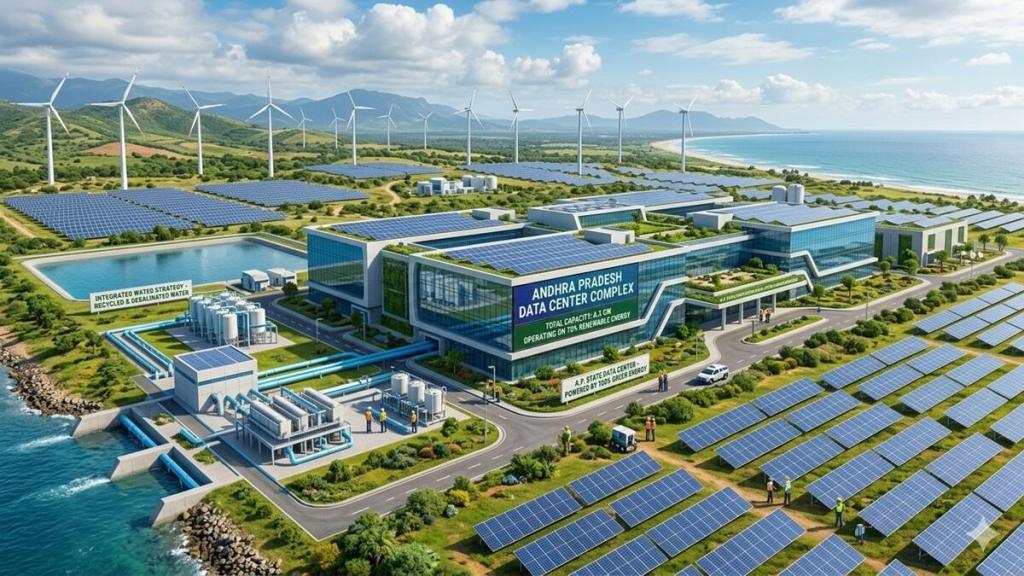

Energy demand has surged as India leads a massive push for data center construction despite water, land and energy pressures. Capacity has surged more then 4x in the past five years to reach 1,575 MW by 2025. Electricity consumption is projected to quadruple by 2030 — heavily testing national grid stability.
According to 2026 predictions shared by Deloitte, the sector will see electricity demand rise to approximately 57 TWh by FY2030. It also projects that data centers’ share of global electricity consumption will rise from approximately 0.8% to around 2.5% to 3%.
“As utilisation remains high and reliability requirements are stringent, the next growth phase will hinge on power readiness and grid deliverability and not just generation. Efficiency becomes a material lever,” the accounting firm added.
12 GW data center expansion
India has seen its data center capacity surge more than 4x since 2020 — reaching 1,575 MW in 2025 — as cloud adoption, 5G, data localisation and artificial intelligence led a rapid expansion. According to the India Data Center Colocation Report 2026, the market is expanding by 25.5% annually to reach $7.31 billion in 2026.
A recent Wood Mackenzie report projects that the country will see its operational data centre capacity will increase from 2.2 GW in 2025 to 12 GW by 2030 at a compound annual growth rate of approximately 40%. The global research and data analytics firm noted that “convergence of hyperscale capital, AI workload growth and a decade of policy support” had created the conditions for India to rival any market in Asia-Pacific. It also added that states with “liberalised open-access frameworks and competitive intra-state transmission charges” were now positioning themselves as preferred hubs for new capacity, as power procurement strategy increasingly determines site selection.
How much energy do data centers in India consume?
According to the International Energy Agency, data centers consumed around 1.5% of global electricity consumption in 2024. Investment in data centers has surged rapidly in recent years — with the size and capacity increasing steadily in anticipation of growing demand for AI-related services.
The IEA added in its World Energy Outlook Special Report for 2024 that a conventional data center was typically around 10 to 25 MW in size. But a hyperscale AI-focused data center can have a capacity of 100 MW or more — consuming as much electricity annually as 100,000 households.
According to the IEA, global electricity consumption from data centers amounted to around 415 TWh in 2024. Base case projections found that the figure would double to reach around 945 TWh by 2030.
“From 2024 to 2030, data centre electricity consumption grows by around 15% per year, more than four times faster than the growth of total electricity consumption from all other sectors…Electricity consumption in accelerated servers, which is mainly driven by AI adoption, is projected to grow by 30% annually in the Base Case, while conventional server electricity consumption growth is slower at 9% per year,” the IEA analysis adds.
Govt estimates over 26 GW additional load
According to an official release from the Electronics and IT Ministry at the end of March this year, data centre capacity in the country has increased from about 375 MW in 2020 to around 1500 MW by 2025. About 38,231 GPUs had also been onboarded by mid-March under the AI compute capacity framework.
“The expected electricity demand from the growth of AI and other large-scale data centres is factored into the planning process of government. As per information available with the Ministry of Power, electricity demand from data centres is estimated to reach 13.56 GW by 2031–32,” the PIB press release added on March 13.
The figure was revised mere weeks later as the government told Rajya Sabha at the end of July that artificial intelligence data centers would add an extra 26.3 GW to India’s power demand by 2031-32. As per the written reply, peak demand is set to rise by roughly a third over the next five years. The government also told Parliament that more than Rs 9 lakh crore has been earmarked for transmission under the National Electricity Plan amid a growing push for renewable energy sources. The additional AI-linked load is expected to be integrated into the grid and will primarily be served by renewable energy capacity, rather than dedicated captive coal or gas plants.
20x surge to 191 billion kWh demand
According to projections from the International Energy Agency, India is expected to post an increase of 6.4% annually over the 2026-2030 forecast period. The country is likely to add over 570 TWh to its annual consumption in the next five years.
Wood Mackenzie estimates electricity consumption by data centres will rise nearly 20-fold in the coming years — from 10 TWh in 2025 to 191 TWh by 2040. The global analytics firm added in its recently published ‘India’s Data Centre Landscape: Powering the Digital Economy’ report that energy consumption by AI data centers would account for around 7% of India’s total electricity demand by this time.
To put this figure into perspective, 191 TWh (or 191 billion kilowatt-hours) of electricity is enough to power the entire country for more than a month at current consumption levels. It is also the exact amount of electricity Greenpeace estimates India could save by completely upgrading to energy-efficient agricultural pumps, LED streetlights, and smart home appliances across the country.