



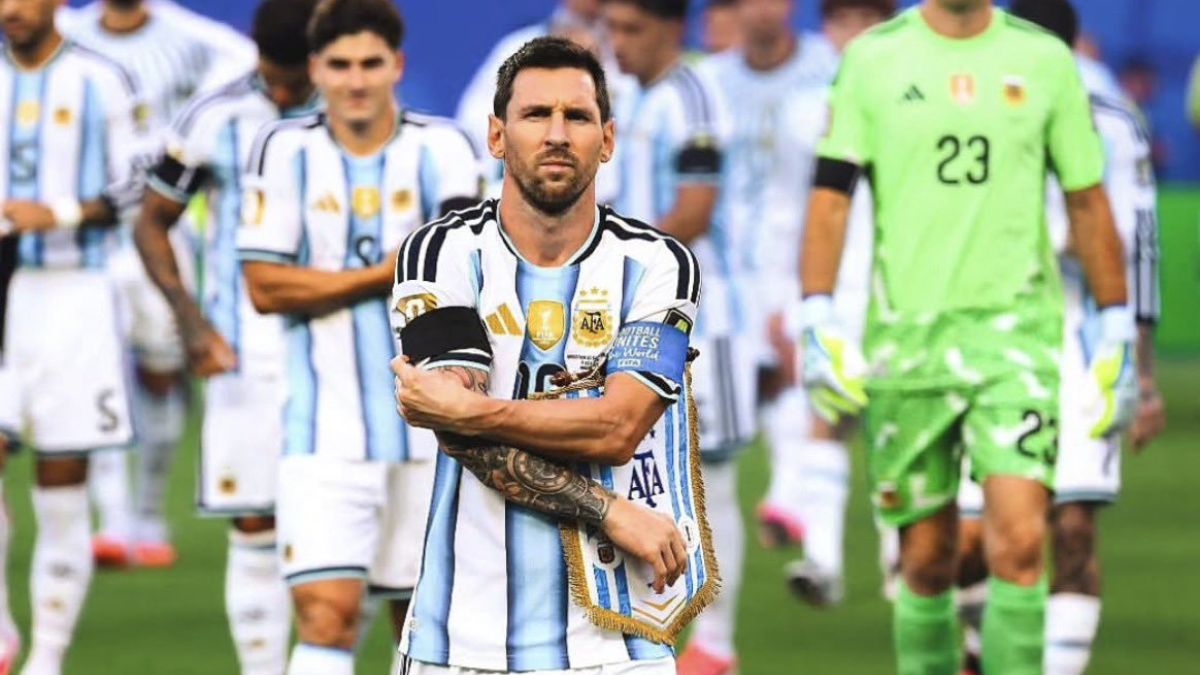
It sounds like an impossible piece of football trivia. Lionel Messi has been playing senior international football since 2005. He has played in a record-breaking six different World Cups, won the tournament in Qatar, and faced every single other World Cup-winning nation on Earth—Brazil, Germany, Italy, France, Uruguay, and Spain.
Yet, when the 39-year-old steps onto the pitch at the Mercedes-Benz Stadium in Atlanta for tonight’s (July 16 in IST), 2026 World Cup semifinal, he will face the England national team for the very first time in his legendary 21-year career.
How did the defining player of the 21st century completely miss one of the sport’s greatest heavyweights for over two decades? The answer is a mix of teenage hotheadedness, cruel tournament draws, and the commercial inflation of modern football.
1. The 47-Second Debut Disaster (2005)
The closest Messi ever came to playing against England was in November 2005, when the FA and the Argentine Football Association (AFA) booked a high-profile international friendly in Geneva, Switzerland. Messi was a hyper-hyped 18-year-old breakout star for Barcelona and was locked in to start.
He missed it because of 47 seconds of madness three months prior.
Making his senior Argentina debut against Hungary in August 2005, Messi came off the bench in the 64th minute. Less than a minute later, he swung a trailing arm to shake off a defender who was aggressively tugging his shirt. The referee flashed a straight, highly controversial red card. The resulting international suspension carried over to the winter break, forcing Messi to watch from the sidelines as Michael Owen scored two late goals to beat Argentina 3–2. The two nations have not scheduled a friendly since.
2. The Cruel World Cup Brackets
Because Argentina and England play in separate continental federations (CONMEBOL and UEFA), they can only meet competitively at the FIFA World Cup. For twenty years, the tournament’s knockout brackets have actively kept them apart like star-crossed lovers:
- 2006 (Germany): A young Messi watched from the bench as Argentina went out in the quarterfinals to Germany; England went out on the exact same weekend to Portugal.
- 2010 (South Africa): The tournament grid was perfectly aligned for an England-Argentina quarterfinal. Instead, Germany brutally crushed the script, knocking out England 4–1 in the Round of 16 before turning around and hammering Maradona’s Argentina 4–0 in the next round.
- 2014 (Brazil): Messi dragged Argentina all the way to the final, but England didn’t hold up their end of the bargain, shockingly crashing out in the group stage.
- 2018 (Russia): Argentina fell to France in a Round of 16 classic; England marched to the semifinals on the completely opposite side of the bracket.
- 2022 (Qatar): Another near-miss. England fell to France in the quarterfinals, erasing a highly anticipated semifinal matchup against Messi—who instead dispatched Croatia and went on to lift the trophy.
3. The Multi-Million Dollar “Messi Fee”
You might wonder why the FA didn’t simply invite Argentina to Wembley for a lucrative friendly at some point over the last two decades. The barrier was entirely financial.
As Messi morphed into a global commercial juggernaut, the AFA began commanding astronomical appearance fees for international friendlies. Staging a match with a contractual guarantee that Messi would play reportedly cost promoters between £3 million and £4 million ($4.5+ million USD).
Between tight European league schedules, the introduction of the UEFA Nations League, and the exorbitant costs required to secure the AFA’s signature, European federations simply chose easier, cheaper friendly options.
The Great Club Paradox
| English Opposition | Messi’s Club Track Record (UEFA Champions League) |
| Matches Played | 36 |
| Goals Scored | 27 |
| Assists | 6 |
What makes his international absence against England so profoundly bizarre is that Messi has spent his entire adult life absolutely terrorizing English teams at the club level. He has scored more Champions League goals against English teams than any other player in history, including iconic goals in the 2009 and 2011 finals against Manchester United.
Tonight in Atlanta, the two decades of waiting finally come to an end. In the twilight of his record-breaking 205-cap career, the ultimate football resume finally gets its missing piece