



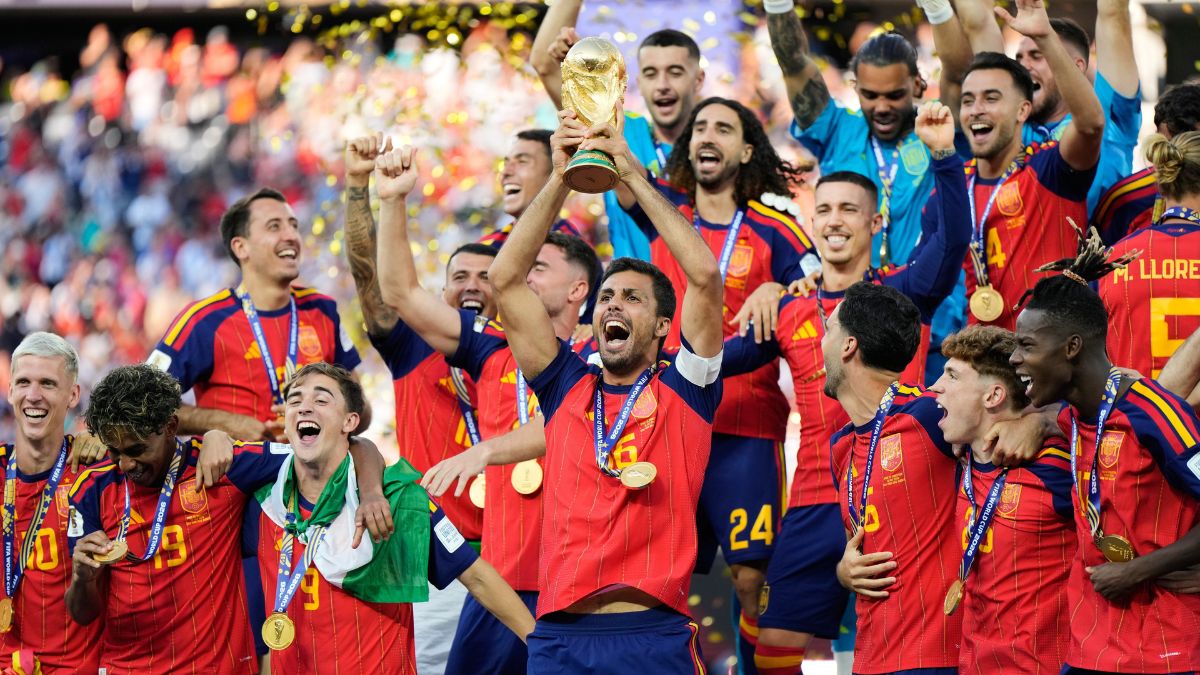
Spain may have only just lifted the FIFA World Cup trophy, but planning for football’s next global spectacle is already well underway. Unlike previous editions, the 2030 FIFA World Cup will not belong to a single nation or even a single continent.
To mark 100 years since the inaugural World Cup in Uruguay in 1930, FIFA has approved the most ambitious hosting plan in tournament history, with six countries across three continents sharing hosting duties.
While the tournament is still four years away, several key details have already been confirmed.
A World Cup spread across three continents
The 2030 edition will be jointly hosted by Spain, Portugal and Morocco, while Uruguay, Argentina and Paraguay will stage the tournament’s opening fixtures as part of the World Cup’s centenary celebrations. It will become the first FIFA World Cup to span Europe, Africa and South America.
The tournament will officially begin in South America before shifting across the Atlantic, where the remaining 101 matches will be played across Spain, Portugal and Morocco.
Why South America will host only three matches
Although Spain, Portugal and Morocco won the main hosting rights, FIFA wanted the centenary edition to honour the tournament’s origins.
Uruguay, which hosted and won the first World Cup in 1930, will stage the opening match at Montevideo’s iconic Estadio Centenario.
Argentina, runners-up in that inaugural tournament, will host the second opening fixture, while Paraguay, home to CONMEBOL headquarters, will stage the third.
After those three matches, every team will relocate to Europe and North Africa for the remainder of the competition.
Six teams already know they’ll be there
The unusual hosting model also means an unprecedented number of automatic qualifiers.
FIFA has confirmed that all six host nations- Spain, Portugal, Morocco, Uruguay, Argentina and Paraguay will qualify automatically.
The tournament will continue with the expanded 48-team format introduced in 2026, featuring 104 matches. FIFA is even mulling a 64-team format but for the 48-team edition seems a more likely prospect.
The stadium race has already begun
While FIFA is yet to finalise the full venue list, several stadiums are expected to headline the tournament.
Barcelona’s renovated Camp Nou is projected to hold more than 100,000 spectators, while Morocco’s under-construction Hassan II Stadium in Casablanca is planned to become one of the largest football stadiums ever built.
Madrid’s Santiago Bernabeu remains the leading contender to host the World Cup final, although FIFA has not officially confirmed the venue.
Travel will become football’s biggest challenge
Hosting a tournament across three continents presents logistical challenges never seen before in World Cup history.
The symbolic South American opening means participating teams will have to cross the Atlantic before the main competition begins, creating unique scheduling and recovery considerations for players.
Once the tournament settles into its main phase, however, matches will be concentrated across Spain, Portugal and Morocco, reducing travel compared with the opening week.
A tournament built around history
For FIFA, the 2030 edition is designed as both a celebration of football’s past and a glimpse of its future.
Exactly a century after the first World Cup kicked off in Montevideo, the tournament will return to its birthplace before continuing across Europe and Africa- a symbolic journey that reflects how the game has evolved into a truly global event.
With the curtain now falling on the 2026 World Cup, the countdown to football’s most ambitious tournament has officially begun.