



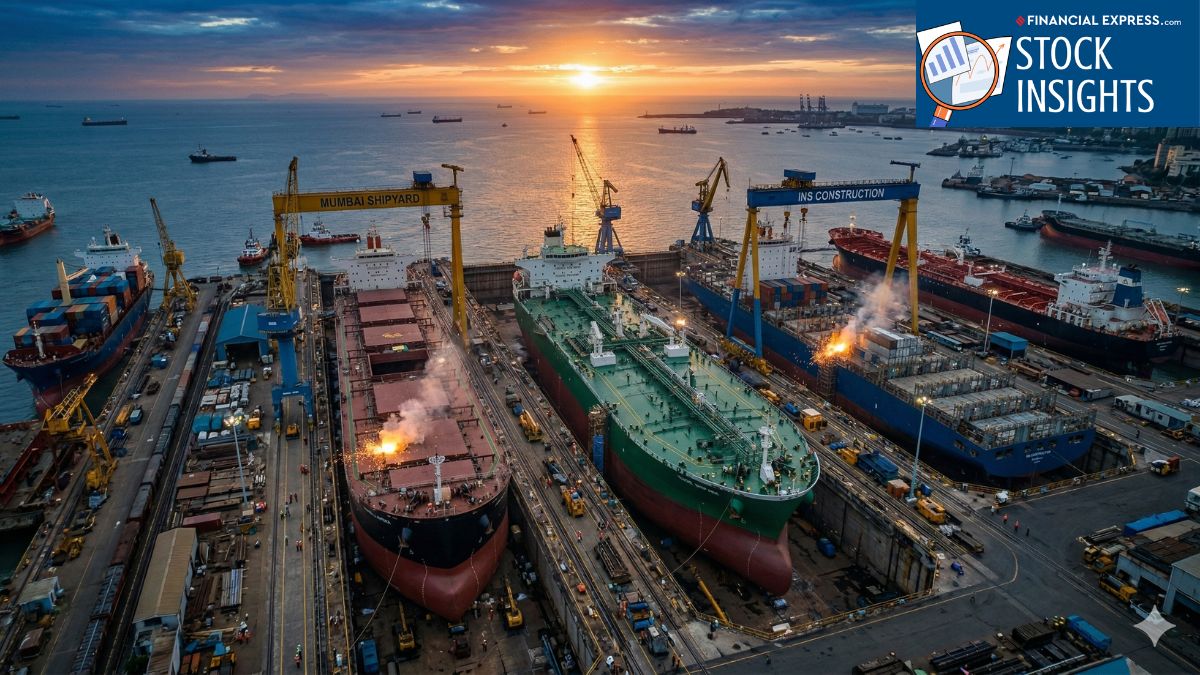
India’s shipbuilding story is quietly moving from dependence to ambition. With nearly 90% of its trade carried on foreign vessels, the country has long remained exposed to global disruptions. The recent allocation of ₹70,000 crore under the Make in India initiative signals a clear shift towards building domestic capability, securing trade routes, and reducing strategic vulnerability.
This transition is not just policy-driven. It is creating a multi-year opportunity for domestic shipyards. Defence orders, commercial vessel demand, and global supply chain realignments are converging at a time when Indian players are scaling up capacity and capabilities.
The question now is not whether the opportunity exists, but which companies are best positioned to capture it. Let’s take a look…
#1 Mazagon Dock Shipbuilders: India’s ₹23,758 Crore Naval Powerhouse
Mazagon Dock Shipbuilders (MDL) is a ‘Navratna’ company of the Government of India. It is India’s only public sector defence shipyard that constructs destroyers and conventional submarines. The company boasts a massive concurrent building capacity capable of handling 11 submarines and 10 warships simultaneously.
The Submarine Moat: Exclusive Manufacturing Capabilities
MDL caters to a diverse range of maritime needs across defence and commercial sectors. It manufactures high-end destroyers, conventional submarines, stealth frigates, corvettes, and missile boats. The commercial portfolio includes cargo vessels, multipurpose support vessels (MPVs), tugs, dredgers, water tankers, and pontoons.
In addition, MDL also has a strong foothold in oil-sector engineering. This shipyard constructs offshore platforms and jack-up rigs and also executes subsea pipeline-laying projects.
MDL is executing major contracts for the Oil and Natural Gas Corporation. These oil sector projects account for approximately 18% of MDL’s current order backlog. Out of a total value of ₹6,524 crore, 3 units with a remaining balance of ₹4,374 crore are currently pending delivery.
In the export and commercial shipping domain, MDL has been contracted by the client, NAVI MERCHANTS, to construct 6 Multipurpose Hybrid Powered Vessels. This commercial project is valued at ₹715 crore, with a remaining balance of ₹638 crore.
As of 31 December 2025, MDL’s total order book stood at ₹23,758 crore. The company’s order book has been gradually depleting over the last 5-6 years, dropping from approximately ₹49,700 crore at the end of FY21. This current backlog is equivalent to 1.9x trailing twelve months (TTM) revenue and is expected to be executed over the next 2 to 2.5 years.
Order Book Outlook: Navigating the ₹1.55 Lakh Crore Pipeline
The current backlog is primarily driven by a few major contracts, with P-17A frigates accounting for approximately 42% of the total and ONGC projects accounting for about 18%. The order pipeline remains robust across both defense and commercial segments.
The government has cleared the procurement of six next-generation submarines under Project-75I (₹70,000 crore), and three additional Kalvari-class submarines (expected order of ₹30,000-40,000 crore), with the latter expected to be concluded in the coming months.
Another project for next-generation frigates (P-17B) worth ₹70,000 crore, and next-generation destroyers (P-18) worth ₹85,000 crore, are expected to be finalized in the coming years. These naval defense projects, along with opportunities in the commercial shipbuilding sector, provide MDL with strong long-term visibility for order inflows.
Muted 9MFY26 Financial Performance
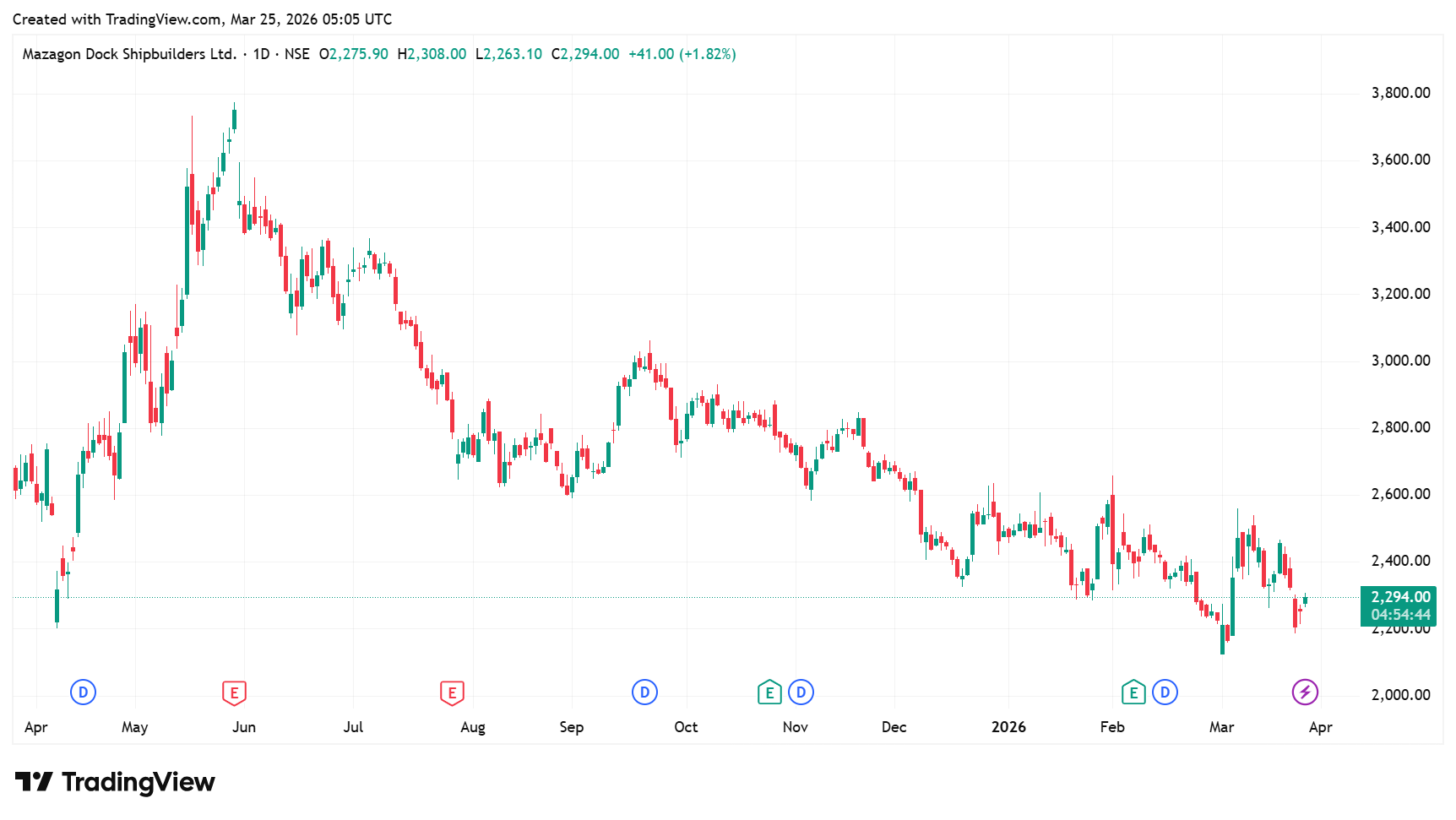
Revenue grew 11% year-on-year to ₹9,156 crore in 9MFY26, driven by improved execution across ongoing naval programmes. EBITDA was 4.4% lower at ₹1,883 crore, with margins at 20.6%. Net profit remained flattish, declining by 0.3% to ₹2,081.4 crore.
#2 GRSE: Accelerating Execution to Secure a ₹50,000 Crore Order Book
Garden Reach Shipbuilders (GRSE) is a Government of India Undertaking operating under the Ministry of Defence. The core of GRSE’s business is the construction of advanced warships and support vessels for the Indian Navy and Coast Guard. It also builds specialized vessels for non-military government departments and domestic clients.
The P-17 Alpha Moat: Decoding the 77% Defence Backlog
As of 31 December 2025, the order book stood at ₹18,482 crore, comprising 10 projects and 42 platforms. This marks the first time the order book has dipped below ₹20,000 crore in recent months, which management views as a positive indicator of accelerated project execution. But this also implies the necessity of order inflow to maintain momentum.
Defense projects account for 77% of the order book, with the P-17 Alpha Frigate project playing a pivotal role, contributing 46% on its own. Non-defense sectors contribute 18%, while other areas such as exports, portable steel bridges, and ship repairs account for the remainder.
The ₹2.5 Lakh Crore Order Pipeline
GRSE is well-positioned to capitalize on defense and commercial shipbuilding opportunities. It estimates the order pipeline for the next 12-18 months across the defense and non-defense segments at over ₹2.5 lakh crore.
The L1 Catalyst: Tracking the ₹33,000 Crore Next-Gen Bid
GRSE has emerged as the lowest bidder for the 5-ship project valued at approximately ₹33,000 crore. It expects to officially conclude and sign this contract by the end of March 2026, which will push the total order book to roughly ₹50,000 crore by the end of FY26.
The Defence Acquisition Council has granted ‘Approval of Necessity’ for seven upcoming projects, estimated at approximately ₹1,55,000 crore. These include the P-17 Bravo project (7 ships worth ₹70,000 crore), Landing Platform Docks (₹35,000 crore), and Mine Counter Measure Vessels (₹32,000 crore).
GRSE aims to achieve an order book of ₹70,000 crore by the end of FY27. The Government has aggregated the demand for about 207 commercial ships (ranging from support vessels to Very Large Gas Carriers). Management conservatively values this pipeline at over ₹1 lakh crore.
From Kolkata to Gujarat: Expanding Capacity to 35 Ships
To handle this surging demand, especially for larger commercial vessels, GRSE is actively scaling its infrastructure and leveraging strategic partnerships. Today, GRSE can build 28 ships simultaneously, and their goal is to reach a capacity of 35 ships by the end of 2026.
GRSE has taken over three sites from the Syama Prasad Mookerjee Port in Kolkata, with two facilities expected to start production by the end of 2026. Additionally, it is developing two greenfield sites in Gujarat over the next 3-5 years, specifically to manufacture large-scale vessels (up to 300 meters) like Very Large Gas Carriers.
To bypass physical constraints, GRSE has successfully utilized outsourcing models. The company has signed MoUs with Swan Defence (to bid for and execute large commercial platforms) and Hindustan Shipyard Limited (to leverage its dry dock capacity for the LPD defense project).
9MFY26 Performance: 42% Revenue Growth and Margin Expansion
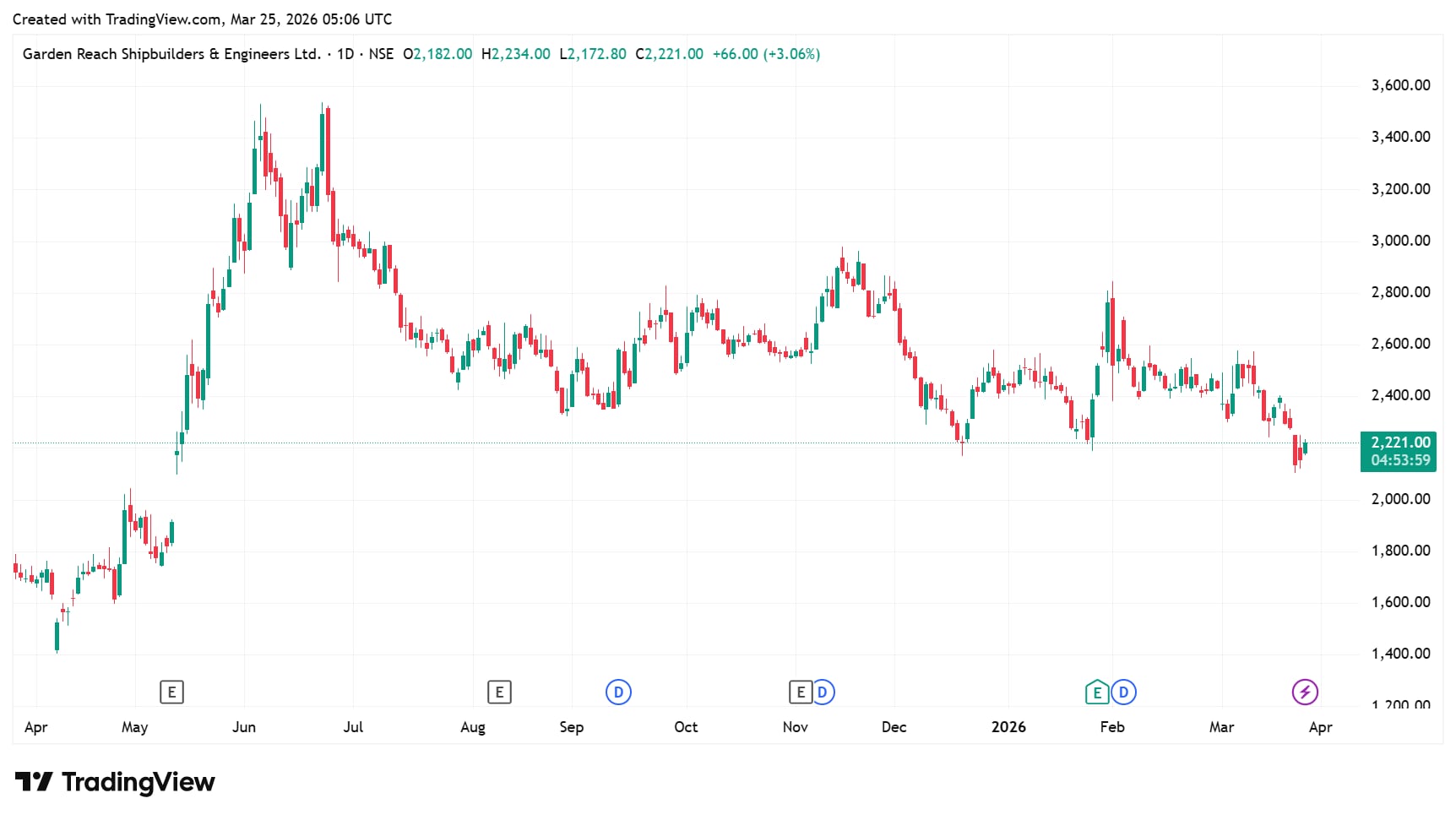
Revenue grew 42% year-on-year to ₹4,883 crore in 9MFY26, driven by strong physical execution across ongoing naval programmes. Operating profit more than doubled to ₹440 crore, up from 200 crore in the year-ago period. Net profit surged by 57% to ₹445 crore.
#3 Cochin Shipyard: Anchoring India’s ₹2.2 Lakh Crore Maritime Vision 2047
Cochin Shipyard(CSL)is engaged in shipbuilding, ship repair, and advanced marine engineering for both domestic and international markets. CSL operates a highly diversified and complex fleet of vessels, serving both the defence and commercial sectors.
The Commercial Pivot: Tapping into the ₹15,000 Crore Annual Market
The Indian commercial shipbuilding segment is a highly lucrative opportunity for the company, estimated at ₹12,000-15,000 crore per year. Key growth drivers in this sector include container vessels, coastal shipping, dredgers, ferries and cruises, as well as oil and gas carriers.
Order Pipeline of 437 Vessels Worth ₹223,570 Crore
The long-term outlook for commercial shipbuilding in India is extraordinarily robust. According to the vessel acquisition programme by Indian companies slated for 2047, the total pipeline stands at 437 vessels, valued at ₹223,570 crore.
The Hyundai Synergy: Securing Tech for High-Value LNG Vessels
To successfully meet the technical qualifications for these commercial orders, CSL is leveraging its partnership with the South Korean shipbuilding giant HD KSOE (Hyundai Heavy Industries). CSL is planning to deepen this relationship by establishing a new shipyard through a 50:50 joint venture with KSOE.
CSL’s current order book stands at ₹23,000 crore, largely driven by recent prestigious global and domestic wins. It secured a major order worth ₹3,240 crore from CMA, the world’s third-largest shipping company, to build six LNG-powered containerships.
This will be executed in technical cooperation with HD Hyundai Heavy Industries and is slated for delivery between 2029 and 2031. CSL is the lowest bidder for the construction of five ‘Next Generation Survey Vessels’ for the Indian Navy at a cost of ₹5,000 crore.
Revenue Visibility: Decoding the ₹94,000 Crore Future Pipeline
This order is expected to boost CSL’s order book by 21%, bringing its total value to ₹28,000 crore. The company’s order win potential from the known pipeline is incredibly robust, estimated at ₹94,000 crore, which translates to 18.1 times its projected FY26 revenue.
CSL is expected to be a major contender for the highly anticipated Landing Platform Dock order, with a potential value of ₹17,000 crore. The Shipping Corporation of India has floated an Expression of Interest (EoI) for eight Very Large Gas Carriers valued at around ₹9,000 crore.
Under this EoI, two of the VLGCs must be built at an Indian shipyard with a technical tie-up to a global shipyard. CSL’s strategic tie-up with KSOE strongly positions it to meet these technical qualifications and capture this lucrative commercial shipbuilding opportunity.
9MFY26 Financials: Navigating Execution Growth and Margin Pressure
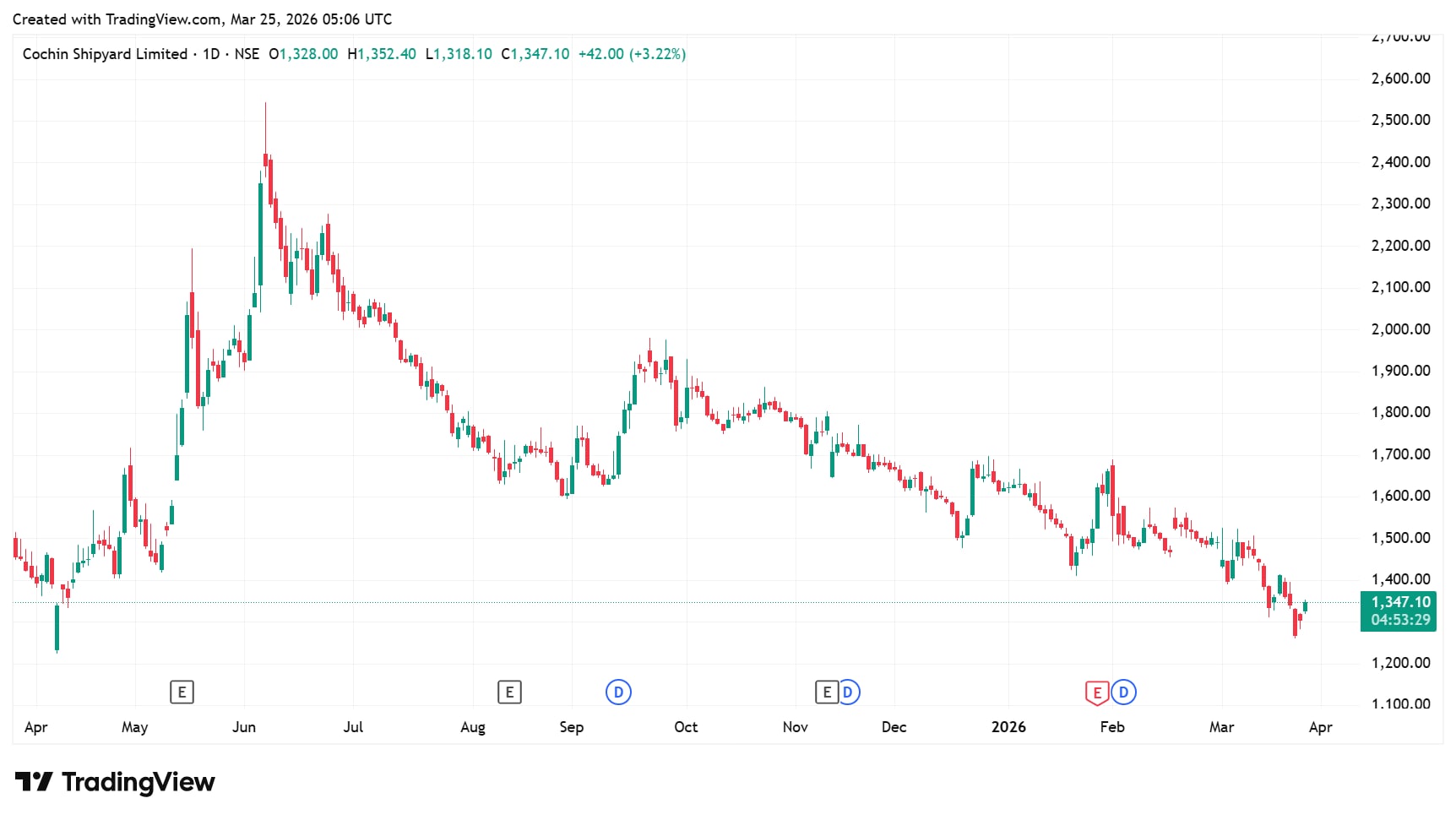
From a financial perspective, revenue grew 8% year-on-year to ₹3,093 crore in 9MFY26, driven by order book execution. Operating profit fell 26% to ₹456 crore, while margin declined 690 bps to 14.7%. Net profit declined by 23% to ₹427 crore.
The Valuation Gap
Mazagon’s return ratios (Return on Capital Employed and Return on Equity) are the strongest among peers, followed by GRSE and Cochin. However, following the recent correction, valuations have moderated. GRSE is trading in line with its historical and industry multiples, whereas Mazagon continues to trade at a premium to its 5-year median multiple.
| Valuation Comparison (X) | |||||
| Company | P/E | 5Y P/E | Industry P/E | RoCE (%) | RoE (%) |
| GRSE | 35.8 | 31.2 | 51.9 | 36.6 | 27.6 |
| Mazagon | 37.8 | 28.5 | 37.8 | 43.2 | 34.0 |
| Cochin Shipyard | 48.3 | 35.6 | 37.8 | 20.4 | 15.8 |
| source: screener.in | |||||
Cochin continues to trade at a higher multiple, primarily due to lower profitability.
India’s ₹70,000 crore shipbuilding push is no longer a distant ambition, but it is unfolding gradually. Order pipelines remain strong, execution is improving, and capacity is expanding. Yet, valuations already reflect much of this optimism. It’s worth keeping them in your watchlist.
Disclaimer:
Note: Throughout this article, we have relied on data from http://www.Screener.in and the company’s investor presentation. Only in cases where the data were unavailable have we used an alternate, widely accepted, and widely used source of information.
The purpose of this article is only to share interesting charts, data points, and thought-provoking opinions. It is NOT a recommendation. If you wish to consider an investment, you are strongly advised to consult your advisor. This article is strictly for educational purposes only.
About the Author: Madhvendra has been deeply immersed in the equity markets for over seven years, combining his passion for investing with his expertise in financial writing. With a knack for simplifying complex concepts, he enjoys sharing his honest perspectives on startups, listed Indian companies, and macroeconomic trends.
A dedicated reader and storyteller, Madhvendra thrives on uncovering insights that inspire his audience to deepen their understanding of the financial world.
Disclosure: The writer and his dependents do not hold the stocks discussed in this article.
The website managers, their employees (s), and contributors/writers/authors of articles have or may have an outstanding buy or sell position or holding in the securities, options on securities, or other related investments of issuers and/or companies discussed therein. The articles’ content and data interpretation are solely the personal views of the contributors/ writers/authors. Investors must make their own investment decisions based on their specific objectives, resources, and only after consulting such independent advisors as may be necessary.