




While public markets remain fixated on the infrastructure and defence cycles, the final frontier (Space) is quietly undergoing a policy-led structural shift.
In fact, the government established the Indian National Space Promotion and Authorisation Center in 2020 as part of its effort to reform the sector. Its role is to encourage private sector involvement in the space sector.
The government also approved a ₹1,000 crore venture capital fund to support the sector. This fund aligns with the government’s aim of promoting innovation and supports the Atmanirbhar Bharat goal.
The annual investment range is projected to be between ₹150-250 crore during FY26-30. These initiatives are expected to expand the sector’s size.
The ₹4 lakh crore trajectory: Decoding India’s space economy targets
According to the Indian government, the Indian space economy was valued at about US$8.4 billion (as of October 2024), representing a 2% share of the global space market. It aims to expand the space economy to US$44 billion (around ₹4 lakh crore) by 2033, including US$11 billion in exports, amounting to 7-8% of the global share.
This growth is expected to be driven by private-sector participation. To support this growth, the Indian government has increased the space budget by 144% (from ₹5,615 crore in FY14 to ₹13,705 crore in FY27). This article examines three private players that are expected to benefit from this scope.
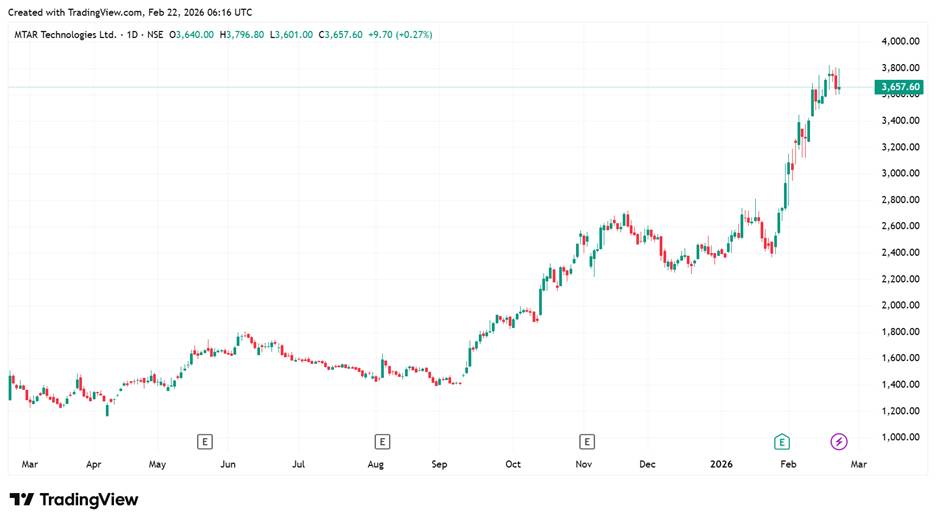
#1 MTAR: The liquid propulsion specialist
MTAR Technologies is a key player in the space sector, with a four-decade association with the Indian Space Research Organization (ISRO). It specializes in manufacturing mission-critical, precision-engineered subsystems for space launch vehicles. This includes the Polar Satellite Launch Vehicle (PSLV) and the Geosynchronous Satellite Launch Vehicle (GSLV).
A four-decade alliance with ISRO
Its current product portfolio supplied to ISRO includes Liquid Propulsion Engines, Cryogenic Upper Stage Subsystems, Electro-Pneumatic Modules, and Mission-Specific Structures. Of these, Mission-Specific Structures (Grid Fin Structures) and Precision Components have been key to ISRO’s flagship missions, including Chandrayaan-3 and Aditya-L1.
Scaling payloads: The semi-cryo engine ambition
To increase its wallet share with ISRO, MTAR is actively developing next-generation technologies and expanding its offerings. MTAR is contributing to the development of the Semi-Cryo engine, designed to increase the GSLV’s payload capacity from 4 tonnes to 6 tonnes.
The company has recently submitted a tender for the supply of launch vehicle actuation systems and is developing space-grade valves to specification. Leveraging its advanced sheet-metal facility, MTAR is pursuing new manufacturing opportunities for motor casings, thrust chambers, and light-alloy structures.
The ₹120 crore space order book
MTAR anticipates over 20% revenue growth, specifically from its space systems segment, driven by the increasing frequency of ISRO commercial launches and private-sector investments. The space sector’s share in the total order book of ₹325 crore for aerospace and defence was ₹120 crore. MTAR has also added global corporations like Thales Alenia Space to its client portfolio.
#2 Data patterns: Radars and deep space tracking
Data Patterns is also a long-standing partner of ISRO. It operates as a fully integrated defence and aerospace electronics solution provider. It possesses strong domain expertise in satellites, satellite subsystems, and associated test equipment.
Vertically integrated electronics for Nano-Satellites
The company focuses on the design and production of Small and Nano Satellites. Beyond the spacecraft, its space sector capabilities extend to developing communication systems for satellite platforms and building complete satellite ground stations.
The successful design, construction, and deployment of the nano satellite in 2017 was a major milestone for the company. Its approach relies on creating in-house-designed building blocks that retain intellectual property, enabling it to deliver highly reliable, end-to-end electronic systems that meet the stringent standards of aerospace and space organisations.
Deep space surveillance: The alpha and bravo edge
Data Patterns has directly contributed to space launch operations by designing and developing a launch pad countdown system. It has built some of India’s most advanced radars, specifically tailored for deep space monitoring.
Alpha Radar (S-Band Space Surveillance and Tracking Radar) is one of the largest radars ever built in India. It is housed in a massive 20-meter spherical radome and used to track and discriminate deep-space targets over thousands of kilometers.
It provides broad coverage across the entire volume spectrum in space, capable of ±270 degrees of rotation in azimuth and ±90 degrees in elevation.
Bravo Radar (UHF Bi-Static Radar) is also used to detect deep-space targets over thousands of kilometers. It is a digital beam-forming, continuous-wave phased array radar. Data Patterns implemented this as a complete turnkey project. This encompasses everything from separate transmit and receive sites to the necessary civil, electrical, and road works.
The clean room advantage
To support the highly sensitive, precise work required in space technology, Data Patterns has built specialized, state-of-the-art infrastructure. This includes a dedicated clean room for satellite integration, ensuring the contamination-controlled environment required to assemble high-reliability aerospace and satellite components.
#3 Apollo Micro Systems: From payload checkouts to telemetry
Apollo Micro Systems (AMS) plays a key role in the space sector by providing mission-critical technology. AMS delivers mission-critical electronic and electromechanical solutions for satellite and space systems. Its offerings include subsystem-level components specifically tailored for space-qualified performance, ensuring robustness and mission success in orbit.
COTS solutions: Bringing industrial efficiency to space
The company develops Commercial Off-the-Shelf solutions that are specially designed and configured to meet the operational conditions and unique requirements of the space industry. AMS has deep expertise in creating advanced Payload Checkout Systems and Telemetry Systems for critical space programs.
A legacy of indigenous innovation
In 1997, AMS delivered its first indigenous payload checkout system to ISRO. Then, in 2005, it launched telemetry products specifically designed for ISRO applications. In 2021, AMS was felicitated by the U. R. Rao Satellite Centre (URSC), formerly known as the ISRO Satellite Centre.
Targeting 2035: The Bharat Antariksh station opportunity
AMS is well-positioned to benefit from major macroeconomic changes in the space sector. The global space economy is projected to reach US$1.8 trillion in valuation by 2035. While India aims to increase its share of the global space economy to 8% by 2030 and 15% by 2047.
The sector growth will be driven by major national initiatives, including the Aditya-L1 solar mission, the Venus Orbiter Mission (VOM), Chandrayaan lunar sample missions, and the goal to establish the “Bharat Antariksh Station” by 2035.
It states that over the last two decades, the cost of space launches worldwide has decreased tenfold, vastly increasing market accessibility. Satellite sizes are shrinking while capabilities are expanding (e.g., 15-centimeter resolution for Earth observation). Consequently, the number of satellites launched annually has grown by 50% over the last 20 years.
The valuation trap: Why high P/E ratios demand caution
MTAR Tech’s valuation (price-to-earnings multiple) is well above both the industry median and its historical multiple. This is despite modest return ratios: return on capital employed (RoCE) of 10.5% and return on equity (RoE) of 7.5%.
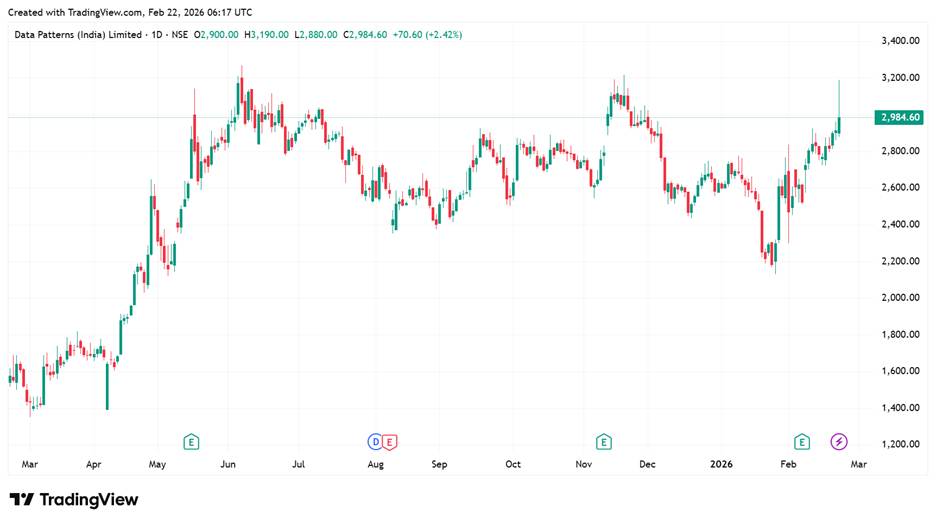
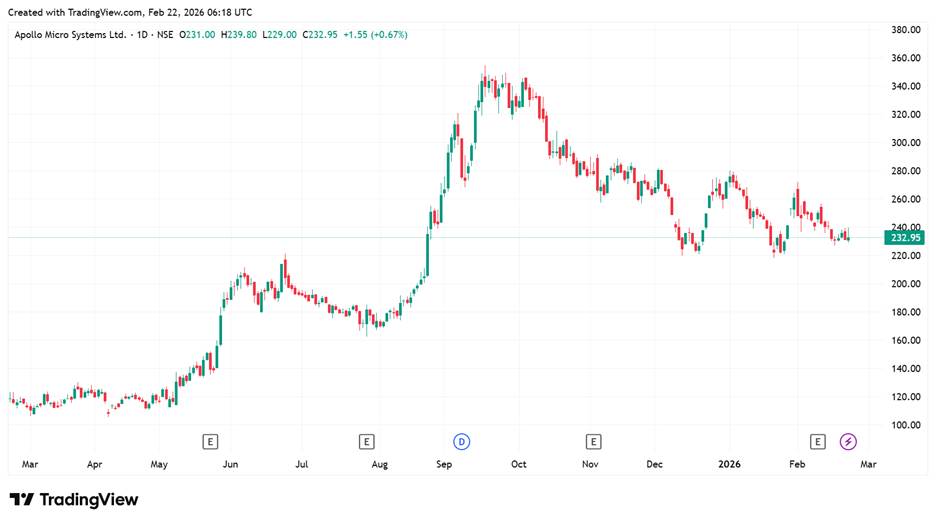
Data Patterns multiples are also at a premium to the industry and almost in line with its own median multiple. Apollo is trading at a premium to the industry, too.
| Valuation Assessment (X) | ||||
| Company | P/E | 3 Year Median P/E | RoCE (%) | RoE (%) |
| MTAR | 166.0 | 88.6 | 10.5 | 7.5 |
| Data Patterns | 67.0 | 72.7 | 21.0 | 15.2 |
| Apollo Micro | 93.2 | 83.6 | 14.0 | 10.0 |
| Industry P/E | 58.9 | 18.7 | 14.4 | |
India’s space economy aims to scale to ₹4 lakh crore by 2033, driven by policy reforms, higher budget allocation, and private participation. MTAR, Data Patterns, and Apollo Micro Systems are positioned to benefit, though elevated valuations contrast with moderate return ratios. How the opportunity evolves will be interesting to see. Until then, keep them on your watchlist.
Disclaimer
Note: Throughout this article, we have relied on data from http://www.Screener.in and the company’s investor presentation. Only in cases where the data were unavailable have we used an alternate, widely accepted, and widely used source of information.
The purpose of this article is only to share interesting charts, data points, and thought-provoking opinions. It is NOT a recommendation. If you wish to consider an investment, you are strongly advised to consult your advisor. This article is strictly for educational purposes only.
About the Author: Madhvendra has been deeply immersed in the equity markets for over seven years, combining his passion for investing with his expertise in financial writing. With a knack for simplifying complex concepts, he enjoys sharing his honest perspectives on startups, listed Indian companies, and macroeconomic trends.
A dedicated reader and storyteller, Madhvendra thrives on uncovering insights that inspire his audience to deepen their understanding of the financial world.
Disclosure: The writer and his dependents do not hold the stocks discussed in this article.
The website managers, its employee(s), and contributors/writers/authors of articles have or may have an outstanding buy or sell position or holding in the securities, options on securities or other related investments of issuers and/or companies discussed therein. The articles’ content and data interpretation are solely the personal views of the contributors/ writers/authors. Investors must make their own investment decisions based on their specific objectives, resources, and only after consulting such independent advisors as may be necessary.