



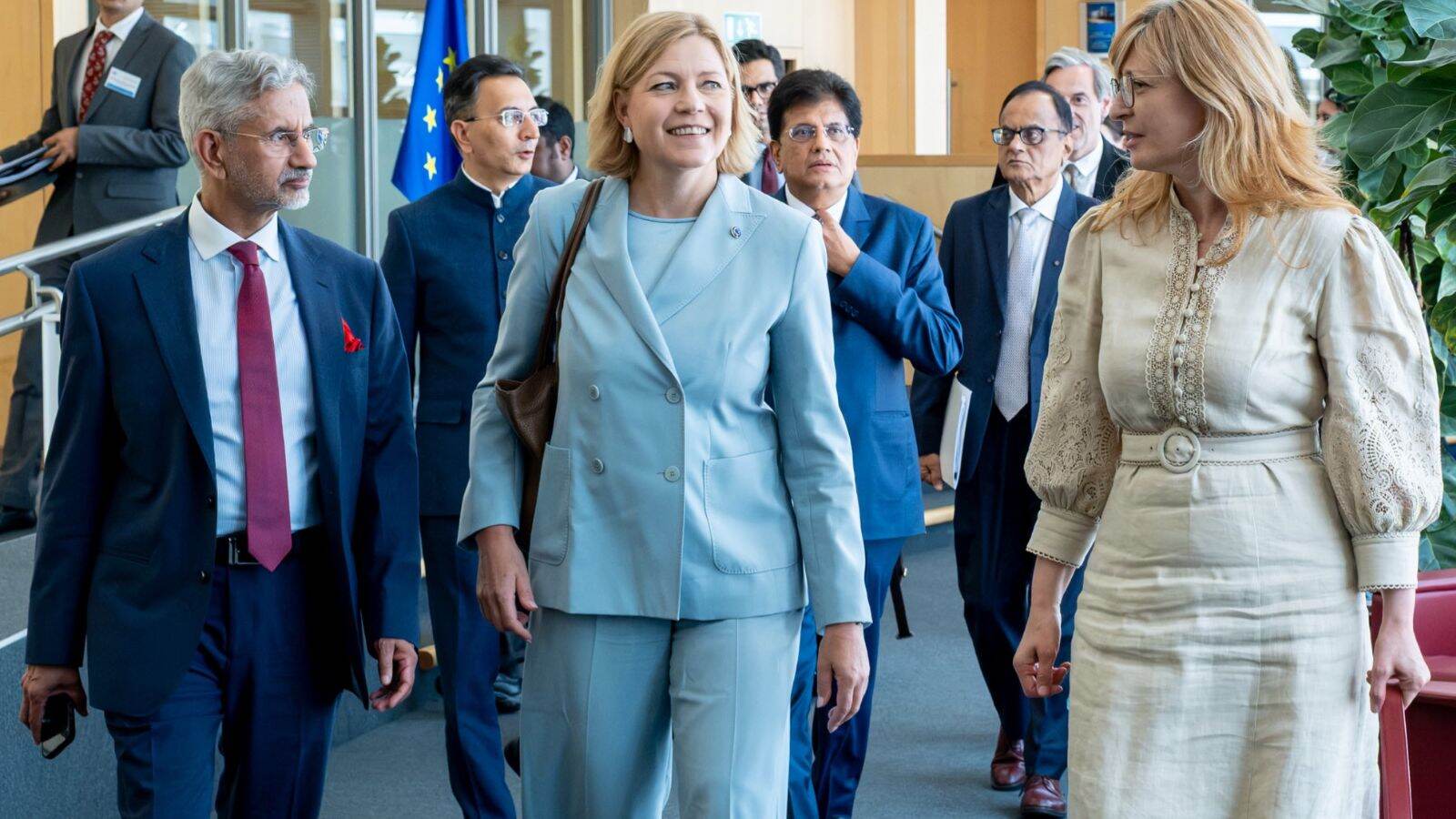
External Affairs Minister S. Jaishankar on Wednesday said trusted partnerships like the one between India and the European Union are becoming more important as the global economy faces supply chain disruptions, market access challenges and technology gaps.
Speaking after the third India-EU Trade and Technology Council (TTC) meeting in Brussels, Jaishankar said both sides reviewed cooperation in strategic technologies, clean energy, trade, investments and resilient supply chains.
“As the international economy faces supply chain chokepoints, market access issues and technology gaps, trusted and reliable partnerships like that of India and EU show the way forward,” he said in a post on X.
The meeting produced several new initiatives across three major areas.
Read joint statement here:
Joint statement on the third meeting of the India-EU Trade and Technology Council | The India-EU Trade and Technology Council (TTC) met for the third time, in Brussels, on 15 July 2026.
— ANI (@ANI) July 15, 2026
India and the European Union reaffirm their shared commitment to deepening digital… pic.twitter.com/UugLWYcpA7
AI, semiconductors and digital technology
India and the EU agreed to work on a Joint Artificial Intelligence Roadmap and share best practices on responsible AI, including in healthcare.
Both sides will expand cooperation in semiconductors, quantum technologies, high-performance computing and 6G, while strengthening secure semiconductor supply chains.
Concluded a productive meeting of the India – EU Trade and Technology Council alongside CIM @PiyushGoyal, MoS MEITY @JitinPrasada and Principle Scientific Advisor Prof Ajay K Sood.
— Dr. S. Jaishankar (@DrSJaishankar) July 15, 2026
Thank EVP @HennaVirkkunen, Commissioners @EZaharievaEU and @MarosSefcovic, for their useful inputs… pic.twitter.com/9yI5qwZCYy
A joint semiconductor roundtable will be held during Semicon India 2026, and both sides will also explore linking India’s DigiLocker with the EU Digital Identity Wallet through a pilot project.
Green energy gets a boost
India and the EU will begin formal negotiations for India’s entry into Horizon Europe, the EU’s €93.5-billion research programme, to complete the process before the end of 2026.
The two sides also announced their first India-EU Innovation Hub for EV charging and testing.
€60 million research partnership expands
The two sides reviewed ongoing research projects backed by a joint investment of €60 million over four years.
These projects include producing renewable hydrogen from agricultural and industrial waste, using AI-powered systems and advanced biosensors to monitor marine pollution, and recycling electric vehicle batteries to recover critical raw materials.
India and the EU also agreed to continue cooperation on hydrogen safety standards, Hydrogen Valleys, electric mobility and other green technologies. Experts from both sides will exchange knowledge on hydrogen projects during the second half of 2026.
Speaking to the press after the 3rd India – EU Trade and Technology Council meeting.
— Dr. S. Jaishankar (@DrSJaishankar) July 15, 2026
🇮🇳 🇪🇺 https://t.co/T97ICBlVgy
Trade and supply chains
Both sides agreed to boost supply chains in pharmaceuticals, agri-food and clean technologies while continuing efforts to reduce trade barriers. India and the EU also backed reforms at the World Trade Organisation (WTO) and discussed market access issues, technical regulations and food safety standards.
The meeting also cleared plans for a Deep-Tech Startup Partnership, an annual India-EU Business Forum and a Blue Valleys platform to connect industries, startups and regulators.
Startups and businesses to get more opportunities
The meeting also resulted in several initiatives aimed at businesses and startups.
India and the EU agreed to launch a Deep-Tech Startup Partnership involving organisations such as the European Innovation Council and Start-Up India. The partnership will help startups access new markets and commercialise innovative technologies.
The two sides also agreed to explore a dedicated platform under the Blue Valleys initiative to develop sector-specific industrial clusters by bringing together regulators, industries, startups and other stakeholders.
In addition, the India-EU Business Forum will now be held every year, along with regular industry-level meetings focused on priority sectors.
Next TTC meeting in New Delhi
The ministers directed all three TTC working groups to move ahead with the agreed action plans and regularly report on their progress. The next ministerial meeting of the India-EU Trade and Technology Council will be held in New Delhi in 2027 as both sides look to deepen their strategic partnership in trade, technology and security.