



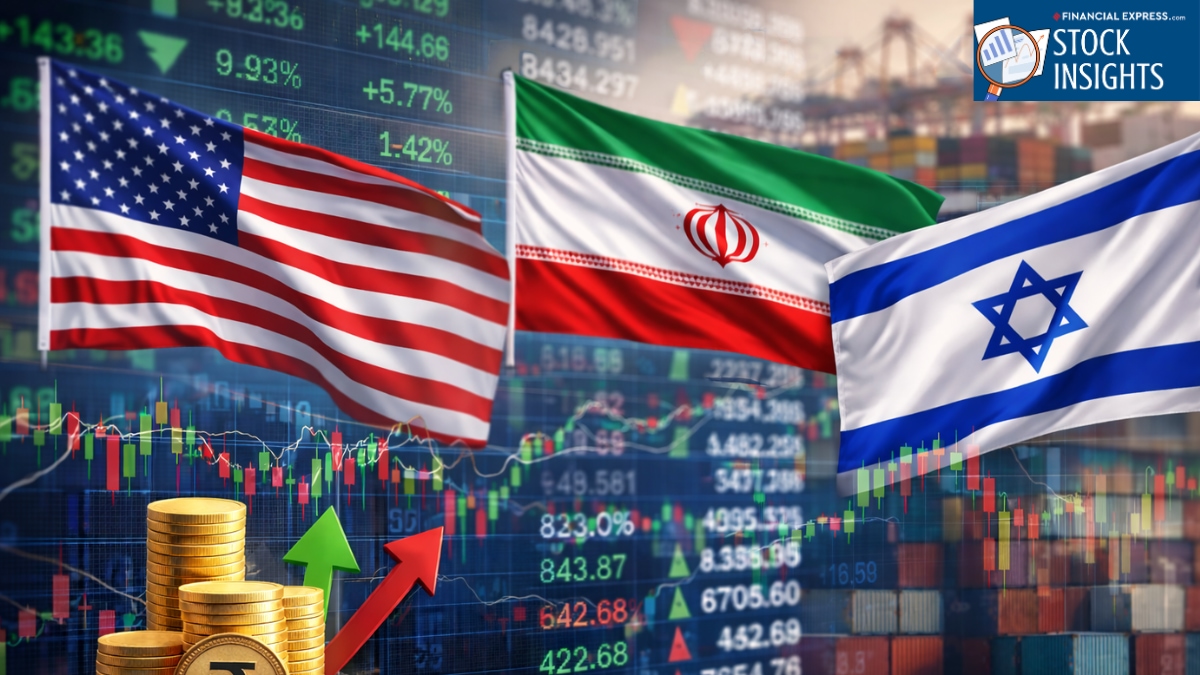
Rising geopolitical tensions between the US, Iran, and Israel have increased risk in global markets, particularly in sectors tied to energy, exports, and regional economic activity.
The Middle East remains strategically important because it supplies a large share of the world’s crude oil and supports major trade flows.
Nearly 20–25% of global crude passes through the Strait of Hormuz, and disruptions to this route can push up energy prices.
For India, the region is critical; a majority of its crude oil imports travel through the Strait of Hormuz and Suez Canal, while any disruption can increase inflation and cost pressures.
Such developments can directly affect companies through higher input costs, delayed project execution, demand fluctuations, currency volatility, and supply chain disruptions.
In this editorial, we cover four stocks with business exposure to the Middle East.
#1 Bharat Electronics Ltd
Bharat Electronics Limited (BEL) is a government-owned defence electronics company. It is one of India’s leading manufacturers of aerospace and military electronics.
The company develops and produces radar systems, missile systems, communication equipment, electronic warfare systems, and naval defence equipment.
Apart from defence, BEL also manufactures selected civilian products. These include electronic voting machines, smart city security systems, homeland security solutions, and certain medical electronics.
Around 74% of its revenue comes from products developed within India, reflecting its focus on domestic manufacturing and technology development.
BEL has an overseas presence, including an office in Muscat, Oman. The company exports defence systems to countries such as Oman and Israel.
It also works with regional defence companies like Israel Aerospace Industries (IAI) and Elbit Systems. BEL has formed a joint venture with IAI to support specific missile systems.
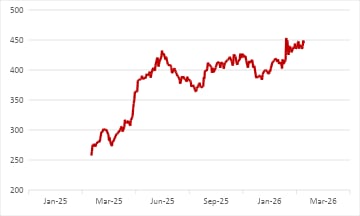
In Q3 FY26, consolidated revenue increased 23.9% to Rs 71,538.5 million (m). Net profit rose 20.4% to Rs 15,797 m. For the first nine months of FY26, EBITDA margin stood at 30%, reflecting improved operational efficiency and strong execution of defence orders.
Bharat Electronics Share Price 1-Year
Source: BSE
#2 Bharat Heavy Electricals Ltd
Bharat Heavy Electricals Limited (BHEL) was established in 1964 and is one of India’s major public sector engineering and manufacturing companies.
Its product portfolio covers thermal, hydro, nuclear, and solar power generation equipment.
Apart from power, BHEL also manufactures systems for power transmission, rail transportation, defence, and aerospace.
Over the years, it has played a key role in India’s power capacity addition. The company has recently expanded into new segments such as Vande Bharat train manufacturing and advanced defence equipment like Super Rapid Gun Mounts.
BHEL currently has an order book of more than Rs 2,196 bn, which provides revenue visibility over the coming years. Its business is largely driven by government and large infrastructure projects.
BHEL has a presence in 91 countries. In the Middle East and nearby regions, it operates in Iran, Iraq, Jordan, Kuwait, Oman, Saudi Arabia, and the UAE. Iran is specifically listed among its overseas markets.
It has financial exposure in certain conflict-affected regions. For example, around Rs 2.11 bn remains overdue in Sudan due to the ongoing civil war.
In Q3 FY26, consolidated revenue rose to Rs 84,731 m from Rs 72,770.9 m in Q3 FY25.
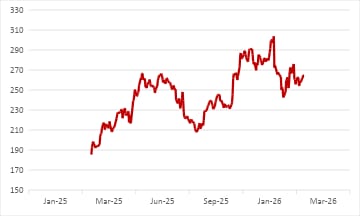
Net profit increased to Rs 3,904 m from Rs 1,347 m year-on-year. Net profit margin improved from 1.85% to 4.61%, supported by higher execution and better operating performance.
Bharat Heavy Electricals Share Price 1-Year
Source: BSE
#3 Kalyan Jewellers Ltd
Kalyan Jewellers was established in 1993 by T.S. Kalyanaraman. Over the years, it has become one of India’s large organised jewellery retailers. Its product portfolio includes gold jewellery, diamond-studded jewellery, and precious stone collections.
The company serves different customer segments through focused sub-brands. The Muhurat brand is positioned for wedding jewellery. Mudhra and Rang cater to customers looking for premium and design-focused collections. Aishwaryam targets value-conscious buyers, while Nimah focuses on traditional heritage designs.
it follows a hyperlocal business model. This means it customises store inventory based on regional tastes, wedding traditions, and cultural preferences. This approach helps the company connect better with customers across different states and communities.
Kalyan Jewellers entered the Middle East market in 2013 as part of its international expansion. It operates in the UAE, Qatar, Oman, and Kuwait via regional subsidiaries. It had 253 jewellery showrooms in India and 36 in the Middle East. By late 2025, its Middle East showroom count increased to 38.
The presence in Gulf countries also gives the company access to a large Indian diaspora customer base.
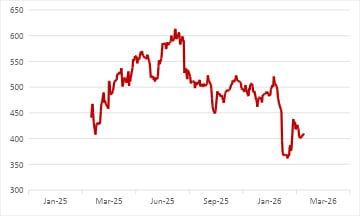
In Q3 FY26, revenue increased 42% YoY to Rs 103,434 m. Net profit rose 90% to Rs 4,163 m.
EBITDA margin improved from 5.9% to 7.3% compared to last year, supported by strong sales growth and operating leverage.
Kalyan Jewellers Share Price 1-Year
Source: BSE
#4 AIA Engineering Ltd
AIA Engineering manufactures high-chromium, wear-resistant castings used in grinding and crushing processes. It offers industrial engineering solutions to business clients across heavy industries.
Its core products include grinding media (metal balls), mill liners, and diaphragms. These products are used in mining (gold, copper, iron ore), cement, thermal power plants, and quarries.
The company has also expanded into rubber and composite liners to offer more complete solutions instead of selling individual parts.
AIA focuses on improving efficiency for its clients by using in-house research and custom-designed metallurgy. This helps customers increase output and reduce operating costs.
With more than 40 years of experience, the company exports to over 120 countries. Its business model is largely export-driven, and it works closely with mining and cement companies globally.
The Middle East plays a key role in AIA Engineering’s business. About 60% of its revenue comes from its Middle Eastern subsidiary in the UAE, Vega Industries (Middle East) FZC. It manages international marketing, customer relationships, and delivery coordination.
Apart from the UAE, AIA has exposure to North America, South America, Africa, and Australia.
The company recently secured a 15,000-ton order in Chile, strengthening its presence in South America.
To manage freight costs and reduce trade risks, AIA is setting up local manufacturing facilities in China and Ghana.
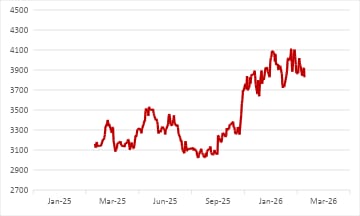
In the latest quarter, consolidated revenue remained almost flat at Rs 10,668.9 m due to shipping disruptions and trade barriers.
Net profit increased 13.5% YoY to Rs 2,944.2 m. EBITDA margin improved to 39.89%, supported by a better product mix and foreign exchange gains.
AIA Engineering Share Price 1-Year
Source: BSE
Conclusion
These four companies operate in very different sectors, but each has exposure to the Middle East either through exports, subsidiaries, or defence partnerships.
In a period of geopolitical tension, investors should closely track oil prices, currency movements, government defence spending, and trade disruptions.
Order books, export contribution, and working capital cycles become important indicators. Risks such as payment delays, shipping disruptions, and regional instability should not be ignored.
Investors should align any investment with their risk appetite, time horizon, and overall portfolio allocation before making any decision.
Disclaimer: This article is for information purposes only. It is not a stock recommendation and should not be treated as such. Learn more about our recommendation services here…
The website managers, its employee(s), and contributors/writers/authors of articles have or may have an outstanding buy or sell position or holding in the securities, options on securities or other related investments of issuers and/or companies discussed therein. The content of the articles and the interpretation of data are solely the personal views of the contributors/ writers/authors. Investors must make their own investment decisions based on their specific objectives, resources and only after consulting such independent advisors as may be necessary