



The ‘Smart Money’ Divergence
Every quarter, the shareholding filings tell two stories at once. One is about the companies. The other, often more interesting, is about the people buying them.
The latest filings carry a striking pair. Mukul Mahavir Agrawal, the founder of Param Capital and one of the most tracked names in the market with 72 disclosed holdings with over Rs 7,380 cr, has taken a fresh 1.59% stake in Arisinfra Solutions, a construction materials platform trading at nearly half below its IPO price. And Akash Bhanshali of Enam Holdings has raised his Greenlam Industries stake for the third time since 2023, taking it to 4.5% as of the June 2026 quarter.
Two very different companies. One common thread. In both cases, the buying happened while most of the market was looking the other way. That alone makes these positions worth a closer look. Let’s dive in.
#1 Arisinfra Solutions: The Broken B2B IPO That Found Profitability
Incorporated in 2021, Arisinfra Solutions is a B2B platform that supplies construction materials in bulk to real estate and infrastructure developers. Think of it as an organised middleman for cement, steel and aggregates, using technology to cut out the layers of brokers that builders usually deal with.
The company has a current market cap of Rs 973 cr and was listed in June 2025 at an issue price of Rs 222 and slipped on debut. It has not recovered since. At around Rs 119 as of mid-July 2026, it trades roughly 46% below its IPO price.
That is exactly where Mukul Agrawal showed up. Per the exchange filings for the quarter ending June 2026, he holds a 1.59% stake in the company, worth roughly Rs 16 cr at the current market cap. He was not alone. Motilal Oswal Financial Services bought a 5.06% stake through a bulk deal on 28th April 2026.
Tracking the Exodus: Why Retail Investors Fled Arisinfra
The shareholding data reads like a changing of the guard. The number of shareholders has dropped from 42,706 in June 2025 to 32,716 by March 2026. Foreign investors, who held 9.79% at listing, were down to 1.94% by the June 2026 quarter. Promoter holding has eased slightly, from 37.93% to 37.59%.
So, retail left, foreign money left, and the stock kept falling. Which makes us wonder, what did Agrawal see? Probably the profit and loss account, which has been moving in the opposite direction to the share price.
| Financial Year | FY22 | FY23 | FY24 | FY25 | FY26 | 4Y CAGR |
| Sales (Rs cr) | 452 | 746 | 697 | 768 | 1,067 | 24% |
| EBITDA (Rs cr) | -1 | -1 | 13 | 50 | 101 | NM |
| Net Profit (Rs cr) | -6 | -15 | -17 | 6 | 60 | NM |
EBITDA here refers to operating profit before other income. The sales grew at a compounded rate of 24% in the last 4 years. The CAGR column is marked NM or not meaningful for EBITDA and Profit, because the company was making losses until FY24. Growth rates calculated from a loss year would be misleading, so the year-by-year picture is the honest way to read this business.
And that picture is clear enough. Sales grew 39% in FY26 to Rs 1,067 cr. Operating profit doubled from Rs 50 cr to Rs 101 cr. Net profit jumped from Rs 6 cr to Rs 60 cr. Every quarter of FY26 was better than the one before it, ending with Rs 22 cr of net profit in the March 2026 quarter alone.
Debt Reduction and Cash Flow: Inside the Clean FY26 Balance Sheet
The IPO did what it promised. Around Rs 205 cr of the Rs 500 cr raised went into repaying debt, and borrowings collapsed from Rs 343 cr in FY25 to just Rs 70 cr in FY26. Annual interest cost fell from Rs 41 cr to Rs 28 cr, and the quarterly run rate has more than halved. Cash flow from operations turned positive at Rs 142 cr in FY26, the strongest in the company’s short history. ROCE for FY26 stood at 15.6%.
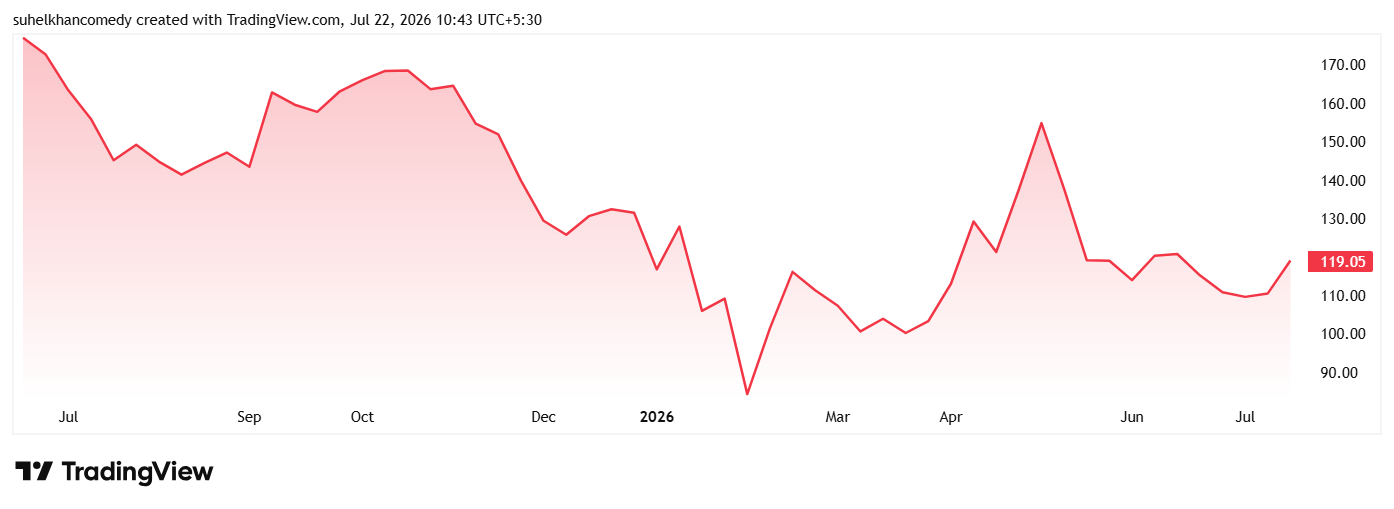
As for valuation, the stock is trading at a PE of 18x which is same as the current industry median as well. The company has barely one year of trading history, so no long-term valuation benchmark exists yet. That cuts both ways. There is no anchor to say the stock is cheap, and none to say it is expensive.
Beyond the Profit Jump: Auditor Exit and Working Capital Risks
Three things deserve attention before anyone gets carried away. First, statutory auditor Price Waterhouse resigned in May 2026, citing a fee disagreement, and MSKC & Associates has been appointed in its place. Auditor exits in young, listed companies always warrant scrutiny, whatever the stated reason. Second, debtor days stood at 140 in FY26. The company pays its suppliers faster than its builder clients pay it, which makes working capital the engine room of this business. Third, the 3-year average return on equity is still just 4.9%, a reminder of how recent the profitability is.
#2 Greenlam Industries: Akash Bhanshali’s Patient Capex Play
If Arisinfra is a fresh entry, Greenlam is the opposite. It is a position Akash Bhanshali has been building patiently, and mostly through pain.
Greenlam Industries makes laminates, decorative veneers, plywood and allied products. It was carved out of Greenply Industries in a demerger and listed in 2015. Promoters hold nearly 51%. It is one of the larger laminate exporters in the country, and it has spent the last four years building new capacity in plywood and particle board.
The company’s current market cap is about Rs 6,296 cr. Bhanshali first appeared on the register with 1.61% in June 2023. He raised it to 2.45% by December 2023, to 2.84% in June 2025, and to 3.23% as of the March 2026 quarter. Per the June 2026 filings this holding has gone up to nearly 4.5% and is worth Rs 277 cr. He has good company in the share register, with Ashish Dhawan, founder of ChrysCapital, holding 3.77% and Vallabh Bhanshali also holding 1.15% as of the same filing.
The Short-Term Cost of a ₹1,749Cr Expansion
Here is what Bhanshali kept buying through. Between FY23 and FY25, Greenlam’s fixed assets more than tripled from Rs 506 cr to Rs 1,749 cr as its new plants came up. Borrowings nearly doubled from Rs 628 cr to Rs 1,199 cr. Annual interest cost went from Rs 23 cr in FY22 to Rs 96 cr in FY26. Depreciation more than doubled from Rs 63 cr to Rs 142 cr over the same stretch.
The result shows up plainly in the table below. Sales kept compounding, and profit went the other way.
| Financial Year | FY21 | FY22 | FY23 | FY24 | FY25 | FY26 | 5Y CAGR |
| Sales (Rs cr) | 1,200 | 1,703 | 2,026 | 2,306 | 2,569 | 3,046 | 20% |
| EBITDA (Rs cr) | 174 | 188 | 233 | 296 | 275 | 325 | 13% |
| Net Profit (Rs cr) | 74 | 91 | 129 | 138 | 68 | 56 | -5% |
EBITDA here refers to operating profit before other income, and the CAGR figures are computed from the FY21 to FY26 numbers shown. That negative profit CAGR is not a demand problem. It is the cost of servicing and depreciating a factory base built for a much larger business than the one that exists today.
The March 2026 Breakout: The Record ₹108Cr Operating Profit
The March 2026 quarter is why the patience argument suddenly has numbers behind it. Sales came in at Rs 858 cr, up 26% year on year. Operating profit rose to Rs 108 cr, the highest ever for a single quarter. Net profit was Rs 41 cr against just Rs 1 cr in the same quarter last year. When the results landed in late May, the stock jumped to a 52-week high of Rs 281.
Management has guided for the plywood and chipboard businesses to reach EBITDA breakeven by FY27, and said the full raw material cost increase was passed on to the market in April 2026. If those two things hold, the interest and depreciation load stops being a drag and starts being absorbed by a bigger profit pool. Free cash flow already turned positive at Rs 204 cr in FY26 after three negative years, and borrowings edged down for the first time since the capex began.
Valuation Check: Does Greenlam’s 109x PE Ratio Leave Room for Error?
The share price of Greenlam Industries was around Rs 135 in July 2021 and as on 22nd July 2026 it was Rs 247.
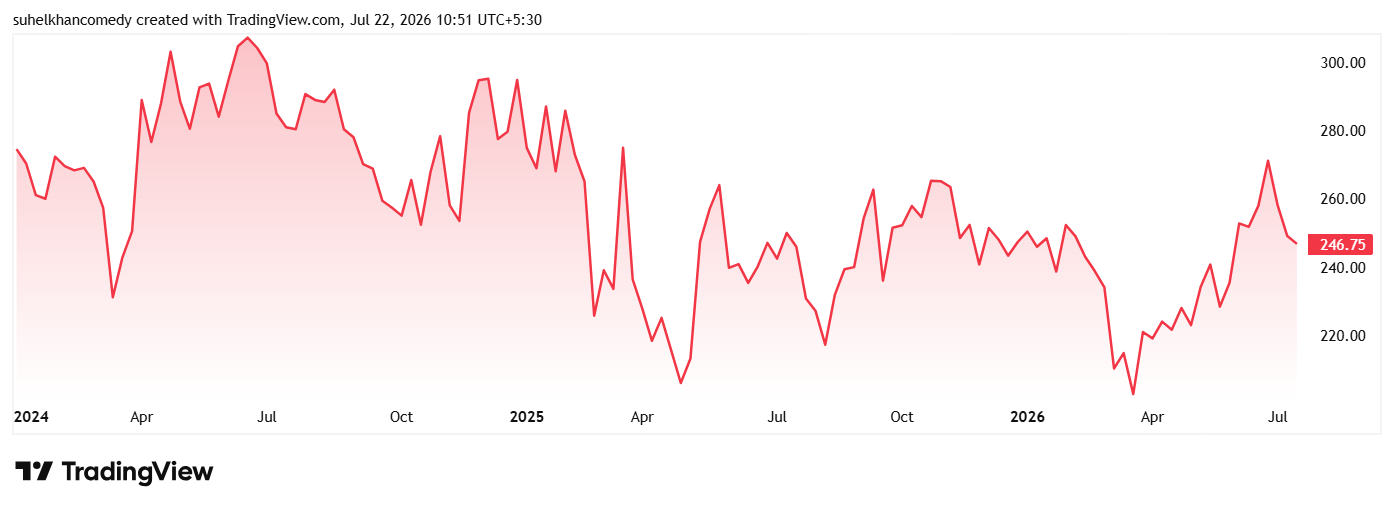
Now the uncomfortable part. Greenlam trades at a PE of about 109 and the current industry median is 40x. The 10-year median PE for the company is 40x while the industry median for the same company is 30x.
Now, while the 109 multiple looks alarming, please note that it is inflated by a depressed denominator. FY26 profit of Rs 56 cr is less than half the Rs 138 cr the company earned in FY24, before the interest and depreciation surge. The market is clearly pricing a recovery, not the present.
The longer arc offers some perspective. Over 10 years, sales have compounded at 11% and profit at just 5%, while the stock has delivered a 15% price CAGR. Shareholders have been paid for the franchise, not for recent earnings. Interest coverage remains low, return on equity for FY26 was just 5.11%, and net debt of around Rs 1,160 cr is not small for a company earning Rs 56 cr. If the plywood ramp-up stumbles, the stock has a long way to fall to meet its own numbers.
The Contrarian Playbook: Why Agrawal and Bhanshali Buy When Retail Panics
Agrawal bought a stock that retail investors and foreign funds spent a year abandoning, just as its profits turned real and its debt disappeared. Bhanshali kept adding to a company through the exact stretch when its reported profit was falling, because the thing destroying the profit was a factory that would eventually produce it.
Neither bet is completely safe. Arisinfra carries an auditor exit and a working capital heavy model. Greenlam carries a triple-digit PE and Rs 1,160 cr of debt. The super investors are not ignoring these risks. They are being paid to take them, in the form of prices that most buyers refused to touch.
For retail investors, the takeaway is not to copy either trade. It is to notice when the shareholding data and the share price are telling opposite stories, because that gap is usually where the interesting questions live. A smart way to do this could be to add these stocks to a watchlist and follow them closely.
Disclaimer:
Note: We have relied on data from http://www.Screener.in and http://www.trendlyne.com throughout this article. Only in cases where the data was not available, have we used an alternate, but widely used and accepted source of information.
The purpose of this article is only to share interesting charts, data points and thought-provoking opinions. It is NOT a recommendation. If you wish to consider an investment, you are strongly advised to consult your advisor. This article is strictly for educative purposes only.
Suhel Khan has been a passionate follower of the markets for over a decade. During this period, he was an integral part of a leading Equity Research organisation based in Mumbai as the Head of Sales & Marketing. Presently, he is spending most of his time dissecting the investments and strategies of the Super Investors of India.
Disclosure: The writer and his dependents do not hold the stocks discussed in this article. The website managers, its employee(s), and contributors/writers/authors of articles have or may have an outstanding buy or sell position or holding in the securities, options on securities or other related investments of issuers and/or companies discussed therein.