




Credit growth is integral to economic growth. In late 2025, credit growth in India showed signs of recovery after a period of moderation. Bank credit growth accelerated through the second half of FY26, driven by retail and MSME demand.
According to ICRA, overall bank credit expanded by around 11.4–11.5% year-on-year by November-end 2025, compared with slower mid-year momentum.
The rebound was reflected in broad-based loan growth across major lenders, with some private banks reporting double-digit growth in the December quarter.
As per Trading Economics, loan values (aggregate credit outstanding) in December 2025 grew close to 14.5% year-on-year, a level broadly consistent with improving credit offtake across sectors.
The pickup in credit was tied to stronger consumer demand, festive season spending, and tax rationalisation measures that improved affordability. Secured retail segments, such as vehicle and gold loans, were notable contributors. Although banks do benefit from rising credit, Non-Banking Financial Companies (NBFCs) do as well.
Let’s take a look at three large NBFCs that are benefiting from the rising credit demand…
#1 Bajaj Finance: The ‘FinAI’ transformation
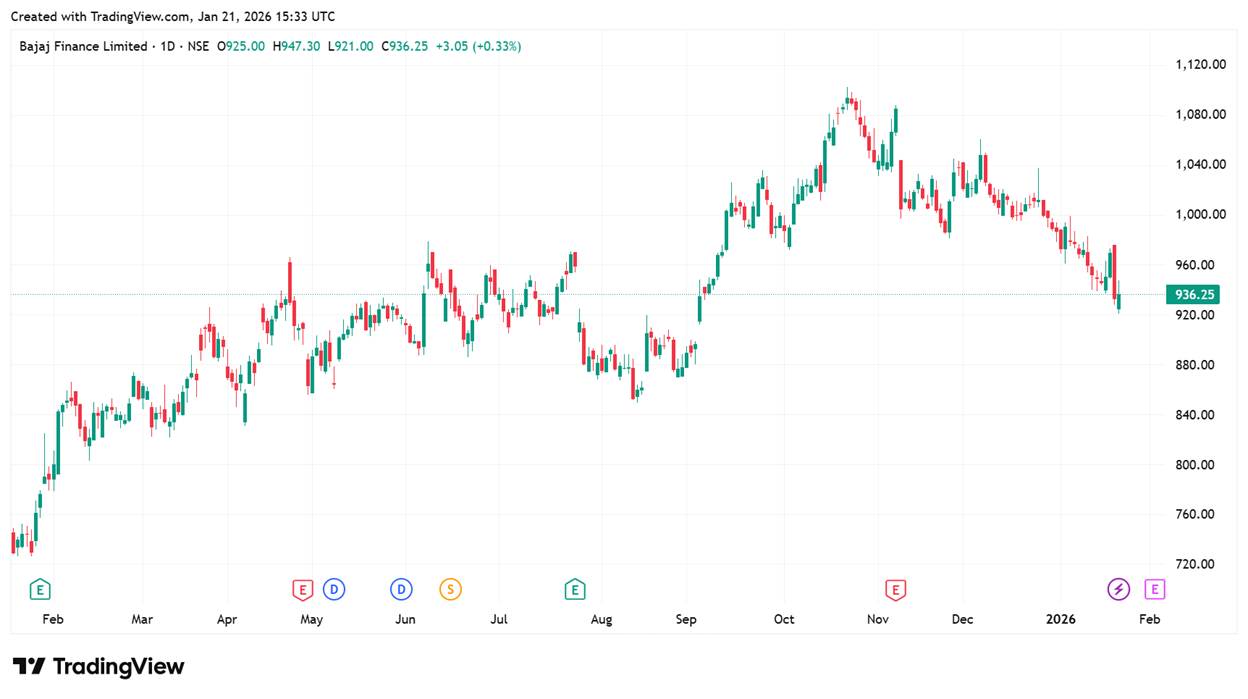
Bajaj Finance, part of the Bajaj Group, is India’s leading non-banking financial company (NBFC). As of 30 September 2025, Bajaj Finance’s Assets Under Management (AUM) grew by 24% year-on-year to ₹462,261 crore. The company added ₹20,811 crore to its Asset Under Management (AUM) during the quarter.
Strategic portfolio mix
The portfolio reflects a diversified mix, heavily anchored by mortgages and consumer lending. Mortgages accounted for 31.2% of the mix, followed by Urban B2C loans (20.9%), MSME lending (11.2%), Urban Sales Finance (7.3%), and commercial lending (6.8%).
Net interest income increased 22% year-over-year to ₹10,785 crore in Q2FY26. Net interest margin remained flat compared to Q1FY26. Although the cost of funds decreased by 27 basis points (bps) to 7.52%, this benefit was passed on to customers.
Asset quality worsened slightly.
Gross non-performing assets (GNPA) increased by 18 bps to 1.24% due to stress in the MSME portfolio, while net NPA stood at 0.6%. A decline in the captive two-wheeler loan book also contributed to the rise in GNPA. Consequently, loan losses increased to 2.1% in Q2FY26, slightly higher than 2.02% in Q1. Profit After Tax (PAT) grew by 23% year-on-year to ₹4,948 crore.
Bajaj has lowered the AUM growth guidance to 22-23% for FY26, from 24-25% previously, due to risk actions in MSME and revised projections for the housing subsidiary. Full-year credit costs are expected to be at the upper end of the guided range of 1.85-1.95%.
The ‘FinAI’ pivot
Management expects significant improvement in credit costs in FY27 as the stressed portfolios run down. The company expects to add 16-17 million new customers in FY26. As part of its “FinAI” transformation, Bajaj Finance has set the following targets for FY30.
It aims to achieve a 3.2-3.5% market share in India’s total credit market (up from 2.32%) and a sustainable return on equity of 19-21%. Bajaj targets a customer base of 20–22 crore, and a GNPA of less than 1.2% and an NNPA of less than 0.4%.
#2 Shriram Finance: The MUFG catalyst
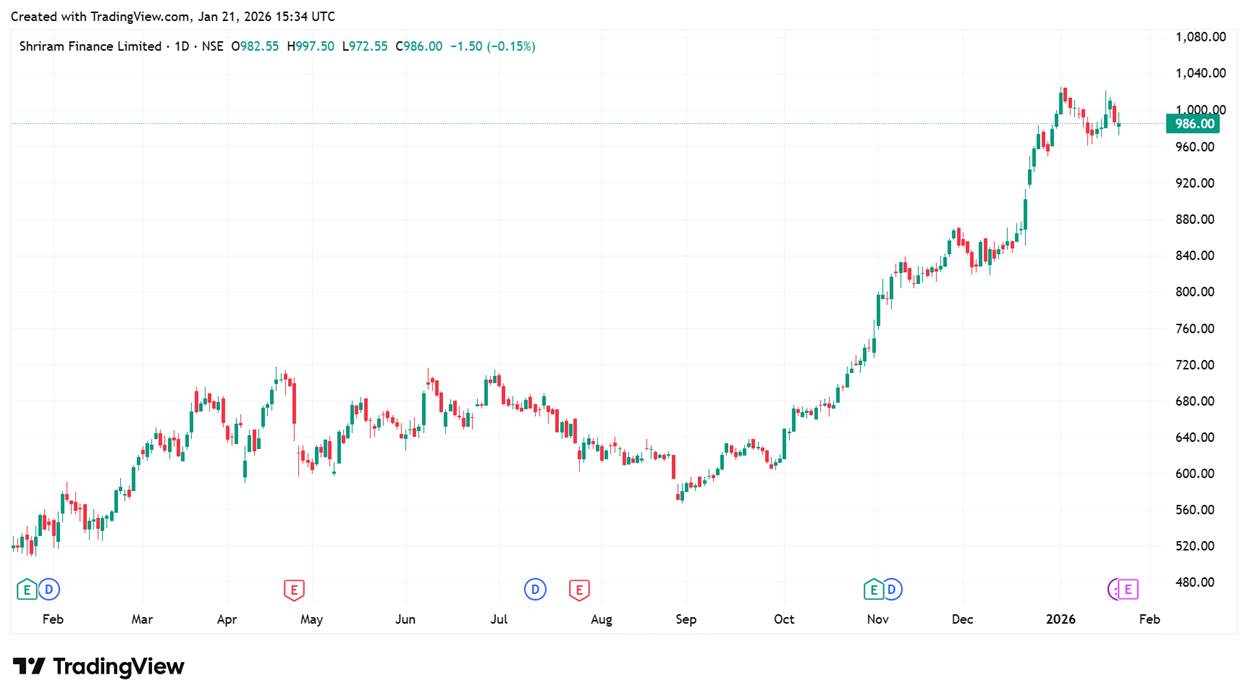
Shriram Finance is the flagship company of the Shriram Group, and stands as one of India’s largest retail asset financing NBFCs. The company was formed through the merger of Shriram City Union Finance, Shriram Capital, and Shriram Transport Finance Company.
As of 30 September 2025, the company manages AUM of more than ₹281,305 crore, up 15.7% year-on-year. It operates a pan-India network of 3,225 branches and serves approximately 96.6 lakh customers.
The leader in the pre-owned CV segment
SFL is a holistic finance provider primarily serving small road transport operators and small business owners. It is a leader in the organized financing of pre-owned commercial vehicles (CV) and two-wheelers (2W). CV AUM grew 14.2% to around 128,140 crore. Passenger vehicles AUM grew by 21.5% to ₹59,551 crore.
With strong AUM growth, Net Interest Income surged 11.8% year-on-year to ₹5,606.7 crore in Q2FY26. Net Interest Margin, however, compressed by 55 basis points to 8.2% due to rate rationalisation following the Reserve Bank of India rate cut. The company reported an improvement in asset quality metrics.
GNPA improved to 4.6%, from 5.3% in Q2FY25. Net NPA improved to 2.5%, from 2.6% during the period. The improvement in asset quality led to a fall in credit cost to 1.7% of total assets, down from 1.8% in the same period last year. As a result, PAT rose by 11.4% year-on-year to ₹2,071 crore.
The MUFG infusion and path to higher ROA
In a landmark event, Japanese giant MUFG agreed to invest ₹39,618 crore for a 20% stake. This is the largest foreign direct investment in India’s financial services sector. The company aims to accelerate its AUM growth rate from the current 16-17% to 18-20%. It aims to double its market share in the new-vehicle segment to 6% over the next 3 years.
With the fresh capital and anticipated lower borrowing costs, management targets an expansion in ROA from the current 2.8% to 3.6% over the next five years. However, due to the large equity infusion, Return on Equity (RoE) is expected to dip to about 13.5% next year, before recovering to over 15% by FY31.
#3 Muthoot Finance: The gold loan renaissance
Muthoot Finance, part of The Muthoot Group, is India’s largest gold financing company by loan portfolio and a trusted pan-India brand in the gold loan sector. The company operates a vast network of 4,967 branches across 29 states and union territories in India.
Muthoot Finance serves over 200,000 customers daily and has an active customer base of about 65.7 lakh. The average loan ticket size has risen, with loans above ₹3 lakhs accounting for 44% of the book. Muthoot Finance has diversified its business through several subsidiaries, which contribute 13% to the consolidated loan AUM.
Capitalizing on the gold loan renaissance
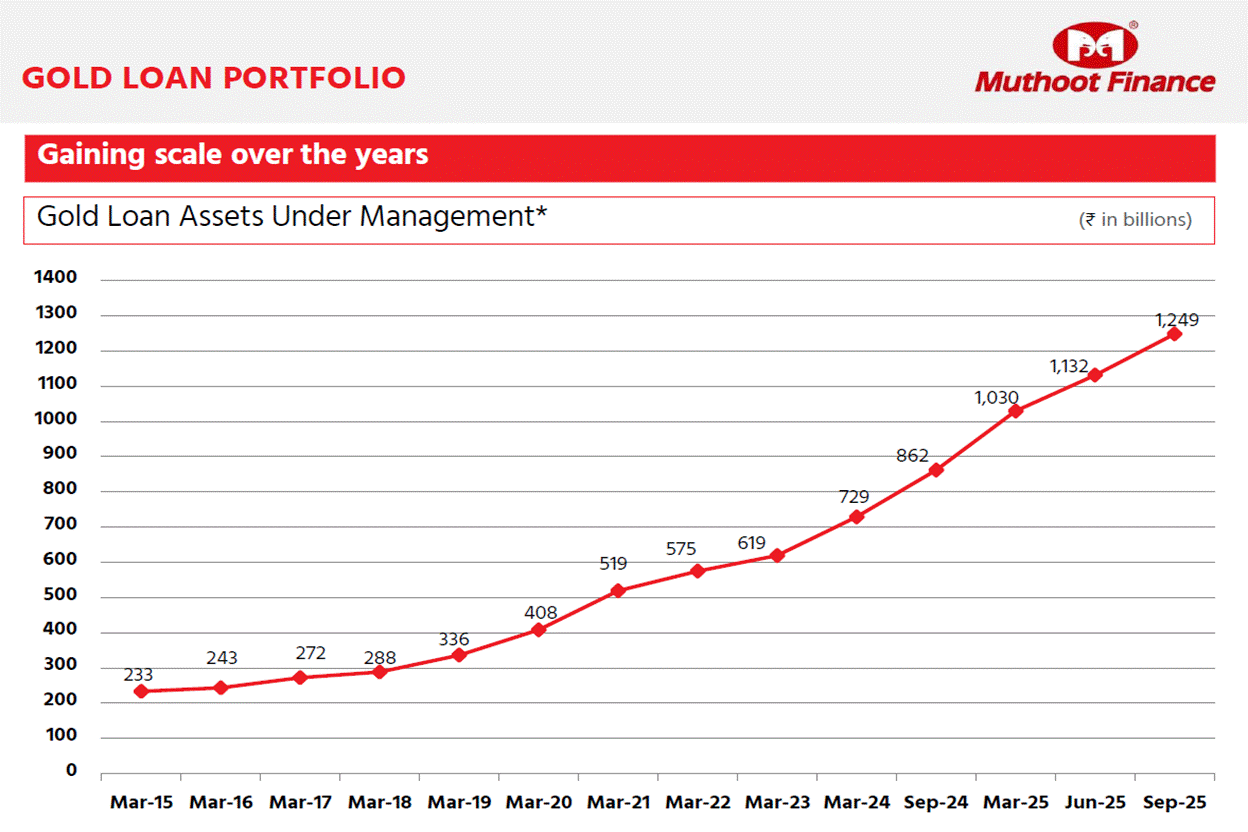
The company’s standalone AUM rose by 47% year-on-year to ₹132,305 crore, with the gold loan portfolio rising 45% to ₹124,918 crore in Q2FY26. As of 30 September, 2025, the company held 209 tonnes of gold jewellery as security, up from 199 tonnes last year. The non-gold loan portfolio constitutes about 12%-15% of the consolidated loan portfolio.
The Net Interest Margin expanded by 22 bps to 11.45%. Interest income increased by 55% year-on-year to ₹6,304 crore in Q2FY26. Asset quality remained strong. Gross NPA improved to 2.3%, down from 4.3% in the same period last year. PAT increased by 87% to ₹2,345 crore.
Gold Loan AUM Trend
Sector-leading efficiency
Looking ahead, Management upgraded the gold loan growth guidance for FY26 to 30-35%, up from previous estimates. This optimism is driven by favorable regulatory changes, higher gold prices, and tighter norms on unsecured credit, which are expected to boost gold loan demand.
Management emphasized that, despite increased competition, they do not foresee the need for “knee-jerk reactions” regarding pricing or strategy. The cost of borrowing has fallen to around 8.8%, with management expecting a further decline of 15-20 basis points starting in Q1 of FY27.
Valuations diverge
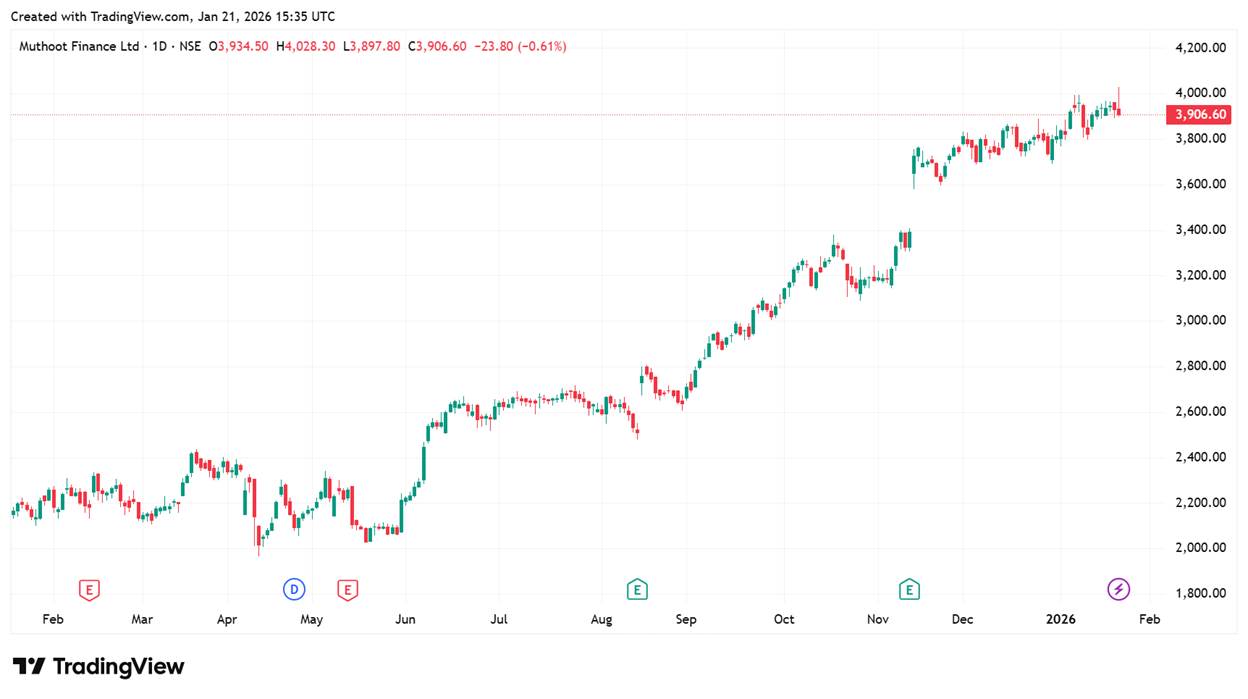
Muthoot Finance’s return ratios, including RoE and Return on Assets (RoA), are the strongest in the sector. This is followed by Bajaj Finance and Shriram Finance. Valuation-wise, Bajaj Finance trades at 5.6X price-to-book (P/B) value due to strong parentage and fast growth. Its valuation has derated over the last few years, from 5 year historical valuation of 8 times.
| Peer Comparison (X) | ||||
| Company | Price-to-Book | 5Y Median P/B | RoE (%) | RoA (%) |
| Shriram Finance | 3.1 | 1.8 | 15.6 | 3.0 |
| Bajaj Finance | 5.7 | 8.0 | 19.2 | 4.0 |
| Muthoot Finance | 4.7 | 3.1 | 19.6 | 4.7 |
| Industry Median | 1.9 | NA | 8.2 | 3.1 |
On the other hand, the valuations of both Shriram and Muthoot have been rerated due to strong growth, asset quality, fund infusion, and gold loan momentum. The recovery in credit growth is clearly flowing through to NBFC balance sheets, supporting AUM expansion and earnings visibility. Bajaj Finance, Shriram Finance, and Muthoot Finance are each benefiting from this cycle through distinct lending niches and execution strengths.
Disclaimer
Note: Throughout this article, we have relied on data from http://www.Screener.in and the company’s investor presentation. Only in cases where the data were not available have we used an alternate, widely used, and accepted source of information.
The purpose of this article is only to share interesting charts, data points, and thought-provoking opinions. It is NOT a recommendation. If you wish to consider an investment, you are strongly advised to consult your advisor. This article is strictly for educational purposes only.
About the Author: Madhvendra has been deeply immersed in the equity markets for over seven years, combining his passion for investing with his expertise in financial writing. With a knack for simplifying complex concepts, he enjoys sharing his honest perspectives on startups, listed Indian companies, and macroeconomic trends.
A dedicated reader and storyteller, Madhvendra thrives on uncovering insights that inspire his audience to deepen their understanding of the financial world.
Disclosure: The writer and his dependents do not hold the stocks discussed in this article.
The website managers, its employee(s), and contributors/writers/authors of articles have or may have an outstanding buy or sell position or holding in the securities, options on securities or other related investments of issuers and/or companies discussed therein. The articles’ content and data interpretation are solely the personal views of the contributors/ writers/authors. Investors must make their own investment decisions based on their specific objectives, resources, and only after consulting such independent advisors as may be necessary.