



Sakshi (name changed) has been a regular user of vapes for the past one-and-a-half years. “I picked up vaping when I was trying to quit smoking,” says the 28-year-old working professional based in Bengaluru. “I borrowed my first vape from a friend, and then bought my own—an Elf Bar—a few weeks after using it,” she recalls. “I have used disposable vapes as well. I buy them only from a cigarette shop near my workplace, as the owner knows me by now that I’m his regular customer,” she adds.
Sakshi is aware of the ban and does not want to get caught on the wrong side of it. But she says she is also reluctant to quit vaping as she is still dependent on it to wean herself off tobacco.
Sakshi’s story is not unique. Even though vaping was banned in India seven years ago, many youngsters like her still can’t seem to kick the habit. Sellers, in turn, ensure that their products are readily available across local markets, and even on some online platforms, while openly defying the prohibition.
When this correspondent visited a few cigarette shops in south Delhi, she was told by most of the owners that while they used to stock vaping products earlier, now they make them available only on demand. “Police patrolling on this street is quite regular, so we do not risk selling vapes too openly,” says a shopkeeper. “But we can arrange it in a few hours or by the next day if a customer asks for one,” adds another.
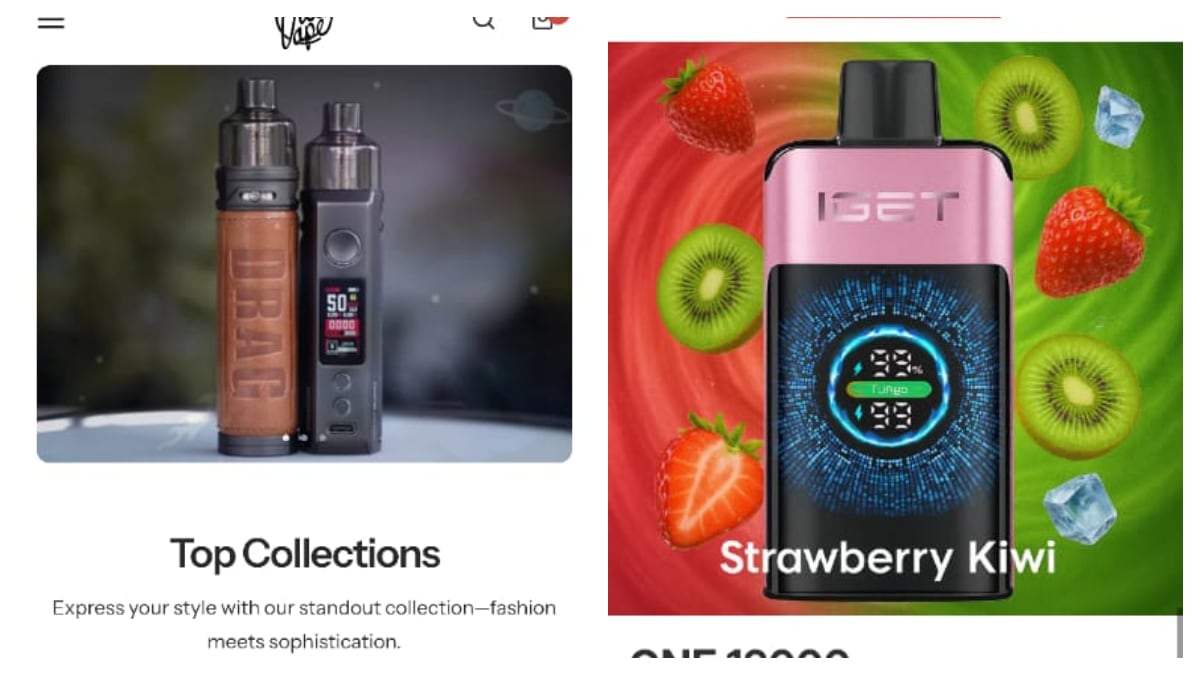
Apart from roadside shops, a simple Google search throws up a number of online platforms selling vapes—We Vape India, VapeMonk, India Vape Store, House of Vapes, and TheVapeStorePro, to name a few. They stock globally renowned brands like Elf Bar and iGet, as well as products from others. They sell disposable vapes, refillable vapes, juice cartridges, and vape kits as well.
Open secret
If you’re a Gen Z, and even if you’re not, it will be hard to miss a vape or e-cigarette—a pen drive-looking device that was first introduced in the market as a convenient and smell-free substitute for smoking. Over time, vapes have also become a ‘cool’ style statement, especially among the younger generations.
Unfortunately, most users of e-cigarettes are of the opinion that vaping is not as damaging to health as cigarettes, gutkha, tobacco, and the rest, reasoning that while impacting the lungs due to smoke inhalation, it poses a tobacco-free alternative, cutting the risk of cancers significantly. In 2019, the Indian Council of Medical Research (ICMR) published a white paper, prior to the announcement of the ban, on such products technically called electronic nicotine delivery systems (ENDS). It stated that e-cigarettes are highly addictive and pose severe risks to the respiratory, cardiovascular, and neurological systems, similar to conventional smoking, while also endangering infant and child development.
Anant Jangwal, founder of the now defunct online e-cigarette store Vape Stop, shares that although no reliable documented and surveyed numbers are available on the size of the vaping population, he estimates that in Delhi, at least 2,500 points of sales in the form of roadside cigarette shops stocking vapes are available to purchase from. Jangwal closed down his company when the e-cigarette ban was announced in 2019.
“We went to the nearest police station and gave up our entire stock. The ban was so new that even the police did not know how to process it at the time,” he says, adding that he did not want to encourage unhealthy and unregulated tobacco consumption by finding a loophole in the ban to exploit it.
According to Jangwal, the age group of 25-35 years makes up the highest adopters of vapes and vaping products, with Bengaluru, Delhi and Mumbai having the highest number of such consumers, and the market in northeastern states growing steadily.
Penetration is increasing, Samrat Chowdhery, founder of Association of Vapers India (AVI) and former president of International Network of Nicotine Consumer Organisations (INNCO) also agrees, adding: “I have travelled to UP and Uttarakhand, in small cities like Muzaffarabad, Roorkee and other places, and sure enough, cigarette shops in these small areas have also begun stocking vapes.”
Vapes are priced anywhere from Rs 300-Rs 500 and go up to Rs 3,000-Rs 4,000 as well. Certainly not an affordable product, but the cheaper disposable ones at the lower price ranges are what that sells, proving to be a good income source for sellers, and a long-term, cost-effective option for smokers.
Jangwal says, while he does not condone the ban or the way it was announced, he did not want to carry on an illicit business. “Moreover, with the way the business has shifted offline, online platforms are not likely to make a lot of profits either,” he says.
“A way to stay out of trouble is to enable only the cash-on-delivery (CoD) option. This takes away the hassle of integrating a payment gateway and informing the authorities,” says Jangwal. True enough, almost all the online stores that are functional, with the exception of one named Vapevilla, have mandatory CoD payments. Despite this, the orders received by them seem to be far from negligible, with some platforms boasting out-of-stock models of vapes as well.
This correspondent approached Vapevilla for their comments, but no responses were received till the filing of this report.
Jangwal also says that changing the name and relaunching a website every few months is a huge inconvenience. “A new domain has to be purchased, new interfaces designed, and fresh SEO to be among the top hits on Google. In this climate, and alongside trying to circumvent this ban, online vape stores are not good for business,” he adds.
Toothless policy
In India, it is criminal to produce, store, import or sell vapes or e-cigarettes in India. The ban was put into effect in 2019, following the enactment of the Prohibition of Electronic Cigarettes Act (PECA) of 2019. Violation of the law is punishable by an imprisonment of one to three years, and/or a fine of Rs 1 lakh, extending to up to Rs 5 lakh. For storage of vapes, the penalty is imprisonment of up to six months, and/or a fine of up to Rs 50,000. However, there is no ban on the personal usage of vapes or e-cigarettes.
The Bill for this ban was originally introduced by the then Union Health Minister Harsh Vardhan, and subsequently approved the same year. According to the Global State of Tobacco Harm Reduction (GSTHR), a global database for tobacco consumption, the tobacco or smoking burden in India consumes 9.3% of the population. Of the 140-crore-strong population, over 13 crore people aged above 15 years are smokers.
Samrat Chowdhery of AVI, who has been advocating against the ban since it was implemented, estimates that about 35-40% of the smoking population of India are now vapers. The government’s efforts have been rather lacklustre in implementing this ban effectively, says Chowdhury, and has nowhere near the momentum or resources as compared to the COTPA (Cigarettes and Other Tobacco Products) Act, 2003.
The ban has received consistent criticism from the public, particularly the organisations vocal about nicotine consumption and tobacco harm reduction (THR). They identify several loopholes in the ban, and reasons why this regulation has failed to work. For starters, the implementation and regulation of the ban is decentralised, and up to the states to manage, which result in scattered raids and non-uniform acceptance and enforcement across the country. In fact, the implementation has been so poor that roadside paanwallahs and cigarette shops are also selling smuggled disposable vapes and e-cigarettes.
In December last year, the Directorate of Revenue Intelligence, in what has been perhaps the biggest e-cigarette raid in India till then, seized e-cigarettes worth over Rs 10 crore from Tuticorin Port in Tamil Nadu; later that same month, a cache of 487 boxes of e-cigarettes worth Rs 10 lakh was seized from a housing colony in Vadodara. In November the same year, Pune police seized vapes worth over Rs 52,000. Other reports of sporadic raids also emerged earlier in 2024, all of which were achieved by individual state law enforcement efforts.
This black market, according to Chowdhury, is much more vast and far reaching than the online sales of vapes. “With such a significant part of the population consuming other forms of tobacco on a daily basis—khaini, gutkha and tambaku—expecting a blanket ban on vapes to be obeyed is quite implausible,” he says.
Further, while travelling by air with vapes is banned, and personal use is not, those that travel frequently find themselves buying vapes more frequently than others, often more than they even need themselves. One has no option but to purchase a new vape in every new city they land in. Moreover, for habitual smokers who are trying to quit tobacco by picking up the vape, Chowdhury says, “It is most difficult to encourage these people to quit vaping, as they do not want to go back to the tobacco products they quit.”
Chowdhury makes it quite clear that the AVI is not an organisation that supports or encourages picking up a smoking habit or tobacco consumption, rather, it is a means to educate people on low risk means of smoking, and to support the mission of THR.
By taking away the market from entrepreneurs, and pushing it into the black market, the government has done more harm than good, says Chowdhury. “Now, nearly 90-95% of the market has been taken over by smuggled products, with no responsibility for end-to-end supervision. Once the tapriwala has sold you the disposable vape, he has made his income, and his interaction with the customer is over,” he explains. “There is no accountability from the manufacturer or seller’s side.”
Consequently, people prefer to buy these products in person more frequently, rather than wait for a delivery from an online source for three to four days. He says that it also increases the risk of the product, because “with an accountable supplier the fresh product will reach you within a few days to a week. But with smuggled products, they may be a year old by the time they reach the consumer’s hand”.
A compounding problem
With a large number of smokers and tobacco users in the country, and India being the second largest producer and importer of dry tobacco, it is quite impossible to do away with tobacco consumption in one fell swoop. In fact, the government’s ban has had the opposite effect—instead of curbing tobacco consumption, it has encouraged it, say experts. “Vapes are now available at lower prices with no quality testing involved, along with the high availability and demand for tobacco,” says Jangwal. “Conversely, allowing registered businesses to operate would have guaranteed an age-based parameter, non-toxic manufacturing materials and quality control, making implementation of the ban smoother, while also gaining in revenue.”
According to Chowdhury, after shifting to vaping, people rarely go back to cigarettes. “You have different flavours, there is no combustion of the tobacco or paper involved, and the lack of dry tobacco removes the taste of tar altogether. Given that the vape is an electronic product, much like all other innovations in the recent decade, it will see its glory days with the consumers. This is not to say that the ban in India will not work—but it also indicates that demand across the world will see an increase,” he adds.
Chowdhury exemplifies the other developing countries that announced prohibitions. A vape ban was put into effect in Thailand in 2014, and in Brazil in 2009—both countries have seen similar outcomes to what we are seeing in India. “In Thailand, vape shops can be spotted in every street corner now. The same is true for Mexico, where the ban is far more recent,” he explains.
“It would be much more practical for the Indian government to take the example of the UK,” he says, where the ban is much more comprehensive, and not a blanket ban without consideration of consumers, businesses, impact and implementation.
The UK has banned single use or disposable vapes, making it illegal for businesses to sell them, in an effort to curb youth vaping and environmental waste. Vapers are required to switch to refillable vapes with replaceable pods and coils.
Jangwal adds, “As we move forward, we have newer models for phones and laptops. It stands to reason that the same will happen with smoking products and accessories. Innovation in products, where the demand emerges from a habit, will always have takers,” he explains. “When the government allows for tobacco consumption in its raw and combustible form, at its most toxic, a ban on vapes will naturally not make sense to consumers,” he says.
“When one can purchase the product by walking down the street, and the ban rings unfounded in comparison to regulations on other tobacco products, obedience will be stunted and difficult to achieve,” says Jangwal. “This ‘problem’ will grow in magnitude over time if better regulatory guidelines and implementation is not sought,” he adds.