



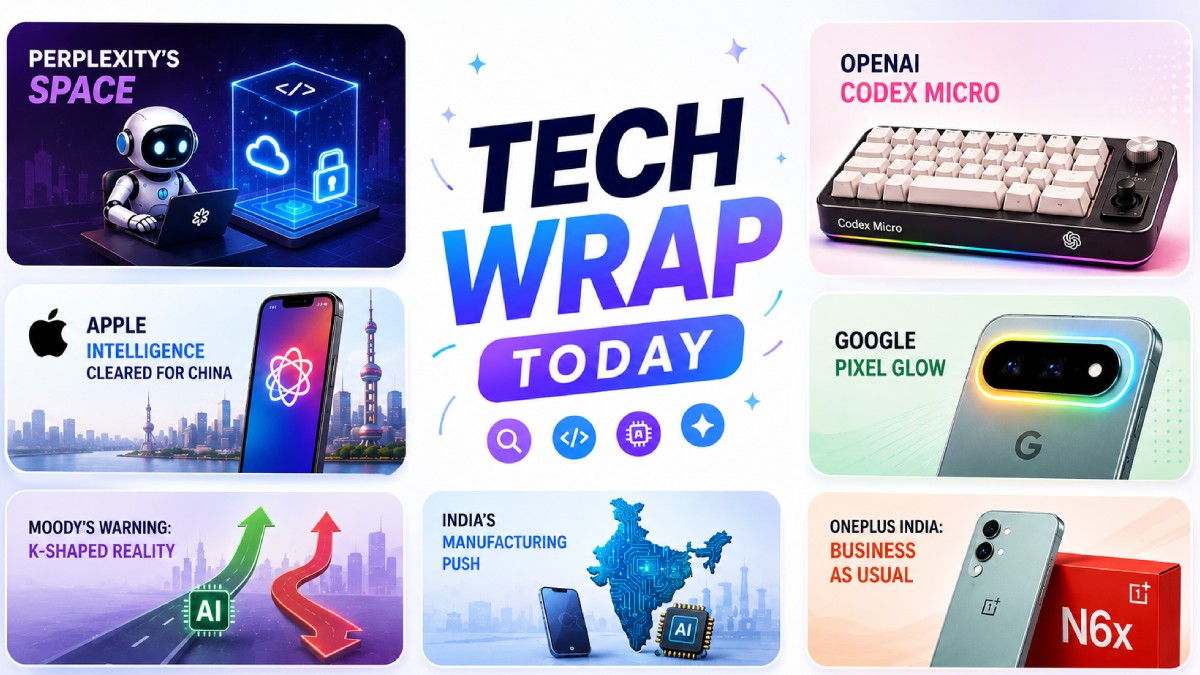
On the occasion of AI Appreciation Day, today’s news cycle had a lot related to AI. From Perplexity’s new SPACE to OpenAI’s cutesy little keyboard for developers, the tech and AI space has seen interesting updates.
On the other hand, Apple has finally overcome massive hurdles to bring its intelligence suite to one of the world’s largest consumer markets – China. Google, on the other hand, has teased what it calls a Glow Bar on its upcoming next-gen Pixel smartphones.
Top headlines from technology and AI that kept us busy today –
Celebrating AI Appreciation Day
Celebrated annually on July 16, AI Appreciation Day honours the impact of modern artificial intelligence on modern society. Established to recognise how advanced AI enhances healthcare, combats climate change, and streamlines daily tasks, the day also serves as a crucial reminder to address pressing ethical challenges like data privacy, transparency, and algorithmic bias. Rather than viewing AI as a human replacement tool, it promotes a collaborative future where AI handles repetitive workflows, freeing humanity to focus on empathy and creative problem-solving.
Perplexity soars its ‘SPACE’
To support its autonomous web-browsing and coding tool Computer, Perplexity AI has officially launched a secure, next-gen runtime platform called SPACE (Sandbox Platform for Agentic Computing Environments). Most existing sandbox environments are designed for quick, disposable tasks. AI agents, however, need to work for hours, but leaving sandboxes open indefinitely exposes sensitive user credentials and data.
Perplexity’s SPACE spins up ephemeral sandboxes (using AWS’s Firecracker microVMs). It takes snapshots of the active memory every single minute. This means you can walk away mid-task, come back a week later, and your AI agent will pick up precisely where it paused. Built to run anywhere, early tests running SPACE on Nvidia’s Vera architecture launched concurrent sandboxes up to 1.9x faster than previous setups. SPACE is live for all “Computer” users.
Moody’s warning of a ‘K-Shaped’ reality
In its latest Global Economy Outlook, Moody’s Analytics noted that while the AI boom has temporarily saved the global economy from a sharper downturn, it is driving a stark ‘K-shaped’ divide. “The global economy is running at two different speeds. In some segments, growth is holding up better than expected, courtesy of the AI boom… But economies and industries less plugged into the AI boom have struggled,” states the study.
This split is widening the wealth gap between tech-heavy, AI-integrated nations (which are racing ahead) and those left grappling with high energy costs and traditional economic stagnation, reveals the study.
OpenAI Codex Micro is its first hardware
OpenAI’s first branded physical device is here and it isn’t a smartphone. The ChatGPT maker has partnered with custom keyboard manufacturer Work Louder to release the Codex Micro — a premium, mechanical keyboard built specifically for developers utilising the Codex AI coding assistant. It features dedicated “Agent Keys” linked directly to active AI coding agents. The keys glow different colours based on what the AI is doing, i.e., White for idle, Blue for thinking, Peach for needing user approval, and Red for errors.
The keyboard includes a physical joystick to navigate AI workflows and a rotary encoder dial to adjust Codex’s “reasoning level” on the fly. OpenAI is charging $230 for one.
Apple Intelligence cleared for China
After more than a year of navigating a complex regulatory ordeal, Apple has officially registered Apple Intelligence with China’s Cyberspace Administration. To get the green light, Apple had to adapt to local compliance laws by striking a major partnership with Chinese tech giants Alibaba and Baidu. Alibaba confirmed that its Qwen AI model will be integrated directly to power text and image generation features across iOS, iPadOS, macOS, and visionOS for Chinese users. This is a massive win for Apple in its effort to sustain smartphone momentum in one of its largest global markets.
Google readies its Pixel Glow
Google dropped a surprise teaser on its store homepage, officially locking in August 12 as the pre-order and launch date for the Pixel 11 Pro. It also confirmed Pixel Glow — a circular, flowing multi-colour light ring built directly into the camera bar. It is expected to function as a highly customisable notification hub or even a tiny circular display. To make room for the Pixel Glow, Google seems to have removed the temperature sensor from the camera bar.
As far as specs are concerned, the Pixel 11 series is rumoured to be powered by the Tensor G6 chip (built on TSMC’s hyper-efficient 2nm process) and will ship with Android 17.
India’s Rs 62,500 crore manufacturing push
The Indian Government has approved the Mobile Phone Manufacturing Scheme (MPMS) with a massive Rs 62,500 crore budget. Combined with the newly cleared Semicon 2.0 (outfitted with Rs 1.27 lakh crore), India is aggressively positioning itself to transition from a basic smartphone assembly hub into a global electronics design and chip manufacturing powerhouse.
‘Business as usual’ for OnePlus India
Following the rumours of OnePlus bidding goodbye to the Indian market in 2027, the brand has officially confirmed that business will run as usual for OnePlus India. The company is gearing up to launch the OnePlus N6x as one of its newest entry-level models.