



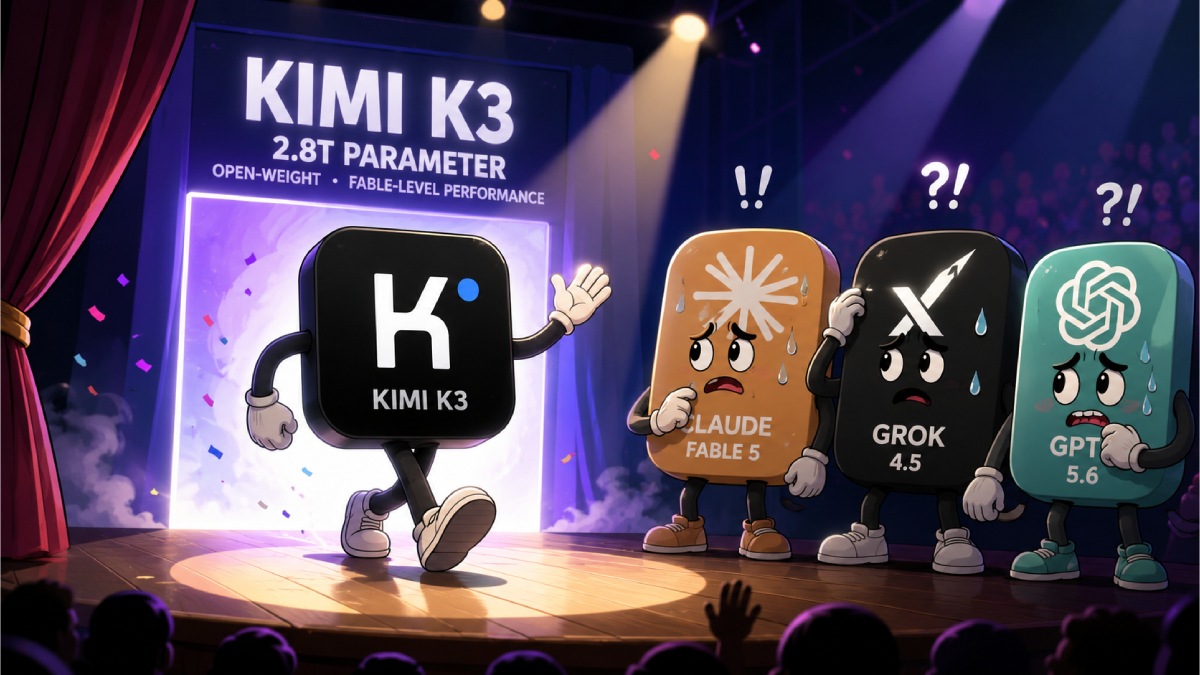
Weeks after OpenAI’s grand release of GPT-5.6 globally, China’s homegrown AI firm, Moonshot AI, has released a ‘Fable-class’ AI model. Beijing’s AI startup brings Kimi K3 – a massive 2.8-trillion-parameter open-weight Mixture-of-Experts (MoE) model that’s acing the benchmarks, competing with frontier-tier AI models like Anthropic’s Claude Fable 5 and OpenAI’s GPT-5.6.
For context, Kimi K3 is now leading in the Frontend Code Arena with 1679 points, surpassing Anthropic’s Claude Fable 5, GPT-5.6 Sol and Grok 4.5.
The internet already witnesses its capability – a creator used Kimi K3 to create a replica of the macOS 27 Liquid Glass interface, while another person created a clone of Counter-Strike: GO (the popular shooter video game) at a fraction of the cost!
Kimi K3’s arrival on the global AI scene comes just weeks after the geopolitical drama surrounding America’s temporary blockade on the flagship AI models from OpenAI and Anthropic, citing cybersecurity as the top reason. Boasting open weights and affordable enterprise pricing, Kimi K3 is shaking up the developer community, encouraging creators to go wild with their creations.
Kimi K3: What it offers
Buckle up as we are about to get a bit technical. Moonshot AI moved away from standard transformer configurations, opting for a highly sophisticated and ultra-sparse Mixture-of-Experts (MoE) setup.
The MoE setup allows Kimi K3 to possess 2.8 trillion total parameters, making it roughly 75 per cent larger than rival DeepSeek’s V4 Pro model. It maintains computational efficiency by utilising 896 expert modules, activating only 16 per inference.
Kimi K3 also introduces a massive 1-million-token context window, quadrupling its predecessor, K2. This allows developers to feed entire massive codebases or hundreds of technical papers into a single prompt without losing the thread.
Much like OpenAI’s “o” series, Kimi K3 features an always-on “thinking mode.”
Kimi K3’s benchmark performance is ‘Fable territory’
Kimi K3’s benchmark data reveals it is up there with the most powerful closed-source systems in the world. On GDPval-AA v2 – a benchmark platform measuring real-world capabilities across 44 occupations and nine major industries – Kimi K3 scored 1,687. This placed it third overall, beating Anthropic’s Claude Opus 4.8 with 1,600 points and trailing only the proprietary tier-one systems like Claude Fable 5 Max with 1,815 points and OpenAI’s GPT-5.6 Sol Max with 1,747 points.
Furthermore, Kimi K3 claimed the top spot on Arena.AI’s Frontend Code Arena with a score of 1,679, outperforming both Fable 5 and GPT-5.6 Sol in human-preference blind testing for web interface building. It also registered a 91.2% on BrowseComp, a benchmark testing long-horizon, complex web information-seeking.
To demonstrate the practicality of Kimi K3, Moonshot AI let Kimi K3 act as an autonomous agent for 48 continuous hours, independently taking a semiconductor chip design from architectural planning through optimisation and verification using open-source electronic design automation (EDA) tools.
Kimi K3 also successfully reproduced the universal “I-Love-Q relation” in computational astrophysics, a task that typically takes a senior human researcher one to two weeks, in just two hours by cross-validating over 20 academic papers.
Kimi K3’s aggressive token pricing
While the performance numbers are turning heads, it is the economics of Kimi K3 that could completely disrupt Silicon Valley AI models.
Moonshot has priced Kimi K3 at $3 per million input tokens and $15 per million output tokens. Crucially, prompt-cached inputs drop to a mere $0.30 per million tokens.
This pricing directly targets Anthropic, which is slated to raise prices for Claude Opus 4.8 to $3/$15 tier in September.
However, note that Anthropic offers a closed, proprietary model; Moonshot is offering a highly competitive system with an open-weight structure.
How can you access Kimi K3?
For those willing to access it, Kimi K3 is already live and selectable for consumers and enterprise clients on Kimi.com, Kimi Work, and the Kimi API.
For the global developer ecosystem, Moonshot AI plans to officially release the full open weights of the model to the public on July 27, 2026. Once released, global developers will be free to download, customise, tune, and run a 2.8-trillion-parameter beast locally, thus accessing “Fable-level” reasoning while enjoying the benefits of open-source AI.