



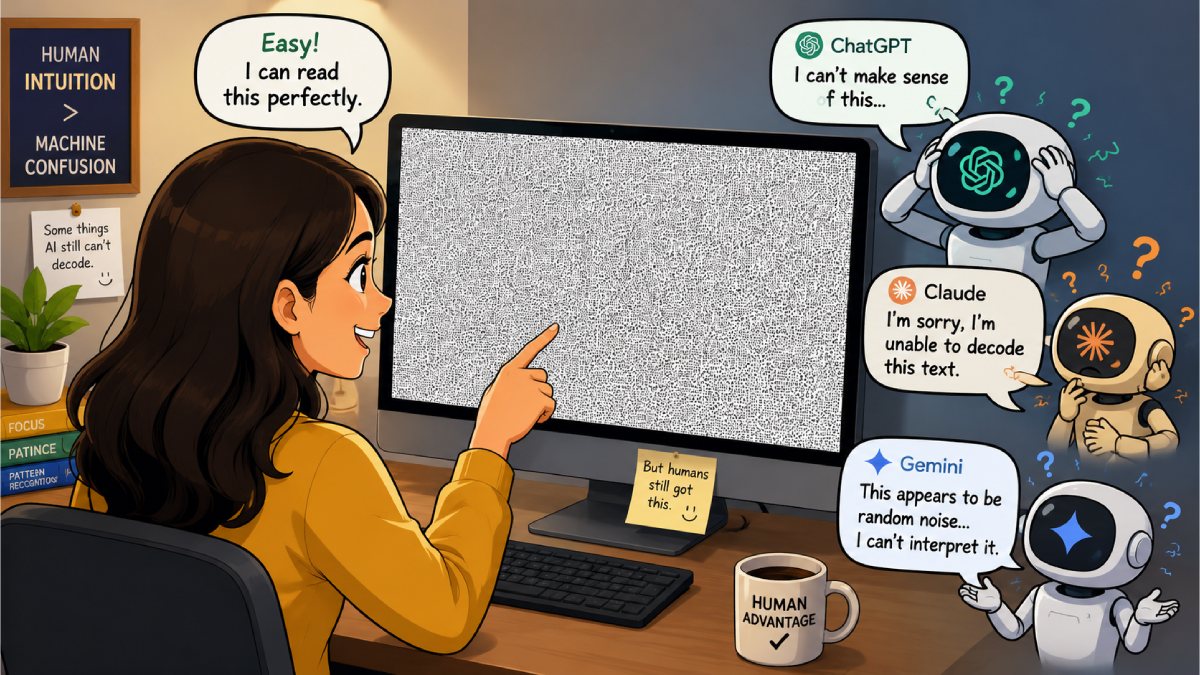
The internet is obsessed with Ghost Font – a new kind of typography designed to make AI scraping fail. Created by Eric Lu, a developer, the new font type works in such a way that it can make humans read a text on the screen, but will confuse frontier AI models. Latest AI models, such as Claude Fable and GPT-5.6, have been unable to decipher the new typography, thus giving AI firms a nightmare to deal with.
Described by its creator as an experiment in “anti-AI typography,” the font represents a massive stand for human ingenuity against automated systems. Can it bypass AI chatbot detection? We tried it out in Gemini, ChatGPT and Claude and here’s what was common in the answers – none of them could read it.
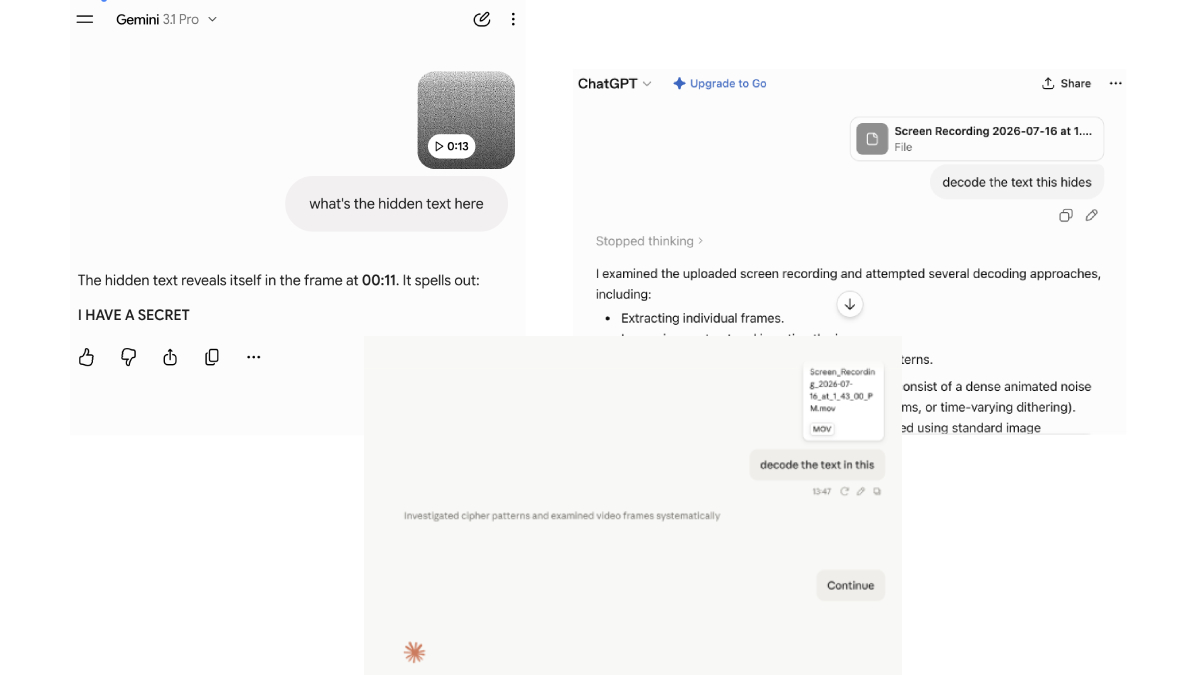
Social media, however, took it upon itself to help AI decode the text. “FWIW I was able to prompt Sol to read a Ghost Font message just by telling it in what direction the pixels are moving,” wrote one use.
Another user, @mirrash7, stated, “Ghost Font hides text in motion that “AI can’t read.” I wrote a notebook that reads the motion.
-Optical flow
-Temporal averaging
-OCR
The word was never in a single frame… it was in the movement.”
How Ghost Font works
Ghost Font is an experimental project designed to be instantly readable by the human eye while remaining entirely undetectable to artificial intelligence.
The secret behind this font? Illusion.
Unlike traditional typefaces that rely on static, visible outlines and curves, Ghost Font operates purely on motion, visual noise, and the unique way the human brain processes moving imagery.
When looking at a Ghost Font file, you are essentially looking at an animation composed of thousands of tiny, drifting dots. The dots that comprise the hidden letters move smoothly in one direction, while the surrounding background dots drift in another.
Due to our evolutionary visual processing, the human brain instantly groups the identically moving pixels together — a psychological phenomenon known as the principle of common fate – allowing the hidden word to seamlessly emerge amidst the chaotic pattern.
However, the moment the animation is paused, the illusion vanishes entirely. What remains is nothing more than a static screen filled with random, chaotic visual noise.
But why are advanced AI models confused?
To test the limitations of modern AI, Lu put Ghost Font head-to-head with the world’s leading foundational models, including cutting-edge releases from OpenAI and Anthropic, such as GPT-5.6 Sol Ultra. None of them could decipher the hidden text correctly.
The reason AI models fail where humans succeed boils down to a fundamental difference in how we read.
Frame-by-Frame limitation: While humans view video as a continuous fluid stream, most current multimodal AI models analyse video content by breaking it down and processing individual static frames. Because a single paused frame of Ghost Font contains only chaotic visual noise with no distinct geometric outlines, the AI sees nothing but static.
Deceptive decoy patterns: To further exploit this weakness, Ghost Font incorporates embedded decoy text patterns. While a human effortlessly bypasses the static noise by tracking the motion, the frame-by-frame analysis of the AI gets tripped up by these decoys, causing the system to confidently output the completely wrong answer.
It was only when the AI models were explicitly taught the specific mathematical technique behind the optical illusion that they could begin to grasp what was happening. This highlighted a significant cognitive gap between human visual perception and machine learning.
Why Ghost Font is hyped on social media
While Ghost Font started as an artistic and technical experiment, the internet believes that such a cryptic font could help with digital security, privacy, and data protection against invasive AI models. As AI scrapers continue to crawl the web, tech teams are looking at Ghost Font as a potential blueprint for the future of “human-only” spaces online:
The next-gen CAPTCHAs: Traditional text-based CAPTCHAs are virtually obsolete, as modern bots can solve them faster than humans. Motion-based typography like Ghost Font could pave the way for a new standard of bot detection that AI simply cannot bypass.
Anti-scraping and data protection: Publicly available data, sensitive medical files, or creative works could be formatted using motion-encoded text. This would allow human users to read the information on a website while completely blocking automated scrapers from mining the data to train future AI models.
Advanced watermarking and DRM: Digital Rights Management (DRM) could utilise Ghost Font-style encoding to embed invisible, unremovable markers into video content, making it incredibly difficult for AI tools to alter or strip away copyright indicators.
Designer Eric Lu noted that the text may not be as crisp as a standard Arial or Times New Roman font, but its illegibility to machines makes it an exciting design innovation for privacy seekers in the AI era.
Is Ghost Font truly invincible?
The internet, however, is trying to figure out ways to decipher the Ghost Font using several advanced techniques. Many developers clarified that giving AI models a temporal vision can help them decipher the text easily, while others say that Claude Fable can decode the decoy text, unlike Gemini and ChatGPT.
“Fable can read it though! Opus, ChatGPT, and Gemini failed but Fable got it, writes @davidgobaud, sharing his Claude chat screen.
Another user wrote, “Grok figured it out with a little push”.