



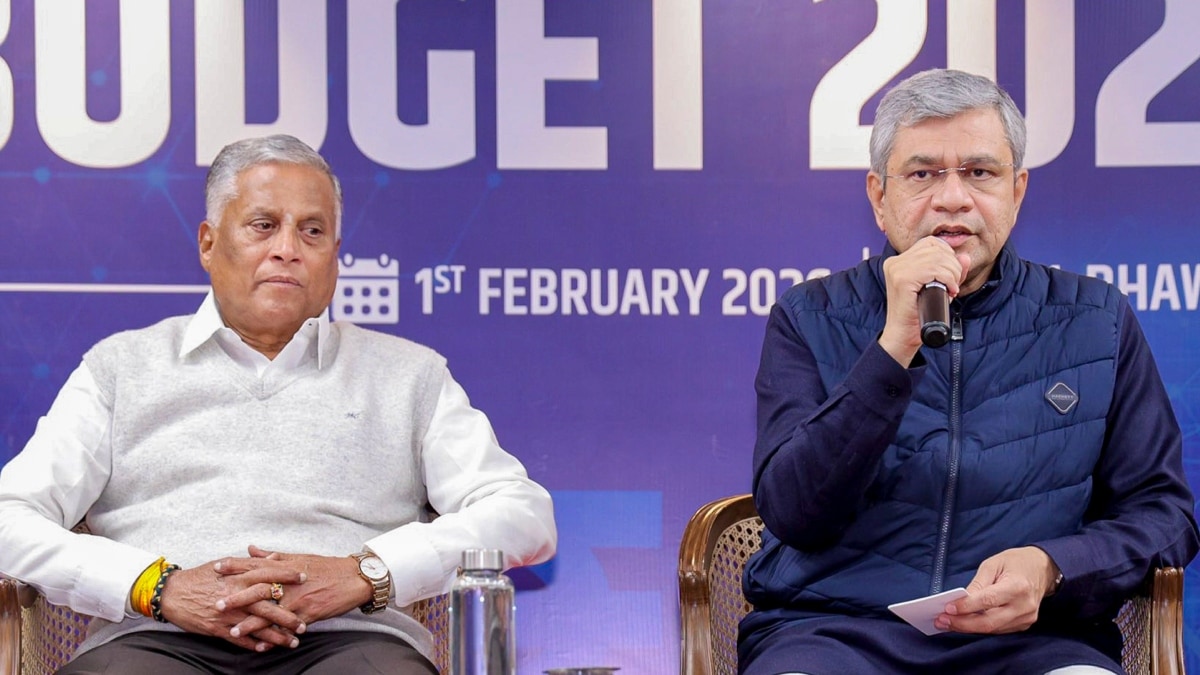
Post the Budget 2026 presentation, Railway Minister Ashwini Vaishnaw on Sunday said that the new high-speed rail corridors will sharply reduce travel time between major cities. For example, commuting from Chennai to Bengaluru could take just about 1 hour 13 minutes, Bengaluru to Hyderabad around 2 hours, and Chennai to Hyderabad nearly 2 hours 55 minutes. Thus, the new corridors are expected to be a game-changer in India’s travel system.
Chennai-Bengaluru travel time will be reduced to just 1 hr 13 min. Bengaluru-Hyderabad will be just a 2 hr journey. Chennai-Hyderabad will be a 2 hr 55 min journey. This will boost South Indian states & benefit Country – Railway Minister Ashwini Vaishnav
pic.twitter.com/jGtLIVe9Kz— Arun Ramesh 🇮🇳 (@arun10venkat) February 1, 2026
Which are the seven new high-speed corridors?
| Route | Current Travel Time (Approx.) | Proposed HSR Time |
| Mumbai – Pune | 3 – 4 hours | 48 minutes |
| Chennai – Bengaluru | 4.5 – 6 hours | 1 hour 13 minutes |
| Pune – Hyderabad | 8 – 10 hours | 1 hour 55 minutes |
| Bengaluru – Hyderabad | 8 – 11 hours | 2 hours |
| Chennai – Hyderabad | 10 – 12 hours | 2 hours 55 minutes |
| Varanasi – Siliguri | 12 – 15 hours | 2 hours 55 minutes |
| Delhi – Varanasi | 8 – 11 hours | 3 hours 50 minutes |
How will the new corridors act as growth connectors?
As part of the government’s long-term mobility plan, seven high-speed rail routes have been announced as “growth connectors” to promote cleaner and more sustainable travel. These routes include Mumbai–Pune, Pune–Hyderabad, Hyderabad–Bengaluru, Hyderabad–Chennai, Chennai–Bengaluru, Delhi–Varanasi and Varanasi–Siliguri. The aim is to make inter-city travel much faster and allow smoother connections between different modes of transport.
The Railway Minister said the travel time between Mumbai and Pune will come down to just 48 minutes, while the Pune–Hyderabad journey is expected to take about 1 hour and 55 minutes. He also said the under-construction Ahmedabad–Mumbai high-speed rail corridor will be extended to connect Pune and Hyderabad, and later Bengaluru and Chennai. According to him, this expanded rail network will be a big boost for people in the region and across the country.
Vaishnaw further added that the Delhi-Varanasi high-speed corridor is likely to bring travel time down to around 3 hours and 50 minutes. Beyond that, the proposed Varanasi–Patna–Siliguri line could reduce the journey between Varanasi and Siliguri to roughly 2 hours and 55 minutes.
With these projects, rail travel in India is expected to see a major transformation. In the south, the Chennai–Bengaluru–Hyderabad routes will form a high-speed triangle, or diamond, connecting key IT and economic hubs. Speaking at a press conference at Rail Bhawan, Vaishnaw said these projects will lead to a significant drop in travel time.
Distance, Investment – All you need to know about the new corridors
The railway minister added that the seven high-speed corridors together will cover nearly 4,000 kilometres and are expected to attract investments of around Rs 16 lakh crore. This will place railways at the heart of India’s future transport system.
The Budget also focuses on improving freight movement. A new Dedicated Freight Corridor has been proposed from Dankuni in West Bengal to Surat in Gujarat, passing through Odisha, Chhattisgarh, Madhya Pradesh and Maharashtra. This 2,052-km corridor will connect with the existing Western DFC, allowing goods to move smoothly to west-coast ports.
Vaishnaw pointed out that the current Eastern and Western Dedicated Freight Corridors are already running close to full capacity, handling about 400 freight trains every day. This highlights the need for more such corridors to meet growing demand.
Highlighting recent achievements, the minister said Indian Railways has laid 35,000 km of new tracks, completed 47,000 km of electrification, and electrified over 99.5% of the broad-gauge network. Production of Vande Bharat sleeper and chair car trains, Amrit Bharat and Namo Bharat trains, along with record additions of freight wagons, is moving ahead at a record pace.