



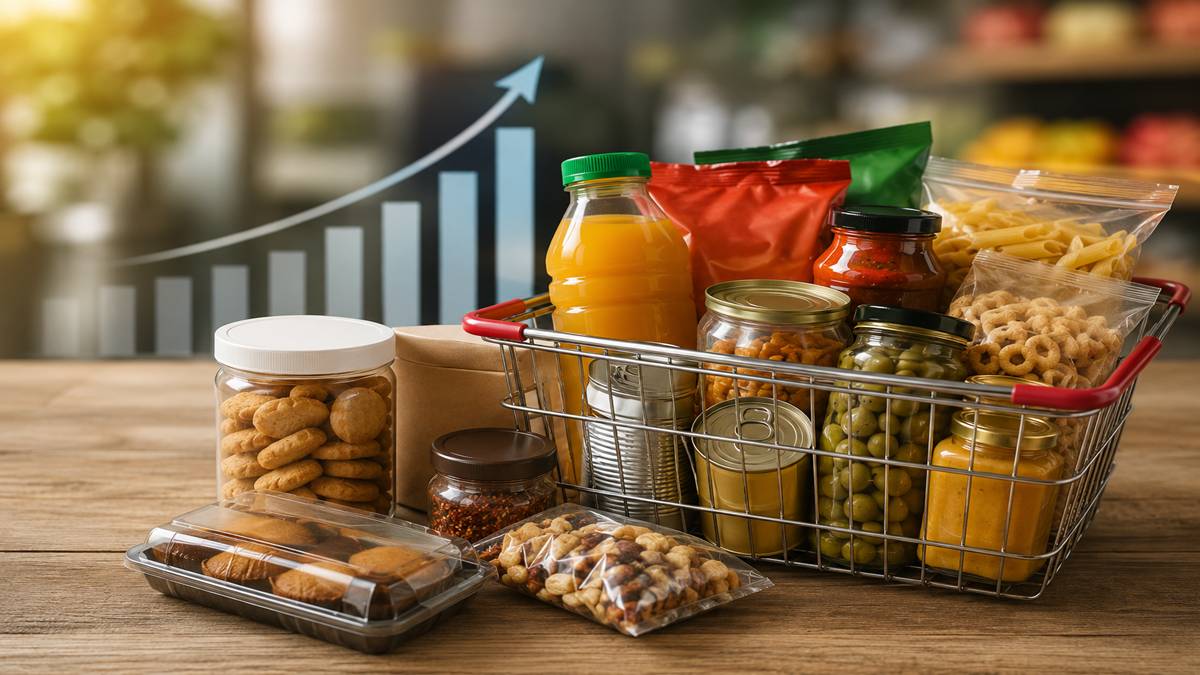
India’s processed food market is expected to nearly double to $600 billion by 2030 from around $300 billion in 2023, driven by rising consumer demand, urbanisation and the rapid expansion of digital commerce, according to a joint report by industry body FICCI and consultancy Deloitte.
Released at the FICCI Food World Summit in New Delhi on Thursday, the report said India’s food sector is shifting from a supply-led, volume-driven model to a consumer-centric, value-led growth trajectory. Despite being one of the world’s largest food producers, only 12% of India’s food output is processed, leaving ample headroom for growth.
Demand for packaged foods is being fuelled by urbanisation, migration to cities, the rise of nuclear families and a growing base of time-constrained working professionals.
“Expanding digital exposure is boosting consumer familiarity and preference for branded packaged foods and the quality associated with them,” said Anand Ramanathan, partner and consumer industry leader, Deloitte South Asia.
The report identified two key growth drivers. The first is strong domestic demand, with consumers increasingly seeking healthier and premium products. Nutritional and functional food categories are growing at 15-20% annually, nearly twice the 10% growth rate of the broader food market.
The second is the rapid evolution of distribution channels. Online sales could account for 25-30% of food purchases in metros by 2030 from 18% in 2025, with quick commerce emerging as a key driver of premiumisation. Modern retail will increasingly become an experience-led channel, while traditional trade is expected to remain dominant beyond metros. The report also noted that up to 70% of new food launches are now digital-first, enabling faster product innovation.
Artificial intelligence (AI) will underpin much of this transformation. The report said AI is evolving from a back-end productivity tool into a core business capability, improving demand forecasting, accelerating product development, enabling hyper-personalised consumer engagement and supporting smart manufacturing.
The report also flagged significant export opportunities. India’s food exports exceed $50 billion, but processed foods contribute only 20% of that total. Value-added products account for less than 15% of India’s food export basket, compared with 40-50% in competing countries. Processing agricultural produce can generate three to five times higher export realisation than exporting raw commodities, strengthening the case for expanding processing capacity and building global Indian food brands.
Continued regulatory simplification, implementation clarity and stronger food safety standards will be essential to unlocking the sector’s full growth potential, the report said.