



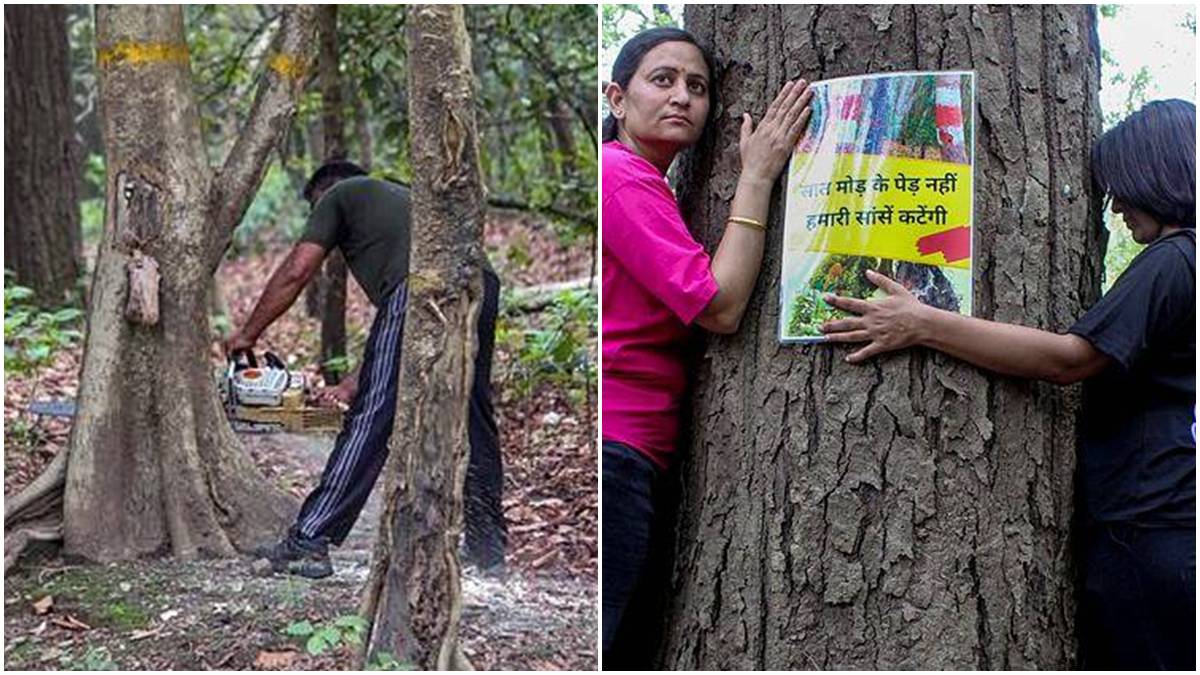
In 1973, villagers in Uttarakhand‘s Chamoli district had wrapped their arms around trees to stop loggers’ axes, giving birth to the Chipko Movement. More than five decades later, those same images have returned to the hills. Residents and activists were once again seen embracing trees to resist their felling.This time over the proposed widening of the Dehradun-Rishikesh National Highway.
The project has triggered protests across Uttarakhand, with residents and environmental activists opposing the planned felling of over 4,000 Sal trees along the Bhaniyawala-Ranipokhari stretch. While protesters fear the project could damage forests and wildlife habitats, the National Highways Authority of India (NHAI) maintains that the highway has been designed with several environmental safeguards to reduce its ecological footprint.
Videos circulating on social media show protesters hugging trees and weeping scenes.
One widely shared clip on X captured Uttarakhand Kranti Dal (UKD) activists demonstrating at Sat Mod in Rishikesh, holding placards and raising slogans calling for unity and a few minutes’ pause for the environment. Hashtags like “save Uttarakhand forests,” “Devbhoomi under threat,” and “stop deforestation” have been trending online — a digital-age echo of a decades-old cause.
Why are residents opposing the project?
Advocate Ashutosh Kothari, among the protesters, told ANI that demonstrations had continued for several days in an effort to save the trees. “These trees have been standing for years, giving us oxygen and preserving the ecological balance. We don’t want them to be cut,” he added.
Environmental activist Shilpi questioned why forests must be sacrificed for development, telling ANI that old forests, once destroyed, cannot be recreated overnight. “Development should not come at the cost of our forests. Once old forests are destroyed, they cannot be recreated overnight,” she stated to ANI. She also said that the region had already been experiencing changing weather patterns and increasing temperatures, making forest conservation even more essential.
Locals and activists warn that felling large numbers of Sal trees could disturb the region’s ecology, raise local temperatures, and affect groundwater levels. These concerns mirror the original Chipko protesters’ warnings about the link between Himalayan forest cover and the region’s environmental stability.
How is NHAI defending the project?
The nearly 20-km Bhaniyawala-Jolly Grant-Rishikesh stretch is being built at an estimated cost of Rs 743 crore to strengthen connectivity between Dehradun, Jolly Grant Airport, and Rishikesh, ease traffic congestion, and support the Char Dham Yatra.
NHAI says it has adopted design changes to limit tree loss, narrowing the right of way in the forest section to 23 metres instead of the standard 60 metres, thereby reducing the land required for construction. The Forest Research Institute (FRI) has also identified 754 trees considered suitable for transplantation during the monsoon season.
What wildlife measures are planned?
Since the highway passes through ecologically sensitive forest ranges, the government release states the project includes wildlife-friendly infrastructure: one major bridge-cum-elephant underpass, four dedicated elephant underpasses, anti-glare screens, sound barriers, wildlife warning signage, no-horn zones, and speed-calming measures aimed at preserving animal movement and reducing human-wildlife conflict.
NHAI says the project has secured the required statutory approvals and is being implemented in accordance with environmental and legal norms, with engineering modifications, tree transplantation, and wildlife safeguards together intended to balance connectivity gains against forest impact.