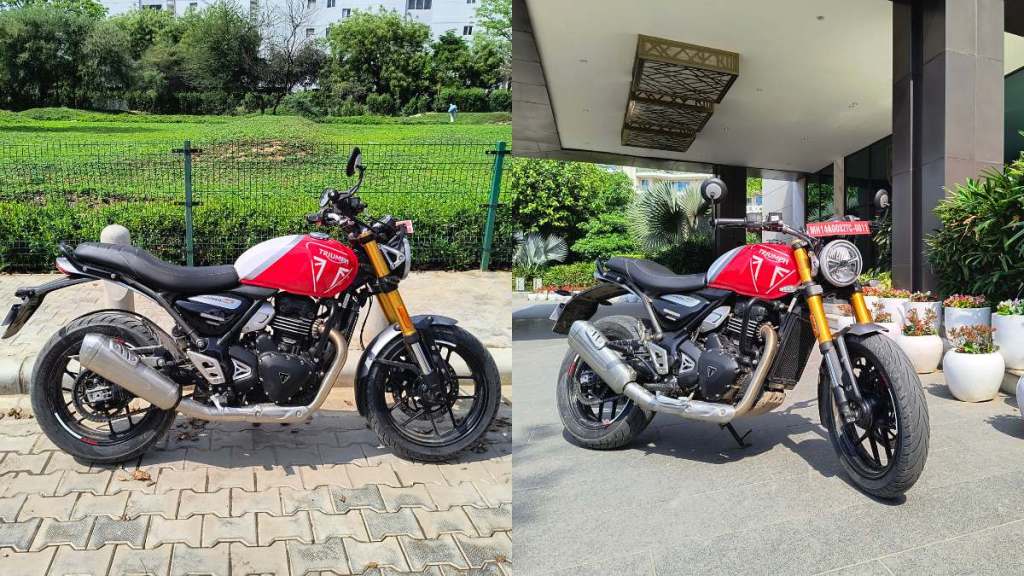
While riding a bike, when you hit an unnecessary speed breaker, you either come to almost a dead stop, or you stand on the footpegs, and increase your pace.
Triumph knows how to ride, and when it hit the GST 2.0 speed breaker in September 2025 – when bikes above 350 cc were placed in the highest bracket of 40% – it quickly developed a new engine for its 400-cc range.
What did it do?
Instead of changing the cylinder bore to reduce the engine size to 349 cc, the engineers shortened the stroke, which has led to a minor drop in power and speed, but may have increased fuel efficiency. It, however, kept ‘400’ in the name – and these bikes are Speed 400, Scrambler 400 X, Speed T4, Thruxton 400, and Tracker 400.
How does it ride?
I tested the Speed 400, and it feels extremely familiar because the riding position and design etc are the same. Even the throaty sound of the 400-cc engine is there.
While the displacement is lower, the tuning has ensured there is no apparent loss of performance. Peak torque has dropped from 37.5 Nm to 32 Nm, and power from 40 PS to 37 PS, but the 0-60 km/h acceleration is almost the same – 3 seconds in the older 400 cc, and 3.1 seconds in the new 349 cc. Beyond 60 km/h, however, the missing grunt of the 400 can be noticed by a good rider – the new Speed 400 goes from 0-100 km/h in 8.1 seconds, compared to 7.4 seconds by the older model.
But in the real world, the performance gap is barely noticeable – I’m sure if Triumph doesn’t tell you that this is a smaller engine, you will not notice any changes at all. The torque delivery is perfectly optimised for urban sprints and highway overtakes, and the 6-speed gearbox remains buttery smooth, ensuring the power is always accessible in the right gear.
On the highway?
It remains one of the easiest motorcycles for long-distance cruising, maintaining stability even at triple-digit speeds. Its telescopic front suspension and rear monoshock provide a balanced lean angle. But an area where the 349 cc shines is efficiency – while I couldn’t test the fuel efficiency in a day-long ride, physics tells you that a smaller capacity engine will likely burn less fuel – making these new bikes an ideal choice for the cost-conscious enthusiast.
Should you buy it?
Priced Rs 2.32 lakh, ex-showroom, the Speed 400 is quicker than Royal Enfield Classic 350 (Rs 1.83-2.18 lakh), and similar in performance to Harley-Davidson X440 (Rs 2.35-2.55 lakh), but the Triumph has the best power-to-weight ratio (223 PS per tonne, compared to just 104 PS of the Royal Enfield and 144 PS of the Harley-Davidson), the lowest seat height (803 mm), and is the lightest (179 kg) – the three attributes that matter the most in a motorcycle.