




India’s renewable energy expansion is creating opportunities beyond solar panels and wind turbines. The growing capacity base is also driving demand for the equipment and components required to build and operate these installations. The Government of India aims to reach 500 GW of non-fossil fuel capacity by 2030, up from 304.3 GW as of August 31, 2026.
Of the 2030 target, wind energy is expected to contribute 100 GW. Achieving these targets will require significant investments in solar and wind projects, creating opportunities across the manufacturing supply chain.
As developers scale up utility-scale solar installations and wind farms, demand for solar mounting structures, solar trackers, turbine towers and specialised drive systems is also increasing. This brings two newly listed engineering companies into focus. Both of them have a strong presence in renewable energy. One has a deep manufacturing footprint in solar and wind energy, with renewable energy products contributing 73% of operating revenue.
The other commands more than 50% of India’s domestic market for wind turbine yaw and pitch drives. Wind energy accounts for 26.8% of this company’s sales. Both are positioned to benefit from the renewable energy opportunity. But converting rising demand into revenue growth and profitability will be key.
#1 Karamtara Engineering: Tapping India’s Solar Infrastructure Growth
Karamtara Engineering is an integrated engineering and manufacturing company based in India. The company designs and manufactures structural steel components for power transmission, renewable energy projects and industrial infrastructure. A large portion of the company’s manufacturing volume supports renewable energy installations.
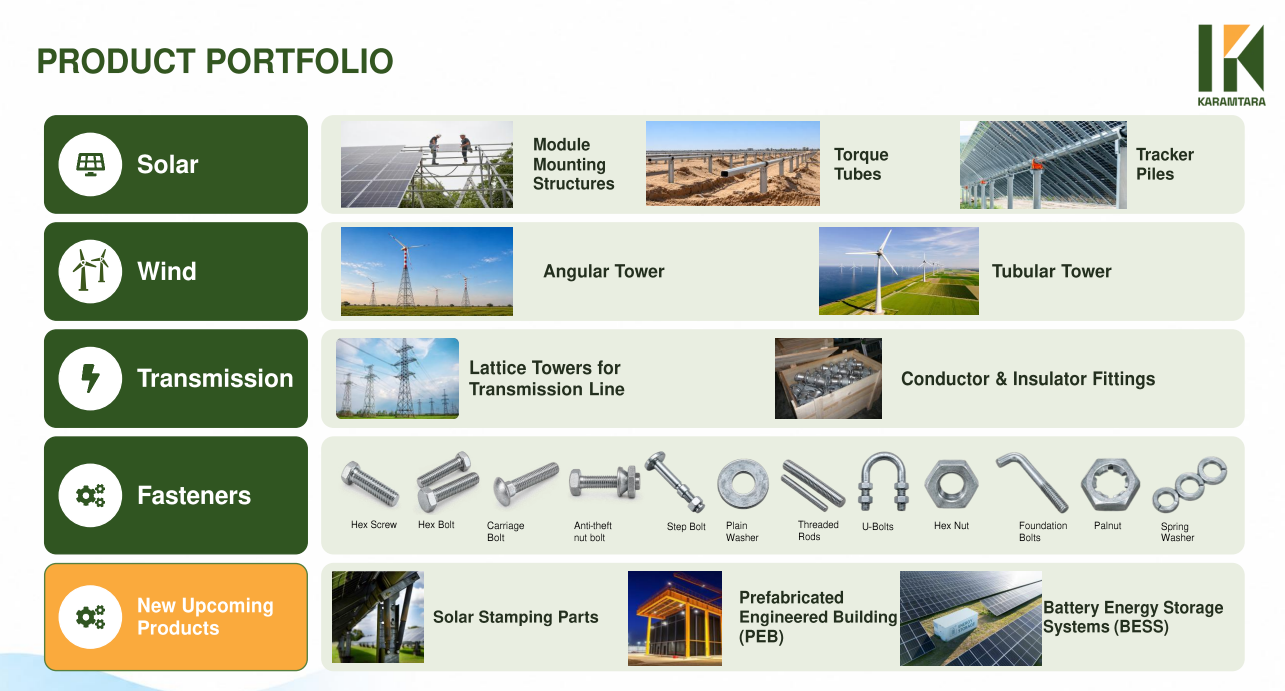
- Solar mounting structures: The company manufactures fixed-tilt solar module mounting structures (MMS) that support solar panels.
- Solar tracker components: It produces solar tracker piles, piers, torque tubes and solar stamping parts for automated tracker systems.
- Wind turbine towers: It fabricates tubular and angular lattice wind turbine towers.
Power transmission remains a traditional business line for the company. It designs and manufactures lattice steel transmission towers rated for line voltages up to 1200 kV, fasteners and conductor and insulator fittings. The company is also expanding into Battery Energy Storage Systems, Defence and Aerospace and Pre-Engineered Buildings.
Karamtara Product Portfolio
Karamtara Engineering’s Solar Tracker Business Drives 73% Renewable Revenue
Renewable energy products generated 73% of total operating revenue. Solar energy products made up 71%, while wind towers contributed 2%. Operating revenue grew 62% year-on-year to ₹1,646.7 crore in Q2FY27, driven mainly by renewable shipments. As of September 30, 2026, Karamtara has an aggregate saleable installed capacity of 879,800 metric tons per annum.
Global Solar Capacity Expansion and US Client Diversification
Karamtara supplies equipment to major solar developers and engineering contractors across the US, Europe, Latin America, and the Middle East. The number of solar product customers increased from 48 in FY24 to 73 in FY26. The top 10 customers accounted for 63.47% of solar revenue in FY24, which dropped to 48.63% in FY26.
The largest single customer’s share fell from 18.93% in FY24 to 7.98% in FY26. Average revenue per solar customer grew from ₹41.3 crore in FY24 to ₹52.4 crore in FY26. In FY26, 45.49% of revenue came from customers associated with the company for at least two years. A key driver of Karmatara’s growth is the shift toward utility-scale trackers.
Ground-mounted solar systems are increasingly shifting toward automated tracking systems to capture more energy. Karmatara is the largest domestic manufacturer of solar mounting structures and tracker components. Its current solar capacity is 527,600 MTPA, accounting for 60% of its total saleable capacity.
Karamtara’s ₹6,500 Crore Order Book and FY27 Manufacturing Scale
The company has broadened its product line beyond standard fixed-tilt mounting structures. It produces torque tubes, tracker piles and piers. Karamtara maintains 126,000 MTPA of capacity for tubular wind towers. The company’s consolidated order book stood at ₹6,500 crore as of September 30, 2026.
Approximately 61.5% of this order book (₹4,000 crore) is scheduled for delivery in H2FY27. The company targets 60% to 65% revenue growth over FY26. The company spent ₹900 crore on capital expenditure in FY26 and ₹370 crore in H1 FY27 to build new capacity. Capacity utilisation is projected to reach 60% to 70% by the end of FY27.
This performance is expected to be broader, with contributions from solar, wind, transmission and fasteners. Management expects long-term operating targets between 85% and 90%. Higher production volumes will improve operating leverage. Management expects continued margin expansion during H2FY27.
Karamtara Q2FY27 Financials: 62% Revenue Surge Meets Margin Pressure
From a financial perspective, operating revenue increased by 62% year-on-year to ₹1,646.7 crore. Operating earnings also increased, driven by volume growth. EBITDA (earnings before interest, taxes, depreciation, and amortisation) rose by 46% year-on-year to ₹196.2 crore. The EBITDA margin stood at 11.9% versus 13.2% in Q2FY26. Net profit grew by 37% to ₹94.6 crore.
However, the company’s cash conversion fell despite revenue growth. Cash flow from operating activities dropped 61% in H1FY27 to ₹114.0 crore, compared to ₹292.7 crore in H1FY26. International sales accounted for 73% of total revenue in Q2FY27. The US accounted for over 57% of revenue and the order book, exposing the company to concentration risk.
#2 Bonfiglioli Transmissions: Capitalising on India’s Wind Energy Expansion
Bonfiglioli Transmissions is India’s largest manufacturer of gearboxes and industrial drive solutions. The company is the Indian subsidiary of the Italy-based Bonfiglioli Group. Financially, the Indian company grew at a 14.5% compound annual rate between 2009 and 2025, with no year of revenue decline.
The wind industry business drives the company’s clean energy exposure. Wind turbines require special drive systems to control mechanical orientation and manage heavy structural stresses. Suzlon Energy, Nordex India and Senvion Wind Technology are its key customers. Bonfiglioli India supplies two key systems for turbines ranging from 225 kW to 5 MW.
- Yaw Drives: These drives rotate the entire turbine nacelle atop the tower to face incoming wind, ensuring steady power capture.
- Pitch Drives: Installed directly on the rotor hub, these drives adjust each blade’s angle to manage generator output and shed wind loads during heavy gusts.
Bonfiglioli Commands Over 50% Share of India’s Yaw and Pitch Drive Market
In total, Bonfiglioli holds more than a 50% market share in India for yaw and pitch drives among domestic manufacturers. Globally, the company holds the top position worldwide in wind turbine drives, with an estimated 21% global market share.
9M2026 Financials: Wind Segment Hits ₹479 Crore
In CY25, India installed roughly 6 GW of wind capacity, while Bonfiglioli produced approximately 12 GW worth of turbine drives domestically. It exports the remaining volume. In 9M2026, the wind vertical generated ₹479.6 crore in revenue, accounting for 26.8% of total sales. In Q32026, wind revenue reached ₹170.0 crore, up 8.0% year-on-year, accounting for 25.7% of sales.
The company has designed and developed more than 50% of the products in its Mobility and Wind divisions in collaboration with its customers. The design process typically takes 1 to 3 years. In the near future, management expects Wind segment growth to be driven by new installations and a shift toward 5 MW turbine models.
The 100GW Macro Tailwind and 15% CAGR Target
Notably, India had approximately 56 GW of installed wind capacity as of March 2026. The central government has set a 100 GW target by 2030. India’s domestic wind capacity is 6.1 GW in FY26. Industry expects 8-10 GW of annual installations. Bonfiglioli could be well positioned to benefit, given its dominant position.
Bonfiglioli Commands Over 50% Share of India’s Yaw and Pitch Drive Market
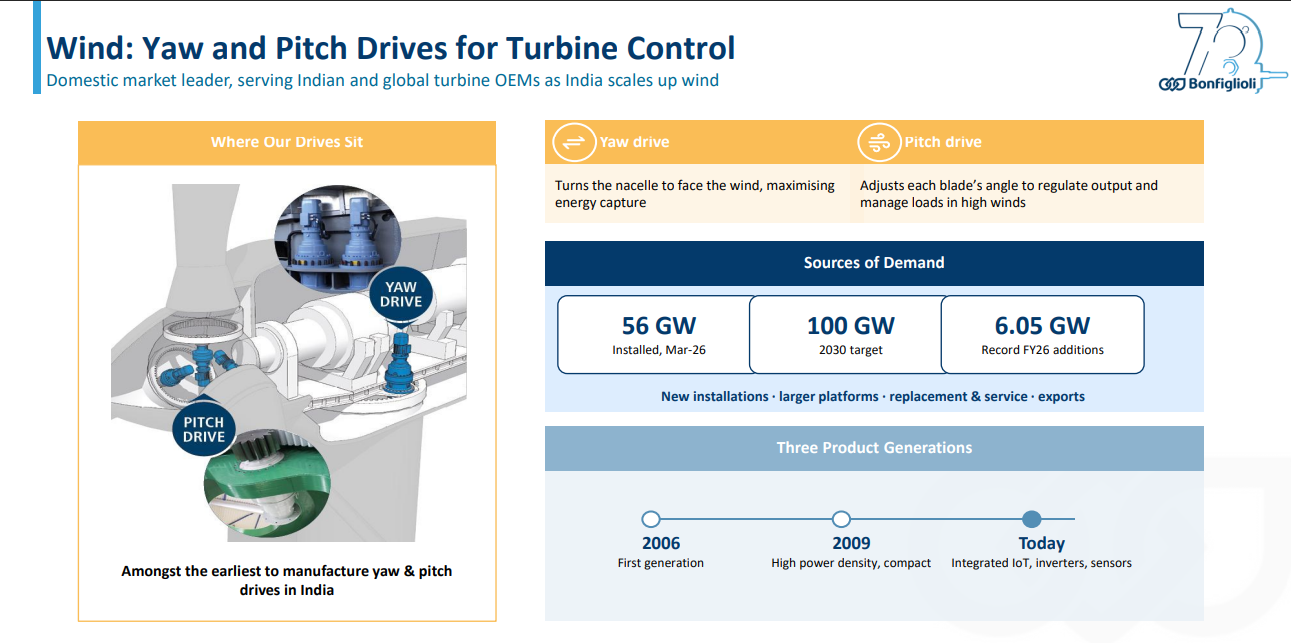
Growth is supported by new installations, replacement demand and repowering of older wind assets. As older wind sites reach late operational life, owners replace smaller, ageing turbines with modern systems to generate more power from existing land concession. The company also earns revenue from after-sales parts, field engineering support, and replacements.
For the medium term spanning CY2026 to CY2028, the company targets 15% compound annual revenue growth. It aims to sustain an EBITDA margin near 18.5% across CY2026-CY2028. Margins reached 19.7% in 9MCY2026, but are expected to return to normalised levels. The company will maintain a net cash position and remain debt-free.
The company follows the calendar year. In Q3CY2026, revenue grew 30.2% year-on-year to ₹660.2 crore, driven by Industry and Automation Solutions (+30.5%) and off-highway mobility (+54.9%). EBITDA grew 38% to ₹128.9 crore while margin expanded 110 bps to 19.5%. Net profit grew 38.2% to ₹87.1 crore.
The Premium Valuation Debate: Growth at a Price
Karamtara trades at a Price-to-Earnings (P/E) multiple of 47.7x. Its Return on Capital Employed (ROCE) and Return on Equity (ROE) stand at 23.4% and 20.8%, respectively. These ratios indicate that the company is generating reasonable returns on its capital and shareholders’ equity.
Bonfiglioli is trading at a high P/E multiple of 57x. However, it boasts strong return ratios, with an ROCE of 35.8% and an ROE of 25.7%. Nevertheless, both companies’ valuations are higher than the industry median. Both are newly listed and thus have limited trading history
| Peer Comparison (X) | ||||
Company | Price-to-Earnings Multiple | Return Ratios | ||
| Company | Industry | ROCE (%) | ROE (%) | |
| Karamtara | 47.7 | 32.2 | 23.4 | 20.8 |
| Bonfiglioli | 57.0 | 32.0 | 35.8 | 25.7 |
| Source: Screener.in (Data as of November 13 2026) | ||||
Overall, Karamtara Engineering and Bonfiglioli Transmissions are positioned to benefit from India’s expanding renewable energy ecosystem. However, they cater to different parts of the supply chain. Karamtara is expanding its manufacturing capacity to capitalise on rising demand for solar trackers, mounting structures and wind towers.
Karamtara is targeting fast revenue growth through expansion and higher manufacturing volume. Bonfiglioli, meanwhile, is building on its established position in wind turbine drive systems, supported by new installations, exports and demand for larger turbines. Bonfiglioli is focused on sustaining growth through its market position, product development and exports.
You could keep these names on your watchlist to track execution.
Disclaimer
Note: Throughout this article, we have relied on data from http://www.Screener.in and the company’s investor presentation. We used an alternative, widely used and accepted source only when the data was unavailable.
This article shares interesting charts, data points and thought-provoking opinions. It is NOT a recommendation. If you wish to consider an investment, you are strongly advised to consult your advisor. This article is strictly for educational purposes only.
About the Author: Madhvendra has been deeply immersed in the equity markets for over seven years, combining his passion for investing with his expertise in financial writing. With a knack for simplifying complex concepts, he shares honest perspectives on startups, listed Indian companies and macroeconomic trends.
A dedicated reader and storyteller, Madhvendra thrives on uncovering insights that inspire his audience to deepen their understanding of the financial world.
Disclosure: The writer and his dependents do not hold the stocks discussed in this article.
The website managers, its employee(s), and contributors/writers/authors of articles have or may have an outstanding buy or sell position or holding in the securities, options on securities, or other related investments of issuers and/or companies discussed therein. The articles’ content and data interpretation are solely the personal views of the contributors/ writers/authors. Investors must make their own investment decisions based on their specific objectives and resources, and only after consulting such independent advisors as may be necessary.