



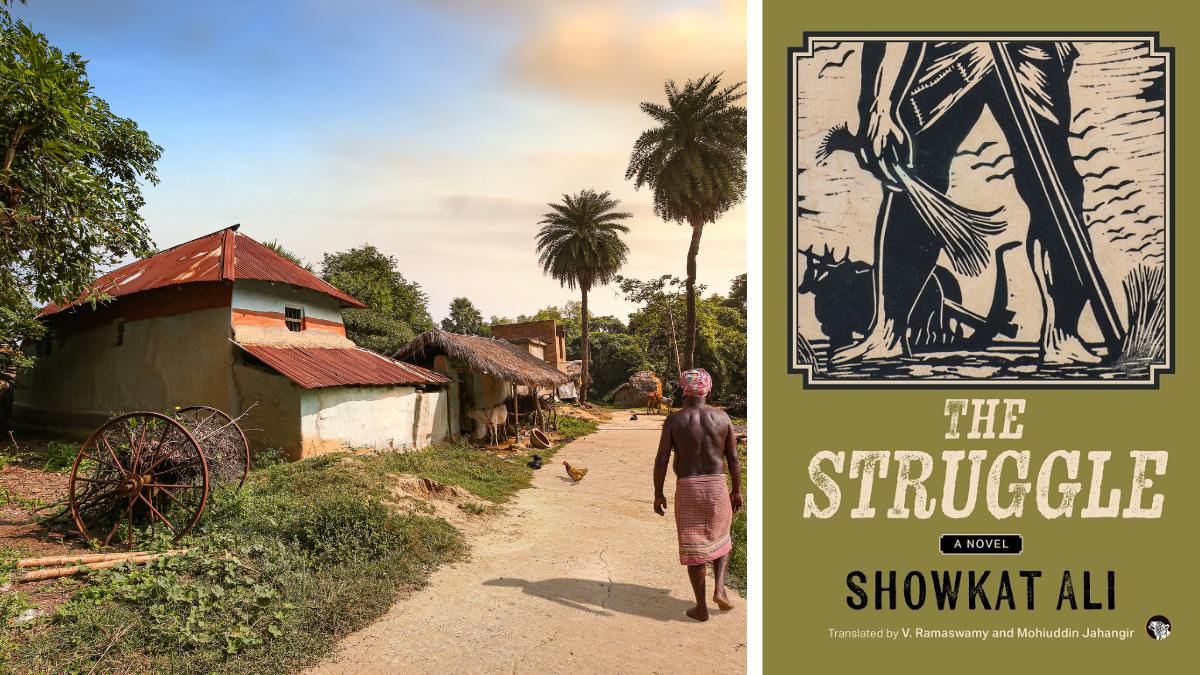
Well known for his celebrated Bengali novel Prodoshe Prakritojon, a thought-provoking tale of the poor and marginalised, Showkat Ali mirrors the continuing saga of the subcontinent’s land and gender politics in The Struggle, his pre-partition story published in the late 1980s. The three protagonists of The Struggle stand out for their aspirations, which clash with the prejudices sustained by a society and deep rooted in the power of land, money and patriarchy.
Phulmoti, one of them, is a young widow who faces the loss of her home, homesteads and a paltry farm if she doesn’t accept the diktats of opportunistic men, greedy landlords and an indifferent religious order. Abedali, Phulmoti’s young, illiterate son, represents a new generation that wants to ward off the ills of society and the weight of poverty. Also caught in the social quagmire is Qutubali, a young, illiterate man who extends a helping hand to Phulmoti and Qutubali in their struggle for survival.
A Widow’s Battle
Rural Bengal is the setting of The Struggle, whose heart-rending beginning exposes the fragility of a skewed social order and portends change in the political landscape. Ahedali, a marginal farmer, and his son Abedali are taking turns to torment a sick bullock that refuses to move forward. A village veterinarian, who attends to the bullock, confirms the animal has been poisoned. A bowl of tree barks and herbs is administered to the sick animal, the only one left to plough Ahedali’s small farm.
The bullock miraculously survives, but its master sadly succumbs to an illness he contracts not much later.
Ahedali’s untimely death sets off a series of events in the remaining family. His widow Phulmoti and her son Abedali are now left with their small land that becomes a bigger problem. To her horror, the young widow realises that her land and life are intricately linked to something that was now missing—a man, her husband. Trouble soon comes calling at her home and homestead, inhabited by the bullock, three goats and a few chickens. Phulmoti’s tiny piece of farm is cultivated by her neighbour Subratu under a prevailing sharecropping arrangement in which a part of the crop is returned to the land owner.
That arrangement now stands broken as Subratu, a married man, eyes the land and its owner who he wants to marry in order to appropriate the land. “When a woman goes to her husband’s house, does anything remains hers?” asks Subratu, while making his case for marrying Phulmoti, who also faces threats from many other men in the village, including a landlord’s son, each of whom have their eyes on the young widow. “These landlord folks are terrible,” Phulmoti tells her son, “They can kill someone with a smile on their faces.” Left to fend for themselves, Phulmoti and her son are clutching at straws to survive.
Sometimes she would find herself doing such ‘silly’ things as looking at the clouds while drying her hair in the sun, counting how long the sunlight would last to determine how soon the rain would fall. The arrival of a young man, Qutubali, into their lives makes their struggle even harder.
Noise of Moral Policing
Before Qutubali moved into Phulmoti’s house, she has to encounter the village munshi’s constant refrain, “How could a young woman roam around by herself?” After his arrival, Subratu’s wife complains, “Why has she kept the young man (Qutubali) in her house?” As the three characters try to repair their home and lives, the noise around them grows louder. Abedali is admitted to school and Qutubali ploughs the field as Phulmoti tries to bring the home together.
It won’t be easy as there will be newer struggles to overcome. Ali’s novel straddles a tortuous geography and politics that is strewn with dreams and contradictions. The author uses a powerful narrative to portray the problems of a country in the middle of change. The translation by award-winning Indian translator V Ramaswamy and Bangladeshi writer and translator Mohiuddin Jahangir illuminates the struggle of the poor and the marginalised with a rare ease and poise.
Faizal Khan is a freelancer
The Struggle
Showkat Ali
Translated from the Bengali by V Ramaswamy & Mohiuddin Jahangir
Speaking Tiger Books
Pp 296, Rs 599