



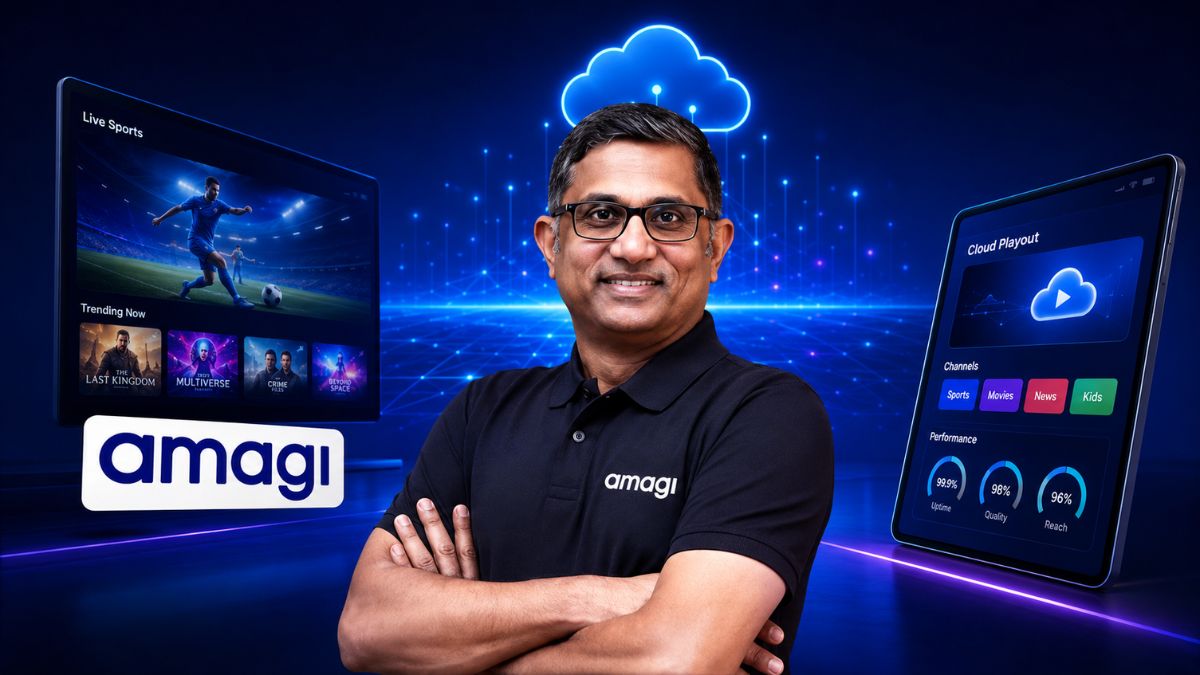
When Baskar Subramanian, Srividhya Srinivasan and Srinivasan KA studied Computer Science together at the Government College of Technology, Coimbatore, in the early 1990s, entrepreneurship was not part of the plan. The three batchmates joined Texas Instruments in Bengaluru after graduation and spent their early careers working on complex engineering systems.
In 1998, they launched their first venture, ImpulseSoft, which focused on Bluetooth stereo and embedded software solutions. The experience shaped how they looked at technology businesses. Their work exposed them to broadcast systems, the limitations of traditional infrastructure and the early changes in how audiences consumed media.
By the mid-2000s, television distribution remained heavily dependent on expensive satellite and hardware infrastructure, even as digital platforms were beginning to offer more targeted and flexible models.
That shift became the basis for Amagi, which the trio founded in 2008. The Bengaluru-based company started with a relatively narrow idea: enabling broadcasters to run region-specific television advertising more efficiently. Over time, it evolved into a cloud-based software company that helps media firms create, distribute and monetise channels across streaming platforms.
Today, Amagi works with broadcasters, content owners and advertisers across more than 40 countries and counts companies such as NBCUniversal, Warner Bros Discovery, DAZN, Roku and Lionsgate Studios among its customers.
The founders did not begin with large market surveys or formal consulting exercises. Instead, they relied on their understanding of broadcast systems and direct conversations with broadcasters and advertisers. Those discussions pointed to a mismatch in the television advertising market.
Brands with regional products were paying for national reach because television lacked the targeting capabilities emerging on digital platforms. “Advertisers were paying for national reach even when their products were relevant only to specific regions,” said Subramanian, co-founder, managing director and CEO of Amagi. “This created both cost inefficiencies and missed opportunities for broadcasters.”
The other problem was infrastructure. Broadcast workflows were built around specialised hardware and satellite networks that were costly to scale and difficult to adapt. The founders believed software and cloud-based systems could eventually replace much of that infrastructure, though the idea was still viewed cautiously by broadcasters at the time.
Convincing the industry was not straightforward. Television networks were accustomed to hardware-led systems and were sceptical of Internet-based workflows. Regional broadcasters became the first testing ground for Amagi’s model. Some agreed to experiment with geo-targetted advertising despite the concept still being unproven.
Those early partnerships helped demonstrate that localised television advertising could be monetised at scale and laid the foundation for the company’s later expansion into cloud broadcasting and streaming infrastructure.
Amagi began operations from a small office in JP Nagar, Bengaluru, with a team of around 10 people. Resources were limited and the founders handled everything from product development to customer discussions. Early funding support played a critical role in keeping the company going.
In 2009, Infosys co-founder N S Raghavan and the Nadathur Group invested in the company. “Their conviction gave us the confidence to invest deeply in product and scale,” Subramanian said.
Subsequent funding from Mayfield Ventures in 2013 and Premji Invest in 2014 helped the company expand internationally. Around that period, streaming television was beginning to gain momentum globally, particularly in the US market. Amagi shifted focus towards connected television and FAST, or free ad-supported streaming television, which relies on advertising rather than subscriptions.
The transition positioned the company alongside a broader structural shift in the media industry. As streaming platforms expanded, broadcasters and media companies increasingly looked for cloud-native systems that could handle channel creation, advertising, distribution and monetisation without relying on traditional broadcast hardware.
Amagi’s pitch to customers today is built around integration. “We bring together what has traditionally been a fragmented ecosystem into a single, unified, cloud-native platform,” Subramanian said. “Most legacy broadcast and media workflows continue to rely on hardware-led systems and operate in silos.”
The company has also scaled financially alongside that transition. Amagi has raised more than Rs 1,600 crore across funding rounds from investors including Accel, Norwest Venture Partners, Avataar Ventures and General Atlantic. Its revenue from operations for the first nine months of FY26 stood at Rs 1,109 crore.
The company’s trajectory mirrors a larger change in the media business itself. Television broadcasting, once defined by satellites and fixed infrastructure, is increasingly being rebuilt around software, Internet delivery and advertising-led streaming models. Amagi entered the market at a time when many broadcasters still viewed cloud systems cautiously.
Its growth came from betting that the economics and flexibility of software-driven distribution would eventually outweigh the comfort of legacy infrastructure. That bet, first tested through regional advertising experiments in India, has since turned into a business serving some of the world’s largest media companies.