



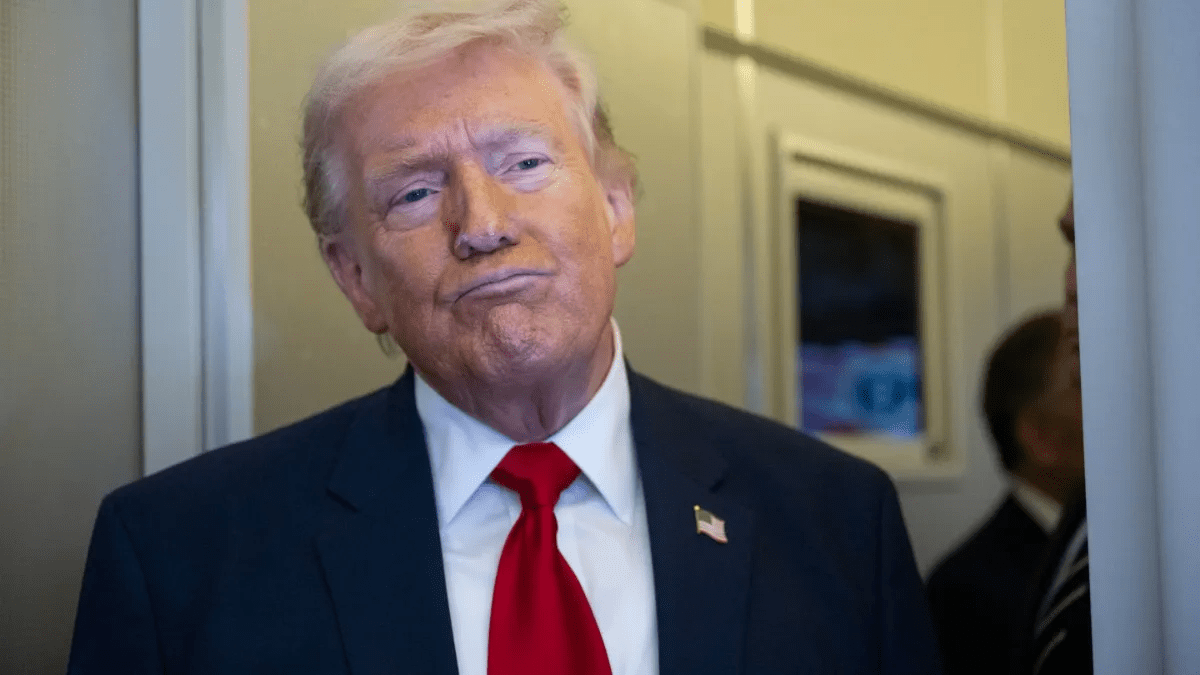
US President Donald Trump used a 25-minute address to the nation on Thursday to once again question the integrity of the 2020 US presidential election, announce the release of what he called new classified documents linked to China, and urge Congress to pass stricter voting laws.
The speech, delivered from the White House, was largely focused on election security, foreign interference, and his long-standing claims about the 2020 election. Trump also briefly touched on the conflict with Iran and claimed the benefits of recent military action would soon become clear.
Trump says China-related election documents will be made public
One of the biggest announcements in Trump’s speech was his decision to declassify documents that he said relate to China’s alleged influence on the 2020 US election.
According to Trump, the documents were collected by the White House Government Transparency Task Force along with staff from the President’s Intelligence Advisory Board. He said the findings had also been reviewed by the heads of US intelligence agencies.
“The White House will declassify documents relating to the 2020 election and alleged influence by China,” Trump said, adding that Americans deserve to know what happened.
However, he did not present any evidence during the speech to support his claims.
Trump says China obtained millions of voter files
During the speech, Trump claimed that newly declassified documents show that China carried out what “the largest compromise of election data in history.”
“The People’s Republic of China carried out what is believed to be the largest compromise of election data in history, resulting in China’s illicit acquisition of 220 million US voter files,” Trump said.
He added that China’s access to those records “presents an unprecedented election security nightmare.”
White House launches new ‘Election Integrity’ website
As Trump spoke, the White House also launched a new website titled “Election Integrity.”
The website contains documents that the administration says highlight what it describes as “key areas of election integrity” and concerns surrounding US elections.
The move came alongside Trump’s announcement that more documents would soon be released.
Trump repeats claims about the 2020 election
Throughout the speech, Trump repeated his long-standing claim that foreign powers interfered in the 2020 election.
He alleged that intelligence agencies had hidden China’s attempts to influence the election and accused members of the “deep state” of covering up information.
Trump has repeatedly made similar claims since losing the 2020 election to Joe Biden. However, those allegations have never been backed by evidence.
In fact, US intelligence agencies informed Trump on January 7, 2021, that they had found no evidence that any foreign country changed vote totals or created fake ballots during the election. There is also no public record showing that Trump objected to that assessment at the time.
Push for the SAVE America Act
Trump also doubled down on his call for Congress to pass the SAVE America Act, saying it is necessary to protect future elections.
The proposed legislation would require people to provide proof of US citizenship before registering to vote and would make voter identification mandatory at polling stations.
The bill, however, faces major hurdles in Congress. It does not currently have enough Republican support in the Senate to overcome the 60-vote threshold needed to move forward, while Democrats strongly oppose it.
Trump again argued that the Senate filibuster should be removed to help pass the bill. Senate Majority Leader John Thune has said Republicans are “not even close” to having enough votes for that step.
DHS Secy to address nation tomorrow
Trump said Homeland Security Secretary Markwayne Mullin will hold a briefing on Friday. According to Trump, Mullin will discuss what he described as the department’s recent work confirming cyber vulnerabilities in America’s electronic voting systems.
The president did not provide details or identify any specific vulnerabilities during his address. Before turning to elections, Trump spent the opening minutes of his address highlighting his administration’s achievements.
He said America was “safer, stronger and wealthier” and told viewers, “We are doing great.” He also pointed to measures such as lowering prescription drug prices before shifting to election issues.
Republican ally calls speech historic
Ahead of the address, Republican Senator Bernie Moreno of Ohio urged Americans to watch, saying he had been briefed by the White House.
“This may be the most important Oval Office address since the Cuban Missile Crisis,” Moreno wrote on X, adding, “The time for complacency with China is over.”
Questions over Trump’s claims remain
During the speech, Trump argued that intelligence agencies had covered up China’s efforts to interfere in the 2020 election.
However, those agencies were led at the time by officials appointed by Trump himself. On January 7, 2021, U.S. intelligence agencies informed him that they had found no evidence that any foreign country had changed vote totals or created fake ballots in the election. There is also no public record showing that Trump challenged those findings at the time.
Trump added that his administration has since reshaped the leadership of intelligence agencies with officials who share his views on election issues.
2021 intelligence report does not support Trump’s claims
Trump’s comments also differed from the conclusions reached by US intelligence agencies after the 2020 election. A US intelligence assessment released in March 2021 said with “high confidence” that China considered trying to influence the election but ultimately decided against doing so.
The report said Beijing believed neither a Trump victory nor a Biden victory was important enough to justify the risk of being caught interfering.
Instead, China relied on more traditional methods, including economic measures, lobbying, public statements and media messaging.
The report also stated there was no indication that any foreign government attempted to interfere with voter registration, ballot casting, vote counting or election results.
One dissenting opinion in the report argued that China did take limited steps to undermine Trump’s re-election campaign through social media and official messaging. Even that assessment agreed that there was “no information suggesting China tried to interfere with election processes.”
Notably, the report was overseen by John Ratcliffe, who served as Trump’s Director of National Intelligence during his first term and is now CIA director.