



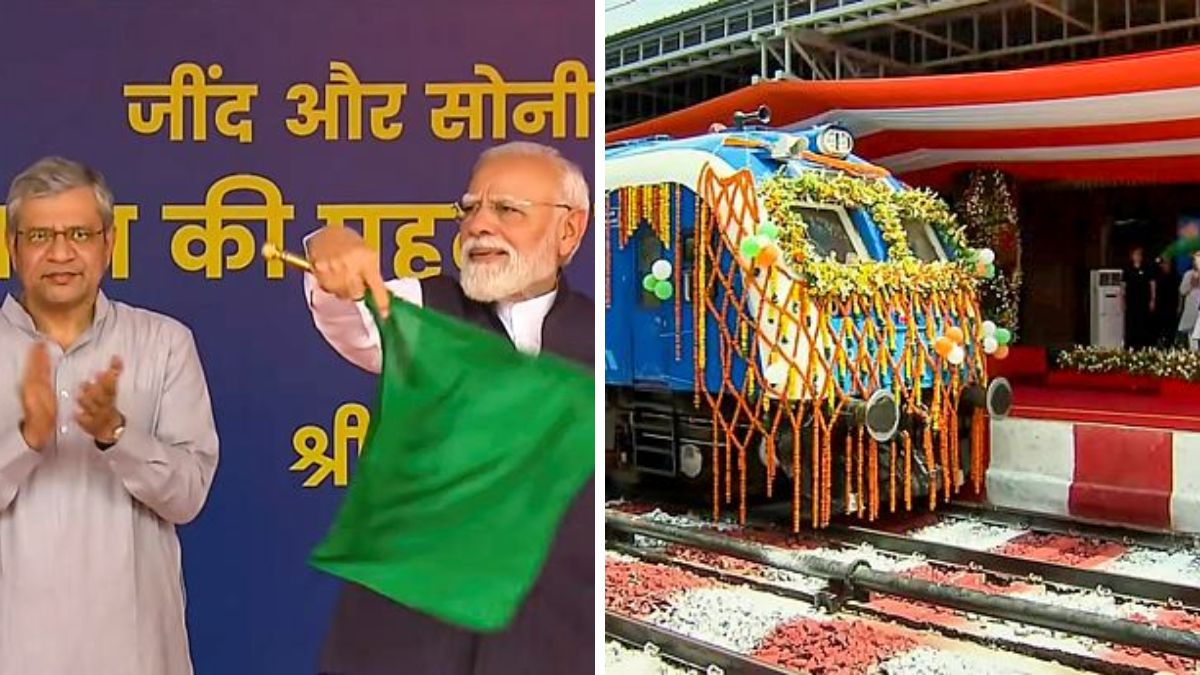
Prime Minister Narendra Modi on Friday flagged off India’s first hydrogen-powered passenger train between Jind and Sonipat, marking India’s entry into a select group of countries operating hydrogen-powered rail services. More than just the launch of a new train, the project signals Indian Railways’ next step in adopting cleaner propulsion technologies after achieving near-complete electrification of its Broad Gauge network.
The 89-km Jind-Sonipat service has been designed, engineered and integrated in India using indigenous technology. The project is intended to demonstrate the operational viability of hydrogen-powered trains while laying the foundation for cleaner rail transport in the years ahead.
A milestone in India’s clean mobility journey
Unlike diesel locomotives, the hydrogen-powered train generates electricity onboard through hydrogen fuel cells by combining hydrogen with oxygen. The process produces only water vapour and heat as by-products, resulting in near-zero emissions at the point of use. The 10-coach train can accommodate around 2,600 passengers and is among the longest hydrogen-powered passenger trainsets developed globally. It has a design speed of 110 kmph and will initially operate at up to 75 kmph on the Jind-Sonipat route.
Earlier in the day, Union Railway Minister Ashwini Vaishnaw described the project as a significant technological achievement for India, saying the entire propulsion system had been developed domestically.
“Hydrogen is a new energy, a new fuel. How to use this fuel in transportation, how to develop that technology in India, and making it an indigenous technology under ‘Atmanirbhar Bharat’ is very important. This is a major milestone for the Railways today, as the entire technology was developed in India and the IP rights are with India,” he said according to ANI.
“Hydrogen is made from water; an electrolyser plant is installed nearby. Hydrogen is produced from water and then converted back into electricity through this fuel cell. This electricity is then used to drive the motors. The entire propulsion system, from hydrogen production to its actual use in the motor, all IP rights are with India today,” he added, while explaining the technology behind the project, according to ANI.
More than a train: Building India’s hydrogen rail ecosystem
The project extends beyond the train itself. Indian Railways has established an integrated hydrogen ecosystem at Jind, including facilities for hydrogen production through electrolysis, storage, compression and refuelling. The supporting infrastructure is expected to help evaluate the long-term feasibility of hydrogen-powered passenger operations under regular service conditions.
Safety has also been a key focus during the train’s development. According to the Railways, the project underwent extensive testing, including an independent safety assessment by TUV SUD, Germany. The train is equipped with hydrogen leak detection, flame, heat and smoke sensors, automatic hydrogen shut-off systems and continuous monitoring mechanisms.
Addressing safety concerns, Vaishnaw told ANI, “A very comprehensive safety assessment was conducted over a long period. An independent safety assessment was done by TUV SUD, one of the world’s most reputed safety assessment agencies. In every way, the train is secure.”
“Many safety sensors have been installed, including heat detectors and leak detectors. Hydrogen is a very safe fuel in the sense that if the hydrogen concentration exceeds 0.25 per cent, all safety systems will be activated. The risk starts if it exceeds 4 per cent, so it’s completely addressed at less than 1 per cent,” he added, as per ANI.
The Railway Ministry said the project aligns with the National Green Hydrogen Mission and India’s long-term decarbonisation goals. Officials also see export potential for the indigenous technology as more countries explore low-emission alternatives for rail transport.
As per ANI, Vaishnaw said, “There are very few countries – one in Europe, one in China, and one in America where hydrogen trains are running. But the important thing is that once we have our own IP rights for this technology in India, we can export this technology to many countries.”