



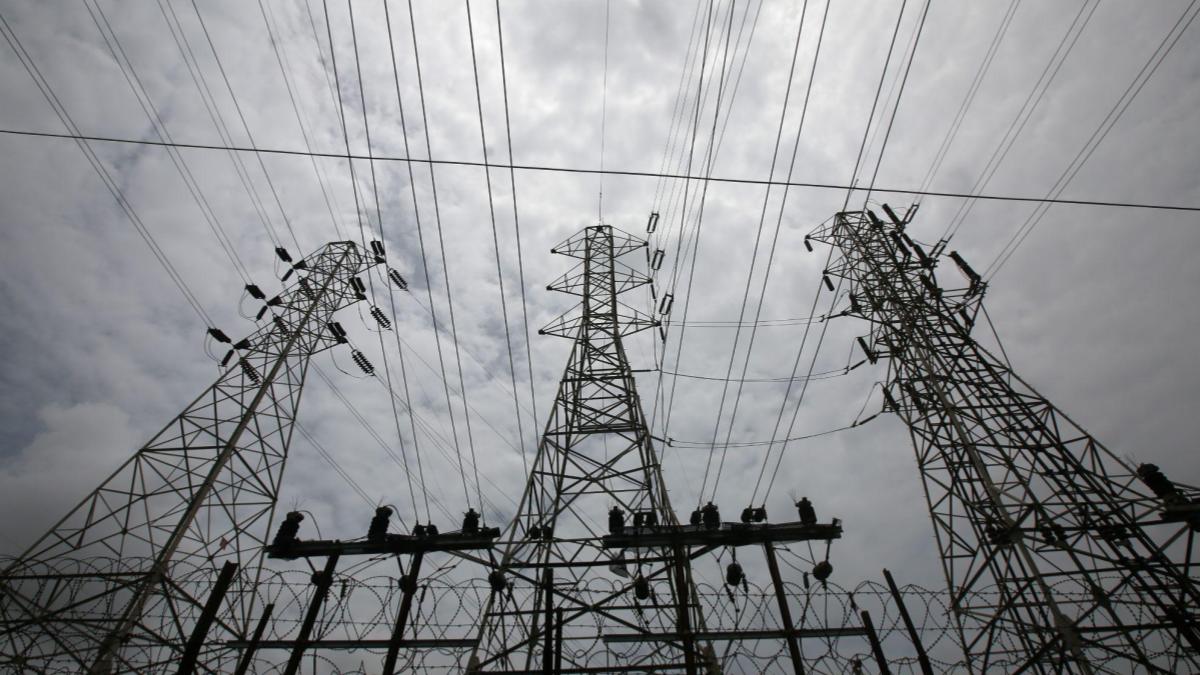
Farmers protesting against ‘inadequate’ compensation for power transmission infrastructure in Gujarat’s Saurashtra region plan to expand their month-long agitation statewide, intensifying pressure on Adani Energy Solutions Ltd.’s 765-kV transmission project linked to the Khavda Renewable Energy Park.
Protest leaders said on Friday that memorandums would be submitted to collectors in every district, while committees are being formed at the taluka level to expand the agitation.
Niket Panchasara, a close aide of Nehul Amruitya, one of the key leaders of the agitation, told FE on Friday that the agitation is now not confined to just Morbi. Nehul is the nephew of Kantilal Amrutiya, minister of state for labor, skill development, and employment.
Panchasara’s father, Pranjivanbhai, holds 12.5 bigha of land, out of which 10 bigha will fall under poles and transmission lines. “What do I do with the remaining 2.5 bigha?” he asked.
Pratik Patel, another farmer, challenged the state government to arrest them when they bring down the electricity poles if their demands are not met.
Khavda Green Energy Link
The project in contention is being implemented by Halvad Transmission Ltd. The company is a special purpose vehicle of AESL to draw additional power from the Khavda Renewable Energy Park in Kutch. The power transmission lines are spread over 240 kilometers. Located near the international border in the Rann of Kutch, the under-construction energy park is slated to be the world’s largest, spanning across more than 72,600 hectares of barren land.
Estimated to cost Rs. 1.5 lakh crore, the park has multiple developers.
Protest leaders say support for the agitation has continued to grow since it began in Jetpar village of Morbi on June 1. Farmers have been holding meetings across villages, while supporters gather daily at the protest camp—or “Chhavani”—where they participate in Ram dhun and garba while displaying placards against Adani and the state government.
“It all began on June 1 when people came to install a pole in one farmer’s field in Jetpar. Since then, we have received signatures in support of our cause from 19 lakh people. Daily on an average, there are 1,000 people who visit the protest site,” Patel said.
Revised Government Policy Fails
Initially, the state government calculated the compensation at 200% of the jantri rates of the affected land. The Jantri rate is a circle rate for land and property valuations decided by the state government. Following the protests, the government on July 4 revised the compensation policy at 200% of the market value, and it also agreed to give a single upfront 100% payment before the work began in the field. It also expanded the tower base area for which the farmers were to be compensated.
The state government revised its compensation policy earlier this month following the protests, but farmers say the changes fall short of their demands.
More than 13 farmers ended the indefinite hunger fast at Morbi after the government came out with a circular. However, they are demanding nothing less than 400% of the market value and 230% of market rates for overhead lines crossing over crops. Their other demands include totally rerouting the transmission lines from their fertile fields. They are also opposing a “lottery system” by which the market rates will be decided.
“We had to continue the fight. We ended the hunger fast on health grounds,” Patel said.
When the poles are erected on fertile land and transmission lines pass over the farms, then the land does not remain useful and its prices come down, he said.
Though the agitation is apolitical, Congress leader Lalji Desai echoed what Patel said. “It is a question of lakhs of bighas of land. The standing crop has also been damaged. An estimated 5.5 lakh families are likely to be affected by this project,” he pointed out.
Sources in the know of the developments said that the leaders are extending support without the party’s banner. Pravin Ram of the Aam Aadmi Party and other leaders too have extended support.
ASEL, in a media statement, stated that they are “fully committed to engaging with the landowners and paying them fair compensation as determined by the civic administration under the law.” It further maintained that their compensation rates are determined by district officials after multiple rounds of stakeholder hearings. Additionally, the company alleged that “some vested interests are instigating the landowners” and noted they received permission to continue work “under police protection” if needed.