



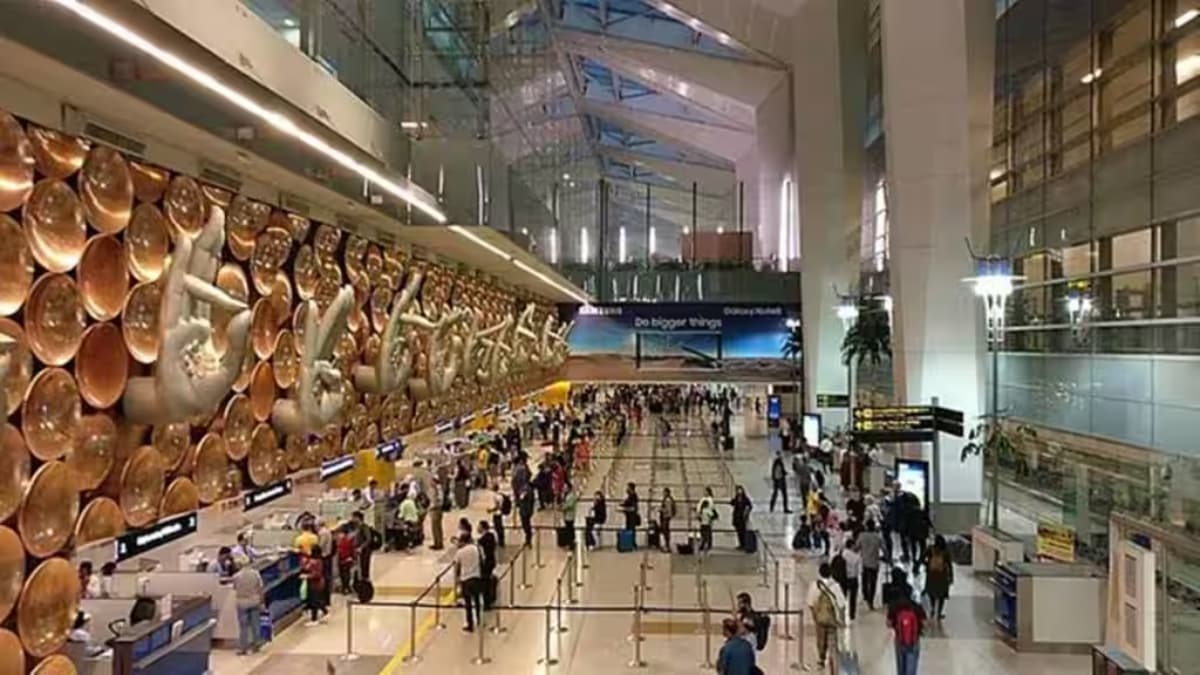
The next time you find yourself paying a premium for a quick snack at any airport terminal, remember that your “airport cravings” are more than just a convenience. They are also fast becoming a financial pivot in India’s aviation infrastructure. According to the latest report by Jefferies, the business of running an airport is rapidly transitioning from a utility service to a high-margin retail play.
India’s airport sector is quietly minting money from a source that most travellers don’t take as much notice of while spending. According to the report by Jefferies, non-aeronautical revenues at airports are growing at an annual rate of 16% between FY25 and FY28e. They now account for 40-50% of total airport income. Interestingly, these revenues drive nearly 80% of airport operator valuations.
GMR Airports, which operates Delhi and Hyderabad, two of India’s busiest airports after Mumbai, expects its consolidated EBITDA to grow at 28% CAGR between FY25-FY28, as per Jefferies’ estimates. The report notes that “GMR’s per-pax spends at Delhi/Hyderabad airports continue to scale up.”
The hidden business model inside your boarding pass
There is a common assumption that airports make money from airlines paying for runway usage and passenger fees. That’s only half the story.
“With aeronautical charges capped by regulation, airports will continue to lean on non-aero streams for margin expansion,” the Jefferies report noted. “Retail, food & beverage, and duty-free segments remain poised for strong traction, supported by rising passenger spend and premiumization trends.”
However, non-aero revenues, which include everything from that Rs 400 Starbucks latte to duty-free shopping and car parking, are projected to grow from Rs 2,900 crore in FY25 to Rs 6,300 crore by FY28 across GMR’s portfolio alone, according to Jefferies data.
Meanwhile, Delhi Airport recently implemented a 148% increase in aeronautical charges, grabbing headlines. But the real profit engine runs on a different fuel, and that is consumer spending inside terminals, Jefferies explained.
Three new airports, 3 new shopping destinations
According to Jefferies, the business model is about to expand, as three major airports are opening in 2026: Navi Mumbai (operated by Adani), Noida International Airport (opeated by Flughafen Zurich), and Bhogapuram near Visakhapatnam (operated by GMR).
These airports aren’t just being built as transit points. The report describes them as “reinforcing long-term growth despite near-term operational challenges and regulatory constraints.”
Adani Enterprises, which operates six airports, including Mumbai, Ahmedabad, and the newly opened Guwahati terminal, is also betting big on this model. The Jefferies report notes that Adani is “amid starting work on RE city side projects at Mumbai, Navi Mumbai, and Ahmedabad Airports.”
Indian flyers are spending more per trip, even when they travel short distances. Jefferies highlights that travellers are “planning short term, spending more per trip, and seeking differentiated experiences rather than just transport and accommodation”.
For context: India’s airport traffic grew from 150 million passengers in FY21 to 412 million in FY25, an 8% annual growth rate. Jefferies projects this could reach 450 million by FY28.
The per-passenger profit machine
As per Jefferies, there are 2 reasons that make this business attractive – monopolistic positioning and rising spending per passenger.
GMR’s strategy includes “retail scale-up and re-monetization,” according to the report. The company is “adding depth in airport-adjacent biz” while “re-monetisation across its airport portfolio is progressing steadily, with new projects coming onstream.”
Real estate here doesn’t mean residential apartments. It refers to commercial space around airports, hotels, office complexes, and what the industry calls “aerocities.” These generate annuity-style rental income that continues regardless of flight schedules.
The report states, “Together, these factors position GMR for another strong year following a robust FY26.”
Who benefits beyond GMR?
While GMR Airports is the only pure-play listed airport operator in India, the opportunity extends to adjacent businesses.
Travel retail companies, food and beverage operators, and duty-free chains stand to benefit. The report notes that both Delhi and Hyderabad airports “are now sourcing all their energy requirements from renewable sources,” suggesting infrastructure investments that enable more commercial space.
Interestingly, the report highlights a business model transition: “Recent transitions include the takeover of Delhi Duty Free and Cargo ops. The centralising of ownership and ops strengthens GMR Airports Limited’s (GAL) credit profile and cash flows and enhances strategic control.”
This means GMR is moving from just collecting rent from duty-free operators to running these businesses directly, capturing the full margin.
The catch: Traffic growth depends on airlines
However, the airport revenue model comes with an Achilles heel; whether they get it from landing fees or samosa sales, they require one thing, and that is passenger footfall. And traffic growth trends in 2026 is projected to be uncertain, according to Jefferies. “Passenger traffic growth should remain positive, though it hinges on pilot shortages and FDTL norms affecting airlines,” the Jefferies report cautions.
FDTL refers to Flight Duty Time Limitations, new regulations that reduced how many hours pilots can work. This has forced airlines, particularly IndiGo, to cut capacity. The report notes air passenger growth slowed to just 1% year-on-year in the first half of FY26, then slowed further in December.
“If crew constraints persist, airlines may cap capacity additions, limiting throughput at airports despite physical capacity being available,” the report warns. “This scenario would particularly impact domestic routes, making non-aero revenue streams even more critical for operators.”
When fewer people fly, retail spending per passenger becomes even more important to maintain profits.
The next privatisation wave
The government is preparing another round of airport privatisations. Round 3 will cover 11 Airports Authority of India properties, bundled into five clusters.
Jefferies pointed out that “following PPAC’s in-principle approval and Cabinet clearance, the government is targeting launch of tenders by March 2026.” These include airports in Bhubaneswar, Varanasi, Amritsar, and Raipur, cities that together handled 19.5 million passengers in FY25, up 13% year-on-year.
For private operators, this represents new captive markets where the retail-first model can be replicated, the report adds.