



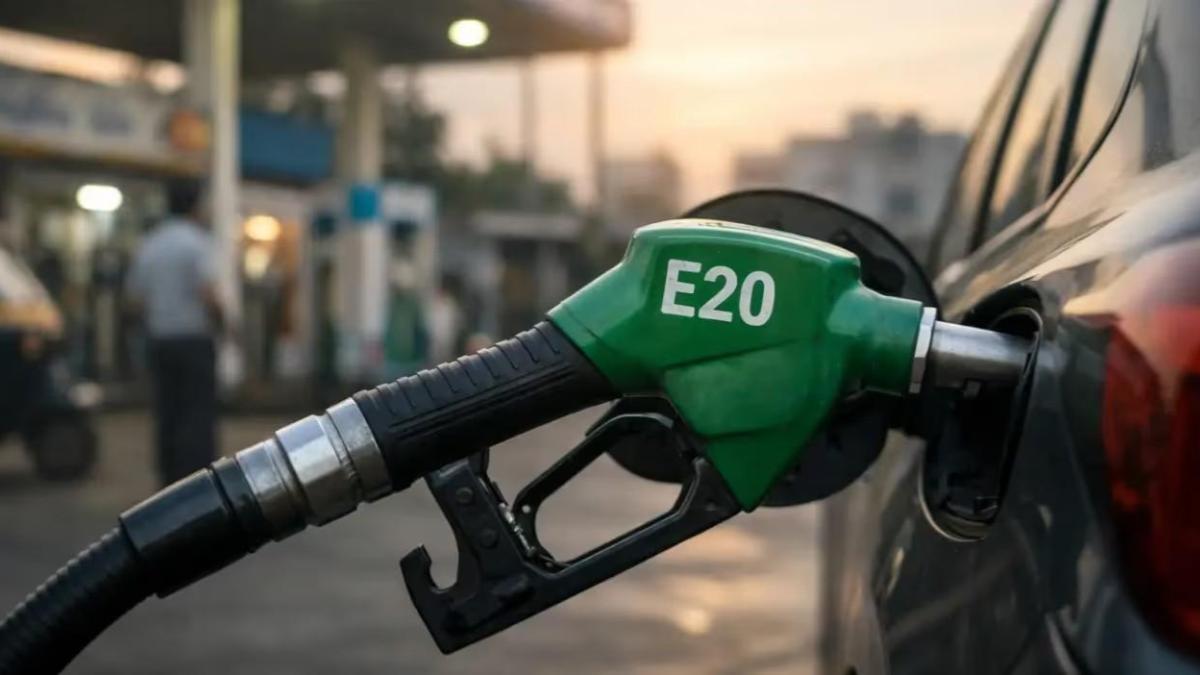
Oil marketing companies are now paying more to buy ethanol than the pre-tax cost of the petrol it displaces, government data placed before Parliament this week shows.
The Petroleum Ministry told the Rajya Sabha on Monday that PSU oil firms procured over 705 crore litres of ethanol for Rs 49,577 crore in Ethanol Supply Year 2025-26 (up to June), an average of Rs 70.2 per litre. The per-litre price has stayed remarkably flat, Rs 71.8 in 2023-24 and Rs 71.6 in 2024-25, even as crude has swung sharply over the same period.
At 705 crore litres in roughly eight months, the current year’s run-rate projects to about 1,050 crore litres, broadly level with 2024-25’s 1,033 crore litres.
| ESY * | Quantity of Ethanol Procured for Blending | Ethanol Procurement Value (Inclusive of Transportation, GST) |
| 2023-24 | 679.04 crore litres | Rs 48,757 crore |
| 2024-25 | 1033.31 crore litres | Rs 73,996 crore |
| 2025-26 (up to June 2026) | 705.43 crore litres | Rs 49,577 crore |
(Source: PSU OMCs)
* The Ethanol Supply Year (ESY) runs for 12 months from November 1 to October 31.
How Ethanol compares with petrol
Against crude, the gap is stark. India’s average crude import cost was Rs 47.54/litre in FY25 and Rs 42.96/litre in FY26, before the Iran conflict pushed the final month sharply higher (Rs 41.76 in February 2026 to Rs 68.69 in March).
Crude has since eased through FY27, from Rs 69.28/litre in April to Rs 45.74 in July, averaging Rs 57.42/litre so far this year.
Crude oil costs during the first four months of FY27:
- April = Rs 69.28 per litre
- May = Rs 64.29 per litre
- June = Rs 50.37 per litre
- July = Rs 45.74 per litre
The retail price of petrol and diesel is formulated by adding state and central taxes, a dealer commission and the relevant operational costs incurred by OMCs.
| Year | Average crude oil cost for India |
| FY25 | Rs 47.54 per litre * |
| FY26 | Rs 42.96 per litre * |
| FY27 (till July) | Rs 57.42 per litre * |
(Source: PPAC data)
*using the current exchange rate of Rs 96.22 per dollar
But the fairer benchmark is refinery-gate petrol, not raw crude. “On a pure procurement basis, the administered price OMCs pay for ethanol, roughly Rs 65 to Rs 72 a litre depending on feedstock, is higher than the pre-tax, refinery-gate cost of petrol, which runs closer to Rs 53 a litre,” KBS Sidhu, IAS (Retd.), former Special Chief Secretary of Punjab, told Financial Express Digital.
Blending turns genuinely advantageous, he adds, only when crude climbs into the $120–130 range or higher. At today’s prices, he argues, the blended fuel is not cost-saving.
The gap widens further once energy content is accounted for: ethanol carries roughly a third less energy per litre than petrol, so more of it is needed to cover the same distance.
None of this disputes the Rs 1.97 lakh crore the government cites in cumulative foreign-exchange savings since 2014-15. It’s a figure earned largely across higher-crude years. The question critics raise is narrower, and it’s whether blending pays at current crude prices.
How ethanol is procured
OMCs source ethanol domestically from sugarcane-based feedstock (C and B heavy molasses, cane juice, sugar syrup) and grain-based feedstock (damaged food grains, surplus FCI rice, maize).
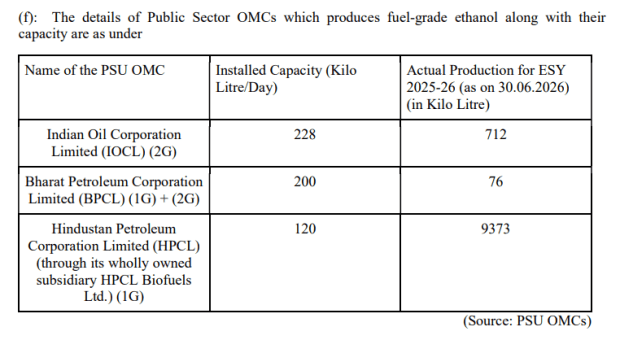
The three big PSUs (IOCL, BPCL and HPCL) produce almost none of it themselves: against installed captive capacity of 5.48 lakh litres/day, their own output to June 30 was about 1.01 crore litres, a fraction of the roughly 1,016 crore litres NITI Aayog’s 2020-25 roadmap estimates E20 requires. As of July 16, 501 ethanol suppliers were registered with OMCs.
No decision yet on blending beyond 20%
The government confirmed it has not decided to raise blending above E20. Any increase would follow “only after detailed scientific and technical studies and consultations with all relevant stakeholders,” Union Minister Suresh Gopi said. He noted India hit the E20 target five years early, crediting the programme with over Rs 1.97 lakh crore in FX savings since 2014-15, the displacement of nearly 316 lakh tonnes of crude, about 952 lakh tonnes of avoided CO₂ emissions, and more than Rs 1.66 lakh crore in additional farmer income.
‘No complaints from vehicle manufacturers about ethanol-blended petrol’
The minister also said that the government had received no “widespread or substantiated complaints” from vehicle manufacturers, automobile associations or consumer groups over engine failure, fuel-pump problems, corrosion or water contamination linked to E20 fuel, though it had taken note of concerns raised in media and on social media and examined them scientifically.
He added that more than 20 crore two-wheelers and over 3 crore petrol cars — including many built before E20 certification — have run on E15/E19/E20 fuel for over three-and-a-half and two-and-a-half years “without any verified evidence of widespread engine failure or vehicle breakdown”.