



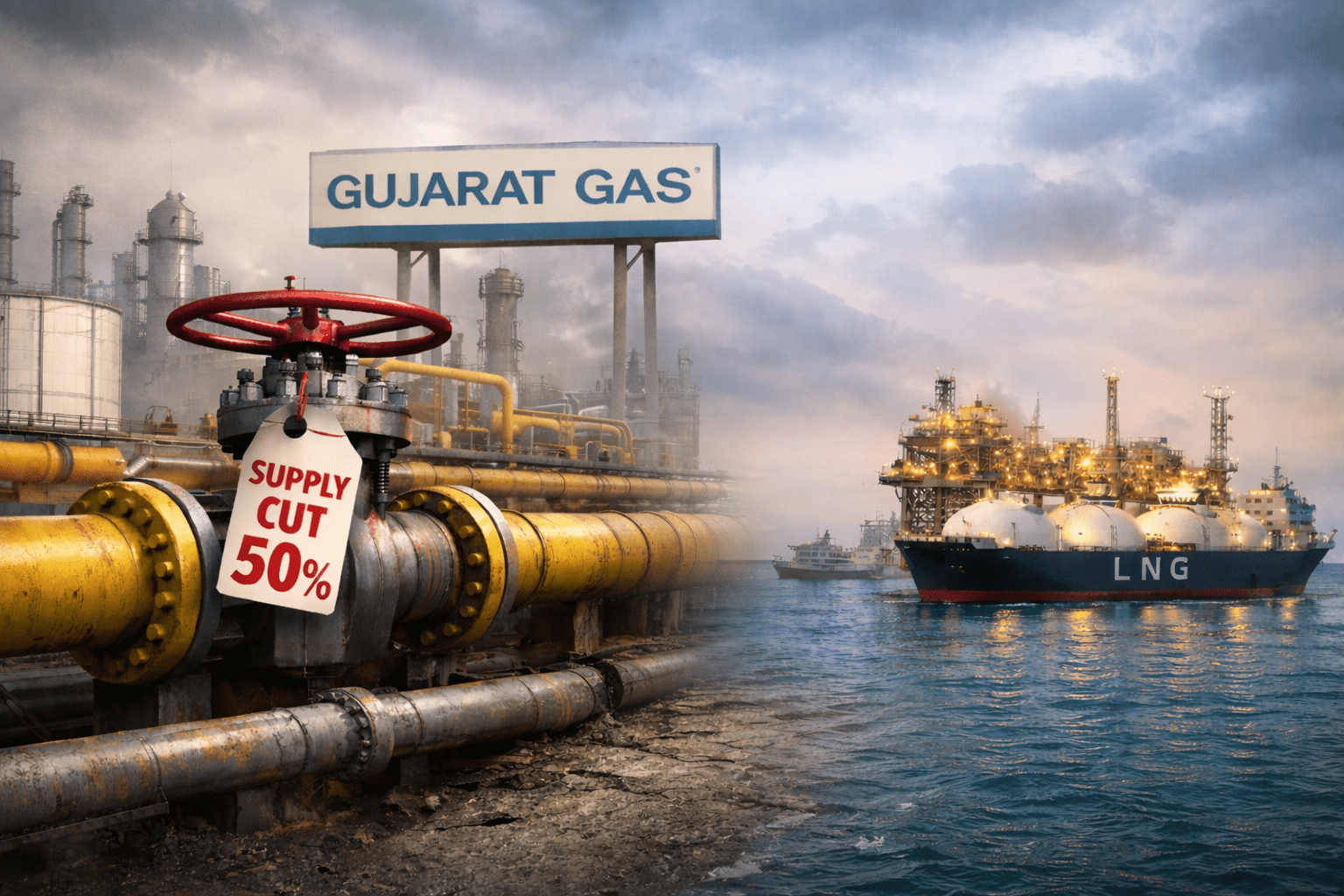
In the wake of the Gulf War crisis and the shutdown of the Strait of Hormuz, Gujarat Gas has announced that it will cut daily contracted gas supply to industrial customers starting March 6.
“In light of the recent ongoing war in the Middle East region impacting the gas supply scenario, the availability of R-LNG has become severely constrained,” the company stated.
Not just Gujarat Gas, other gas importers also issue force majeure notices
It’s not just Gujarat Gas, India’s largest gas importer, Petronet LNG, issued a force majeure notice to its supplier, QatarEnergy, and to domestic buyers including GAIL (India), Indian Oil Corp and Bharat Petroleum Corp, according to Reuters. GAIL and Indian Oil have already reduced gas supplies to industries.
Petronet LNG said three of its LNG tankers were unable to reach the Ras Laffan loading port in Qatar. In a filing, Petronet said QatarEnergy has also issued a notice “indicating a potential event of force majeure” due to hostilities in the region.
Why are companies restricting gas supply?
Amidst the ongoing Middle East war QatarEnergy has halted production at its Ras Laffan LNG facility after drone attacks and declared force majeure on certain deliveries.
This is critical for India because Qatar supplies about 40% of the nearly 27 million tonnes of LNG that India imports annually. On top of that, attacks have effectively brought oil and LNG shipments through the Strait of Hormuz to a near halt, driving up global energy prices and sharply raising war-risk insurance and shipping costs.
What is ‘Force Majeure’?
It’s essentially a legal shield. By invoking this clause in their Gas Supply Agreements, Gujarat Gas is telling industrial customers that it can’t deliver the contracted gas volumes. This isn’t a breach of contract — it’s an extraordinary event beyond their control. The triggering event is classified as “Acts of War,” which is explicitly not covered under Gujarat Gas’s insurance policies.
Who will be most impacted by cuts?
The supply cut mainly affects industries relying on piped natural gas — major manufacturing clusters like ceramics in Morbi, chemicals, textiles, and other energy-intensive sectors across Gujarat. Reports indicate it’s roughly a 50% supply cut. The reduction will remain in effect until at least March 31, with possible extension depending on supply conditions.