



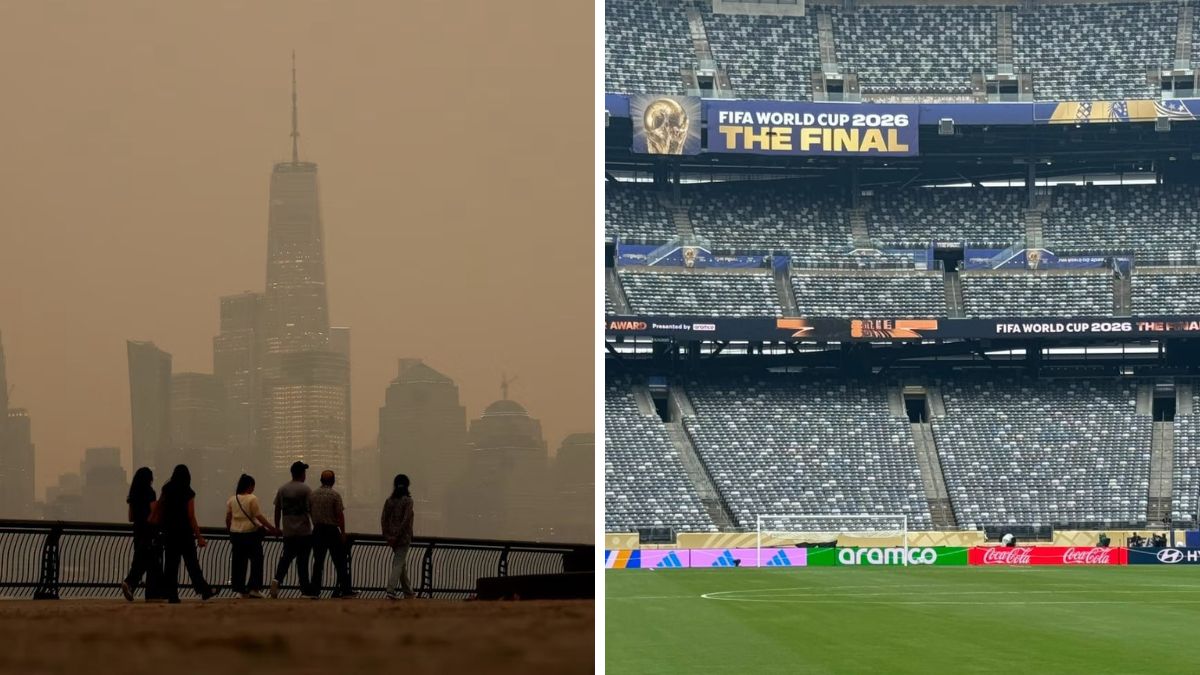
It was meant to be a weekend defined exclusively by tactical masterclasses and the glittering presence of Lionel Messi and Lamine Yamal. Instead, the build-up to the 2026 FIFA World Cup Final between Spain and Argentina has been hijacked by a visible manifestation of the global climate crisis.
A thick, toxic orange-and-grey haze fuelled by unprecedented wildfires in Canada has rolled heavily across the Northeast United States, plunging New York-New Jersey Stadium into an environmental health emergency.
Spain trained outdoors in hazardous conditions on Thursday, drawing criticism from health experts who felt the session should have been moved indoors, before a separate final training session on Saturday was scrapped entirely—not for the smoke, but after a FIFA official invoked the mandatory 30-minutes-without-lightning safety protocol amid the storms rolling through northern New Jersey.
With the open-air stadium offering zero protection against atmospheric hazards, FIFA has found itself under intense scrutiny from global health authorities for an apparent lack of a formal, dedicated air quality contingency framework.
The Medical Verdict: A Threat to Heart and Lung Health
While fans and organisers often view poor air quality as a minor respiratory discomfort, prominent medical figures have stressed that the microscopic particulate matter (PM2.5) floating over the pitch poses a severe threat to the cardiovascular systems of elite athletes and spectators alike.
Dr. Mohammed Alo, a former assistant clinical professor of medicine at Midwestern University and Ohio University, detailed the stark, immediate physiological dangers of placing elite athletes under heavy exertion in these conditions:
“The relationship between air pollution and cardiovascular disease is well established and supported by extensive epidemiologic data. Short-term exposure (hours to days) increases the risk of myocardial infarction, stroke, heart failure, arrhythmia, and sudden death by approximately 1–2% per 10 μg/m³ increment,” Forbes quoted him as saying.
Dr. Alo further warned that letting events proceed under prolonged or recurring exposure escalates the danger dramatically:
“Longer-term exposure (months to years) amplifies these risks to 5–10% per 10 μg/m³, with prospective cohort studies showing 16–31% increases in ischemic heart disease mortality per 10 μg/m³ increment in annual mean PM2.5. Importantly, the exposure–response relationship extends to levels well below current regulatory standards, with no identified safe lower threshold at the population level.”
Adding to this, Dr. Abeer Berry, director of noninvasive cardiology at DMC Huron Valley-Sinai Hospital, emphasised that the toxic chemicals carried within wildfire smoke serve as a direct destabilising force for vulnerable patients, including spectators sitting in the stands who may have underlying health conditions:
“Air pollution increases cardiovascular risk factors like elevating blood pressure and heart rate, increasing insulin resistance and total cholesterol, bad cholesterol and triglycerides. It also can lead to increased calcium scores, accelerated plaque accumulation and higher likelihood of unstable plaque formation.”
FIFA Caught Unprepared Under a Hazy Sky
Unlike domestic North American leagues like Major League Soccer (MLS) and the National Women’s Soccer League (NWSL)—which possess strict, mandatory protocols to delay or cancel matches when the Air Quality Index (AQI) crosses specific thresholds—FIFA’s official rulebooks are surprisingly hollow regarding smoke pollution.
While soccer’s governing body features comprehensive, mandatory protocol measures for extreme heat (such as designated hydration breaks), it does not feature an explicit framework for toxic air conditions. In a previous statement, FIFA noted that “climate-related risks are managed in close coordination with host cities,” but the lack of a clear, public threshold for postponement has drawn sharp criticism from sports ecologists.
A Weather Miracle: Thunderstorms Liquidate the Smog
Just as logistical panic threatened to overwhelm tournament organisers, nature provided a dramatic, eleventh-hour reprieve.
Late Saturday afternoon, a violent front of severe thunderstorms and torrential rain lashed East Rutherford. While the storm caused localised flash flood warnings and temporarily evacuated the stadium’s seating bowl, the aggressive weather front successfully performed a massive atmospheric cleanup.
“The storm front will effectively sweep the atmosphere clean,” explained climate specialist Jeff Berardelli in another report, published in Associated Press (AP) . “It won’t be dangerous anymore. It’s going to be dramatically better.”
Meteorologists confirm that the AQI at New York/New Jersey Stadium is projected to drop from Saturday’s hazardous “unhealthy” tiers down to a safe, highly manageable “moderate” classification by the time Sunday’s match kicks off. With temperatures settling near a comfortable 27°C and a cleansing breeze, FIFA has narrowly avoided a logistical nightmare. However, scientists and sports analysts agree that this near-miss must serve as an urgent wake-up call for the future of open-air global mega-events.