



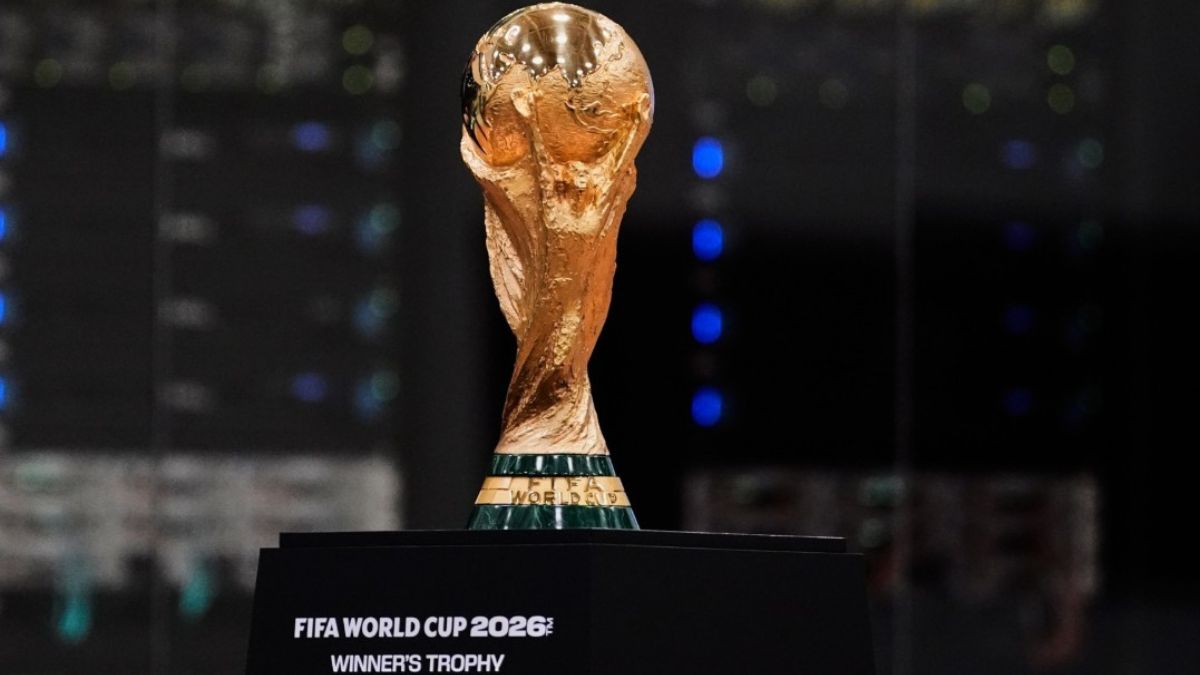
When either Lionel Messi or Lamine Yamal lifts the FIFA World Cup trophy in New Jersey on Sunday, they will add another chapter to football history. They will also quietly move the sport’s most recognisable prize one step closer to retirement.
Unlike most trophies, FIFA’s iconic World Cup prize cannot be won permanently, cannot be bought and, surprisingly, will not last forever.
Only four engraving spaces remain on its green malachite base before FIFA is forced to commission a replacement.
The current trophy, first introduced ahead of the 1974 World Cup, has space for just 17 winning nations. Thirteen names have already been engraved, beginning with West Germany in 1974 and most recently Argentina after their triumph in Qatar four years ago.
Whoever wins Sunday’s final between Argentina and Spain will become the 14th name on that list.
At the current pace, the trophy is expected to reach capacity after the 2038 FIFA World Cup, meaning the game’s most famous prize already has a retirement date.
A trophy nobody gets to keep
The image of captains lifting the golden trophy has become football’s defining moment, but the original never belongs to the winners.
Unlike the old Jules Rimet Trophy, which Brazil earned permanently after winning their third title in 1970, the current FIFA World Cup trophy always returns to FIFA’s headquarters in Zurich. Champions receive an identical gold-plated replica instead. That policy was introduced after the Jules Rimet Trophy disappeared forever.
It was famously stolen in London before the 1966 World Cup and later recovered by a dog named Pickles. But after Brazil took permanent ownership in 1970, the trophy was stolen again from the Brazilian Football Confederation in 1983 and has never been found. Investigators believe it was melted down. FIFA has never allowed another original trophy to leave its possession.
More valuable than gold
Although the trophy appears solid, it is hollow. Made from 18-carat gold, it contains just over five kilograms of the precious metal. If it were solid gold, it would weigh more than 30 kilograms, making it impossible for players to lift comfortably above their heads.
Its material value runs into crores of rupees, but FIFA has never publicly valued the trophy itself. Its significance lies in what it represents rather than what it is worth.
Crafted using a 5,000-year-old technique
Every official FIFA World Cup trophy since 1974 has been produced by Italian manufacturer GDE Bertoni, using sculptor Silvio Gazzaniga’s original design.
The workshop still relies on the ancient lost-wax casting process, a technique dating back around 5,000 years.
A wax version of the trophy is first created before being enclosed in ceramic. The wax is melted away, leaving a hollow mould into which molten gold is poured. Once cooled, artisans spend weeks polishing and refining every detail by hand before attaching the distinctive green malachite rings around the base.
Even champions handle it carefully
Only FIFA World Cup winners and heads of state are permitted to touch the original trophy with bare hands. Everyone else must wear protective gloves because gold scratches easily. Even then, accidents have happened.
During Spain’s 2010 World Cup celebrations, defender Sergio Ramos famously dropped the trophy from an open-top bus. It struck the road and was briefly run over before being recovered and repaired by the same Italian workshop that created it.
One final countdown
The trophy that Spain or Argentina will lift on Sunday has travelled the world, survived thefts, wars and celebrations and become the sport’s ultimate symbol. Yet, hidden beneath the celebrations is a simple mathematical reality.
By the time the World Cup concludes in 2038, there will be no room left to engrave another champion. For the first time since 1974, FIFA will once again face the same question it did after Brazil retired the Jules Rimet Trophy more than half a century ago:
What should football’s next World Cup trophy look like?