



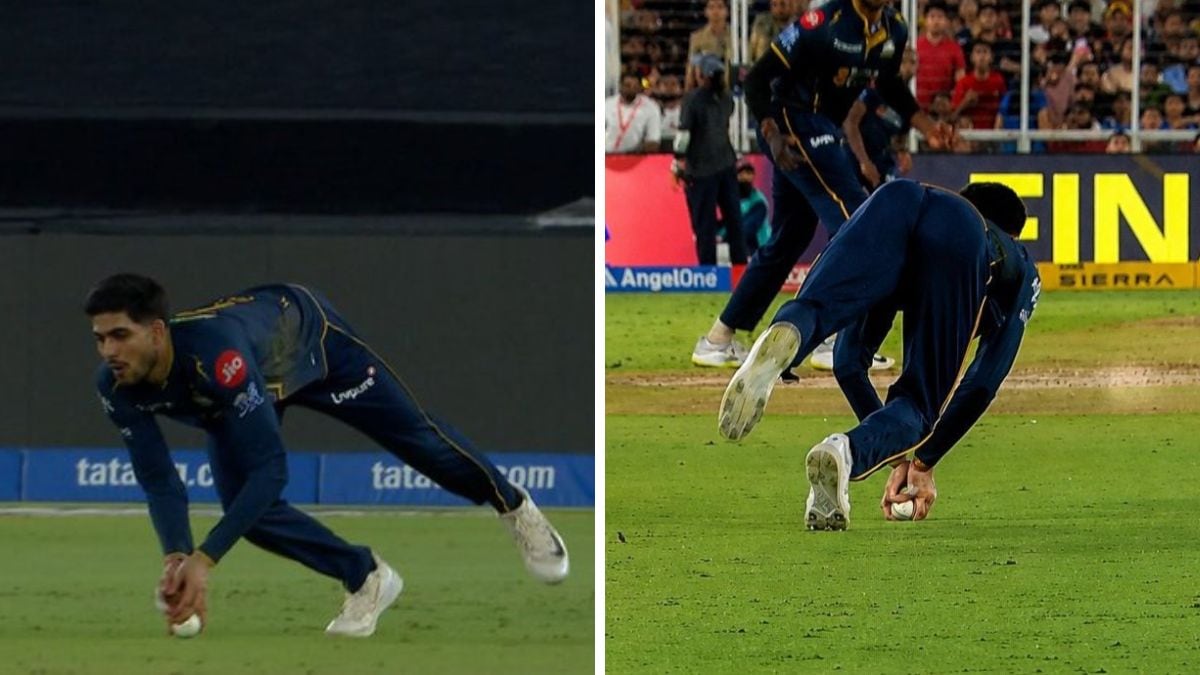
On the last ball of the 16th over in IPL 2026 final, Virat Kohli lobbed a ball in the air on the bowling of Arshad Khan. It was flying and nearly reached the hands of Gujarat Titans (GT) captain Shubman Gill. The umpire thought it was out, GT players were not celebrating much, but also thought that they had their man.
But Kohli, who was leading the Royal Challengers Bengaluru (RCB) to a win, was not convinced. He sought a review. The umpires went upstairs. And it came out as ‘Not Out’. The decision was not bad from an umpiring point of view, but from the POV of a fan, it was one of the very few ones that, if went in favour of the fielding team, would have resulted in a genuine thriller. Here’s how.
The Rashid Khan Factor vs An Untested Middle Order
Had that ball safely rested into the palms of Shubman Gill, the equation would have instantly transformed from a comfortable cruise into a psychological warzone. Kohli’s dismissal would have exposed the lower middle order at a precarious junction, forcing the newly arrived Jitesh Sharma and the explosive Romario Shepherd to march straight into a spin trap.
With Kohli gone, GT captain Gill would have immediately deployed his ultimate weapon: Rashid Khan. Rashid had been troubling batters all through the evening with his deceptive variations and had figures of 2/22 in his three overs till then.
Up against Jitesh and Shepherd, two batters who thrive on pace but can look vulnerable when denied room, Rashid would have smelled blood. Moreover neither of the two had been in form in IPL 2026, totalling 116 and 83 runs in the season so far, respectively.
Rashid was breathing fire and was a bundle of energy in the field, he likely would have snared either Shepherd or Jitesh within his final overs or maybe both for all we know. His ability to slide the ball into the right-hander or rip the leg-break away on a deteriorating surface would have completely hijacked RCB’s momentum.
Exposing a Cold Tail and the Pace Battery
The true catastrophe for RCB lay in what sat behind those two incoming batsmen. Because Kohli had anchored the chase so effortlessly up to that point and throughout the tournament , the RCB tail had not faced a lot of bowling.
Coming out cold in the death overs of an IPL final is arguably the most daunting task in franchise cricket.
Had Rashid struck, the tail would have been exposed prematurely. At that point, Gujarat Titans still had lethal defensive options up their sleeve, with Arshad Khan, Kagiso Rabada, Jason Holder and Mohammed Siraj holding an over each.
- Arshad Khan would have been riding the immense emotional high of taking King Kohli’s tournament-defining wicket. He had also dismissed Tim David.
- Kagiso Rabada would have brought raw, tail-end-crushing pace and sharp bouncers.
- Mohammed Siraj would have had the exact defensive cushion needed to execute his pin-point yorkers.
- Holder with his bounce would have been enough to not let the score flow.
The Double-Paced Trap and the Closing Ring
To make matters worse for RCB, the Ahmedabad wicket had progressively gotten double-paced as the evening wore on. Hard-length deliveries were stopping on the surface, while fuller lengths one were skidding through unpredictably. For a top-order batter like Kohli, managing this variation was an exercise in elite survival; for a lower-order tail, it would have been a minefield.
With the pressure mounting and the runs drying up, Gill would have brought the fielders closing in. A tight, suffocating ring of blue shirts encircling the bat, combined with a vocal Ahmedabad crowd sensing a miraculous turnaround, would have ratcheted the tension to a boiling point.
Instead of a comfortable five-wicket victory with two overs to spare, that single millimeter of a distance between Gill’s fingers, that failed to get underneath the dying ball, is what probably saved RCB from an absolute collapse.
Had the finger stayed up, cricket fans around the globe would have witnessed a final genuinely worthy of the history books—a classic, down-to-the-wire T20 thriller.