



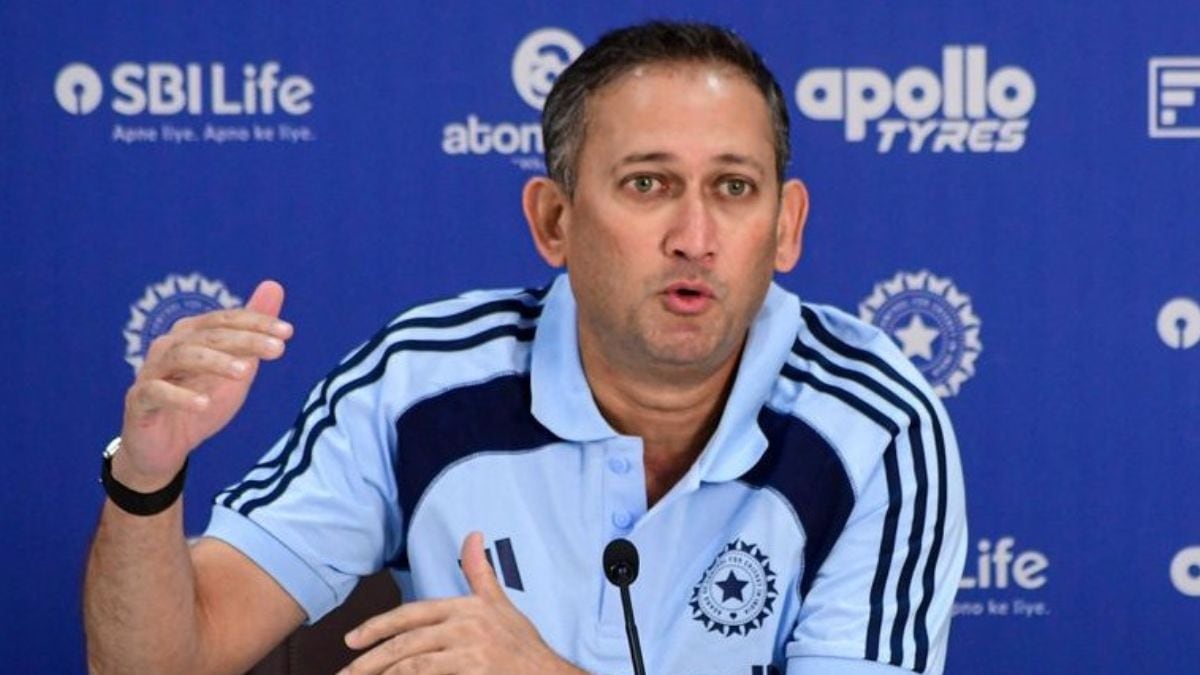
The questions started doing the rounds in BCCI corridors sometime in 2023. Could Ajit Agarkar, a cricketer from a different era, keep pace with a sport now driven by data, match-ups and relentless scheduling? The doubts were not subtle when he took over as chairman of selectors.
This morning, as his extension until the 2027 World Cup in Africa was confirmed, those doubts have largely receded.
What has changed is not just personnel but the underlying selection philosophy.
Agarkar inherited a team in transition. What he has built instead is a system where roles are defined, depth is measurable and decisions are increasingly data-backed.
Selection with clarity, not noise
Handling India’s dressing room, packed with established names and rising stars, is rarely straightforward. Agarkar’s approach has been notably low-key but firm fewer explanations, more consistency.
His decisions have followed a pattern: role clarity over reputation.
A telling example was the call to back a spin-heavy combination during the 2024 T20 World Cup cycle alongside Rohit Sharma, a move that aligned with match-up data rather than conventional team balance.
Similarly, India’s fast-bowling rotation has become more structured. Across formats, the team has consistently fielded fresher attacks, with workload management now visibly embedded in selection calls.
The Suryakumar call that changed perception
One of Agarkar’s most debated decisions came in late 2024, appointing Suryakumar Yadav as India’s T20 captain over Hardik Pandya.
At the time, it was widely questioned. Pandya’s IPL leadership credentials and seniority made him the obvious choice on paper. Agarkar’s panel, however, prioritised availability, factoring in Pandya’s recurring injury concerns.
The numbers since then have strengthened that call.
Under Suryakumar, India have operated with a win percentage of nearly 78% in T20Is, culminating in a successful T20 World Cup campaign in 2026. What was initially labelled a gamble has, over time, come to define Agarkar’s selection template, continuity over star power.
Transition handled without disruption
Agarkar’s tenure has also coincided with a generational shift in Indian cricket.
The exits of Rohit Sharma, Virat Kohli and R Ashwin from Test cricket were managed without major turbulence. Leadership transitioned to Shubman Gill in Test and ODI cricket, while the broader squad saw younger players integrated without breaking core balance.
The results have been tangible.
India’s Test series performance in England, a 2-2 draw, achieved without several senior figures, underlined the depth created during this phase. It was less about individual brilliance and more about a system holding up under pressure.
Although their Test performance at home has been far from their best and perhaps the only area where they are not at par among the best in the business at this time.
Domestic cricket back in focus
Another structural shift has been the renewed emphasis on domestic cricket.
The directive has been clear: if available and fit, players return to the domestic circuit. Backed by head coach Gautam Gambhir, this policy has reconnected the national side with tournaments like the Ranji Trophy and Vijay Hazare Trophy.
Selections have increasingly reflected domestic form, not just IPL performance, a subtle but important recalibration.
The recall of Ishan Kishan into the 2026 T20 World Cup squad is one such example, signalling that the pathway back remains performance-driven.
Staying in the background
Selection in India rarely invites credit. When the team wins, the spotlight belongs to players; when it loses, scrutiny equally shifts to selectors and coaches.
Through both phases, the disappointment of the 2023 ODI World Cup final and the more stable run that followed, Agarkar has remained largely out of public view.
His engagement has been more internal than visible, working across leadership groups from Rohit Sharma’s final phase to the current transition under Shubman Gill.
The road to 2027 ODI World Cup
With his extension now in place, the focus shifts to the 2027 ODI World Cup with a World Test Championship final before that.
The decision to back Gill as a long-term leader, even after Rohit’s success in the 2025 Champions Trophy, reflects a preference for continuity over short-term gains.
Results will ultimately define this tenure. A World Cup win would validate the process; anything short will invite closer scrutiny.
But for now, the indicators point to a system that is more structured than before, one where selection is less reactive and more aligned to long-term planning.
Agarkar may not dominate headlines but his tenure has quietly reshaped how India builds teams, not just for the next series, but perhaps for the next cycle.