



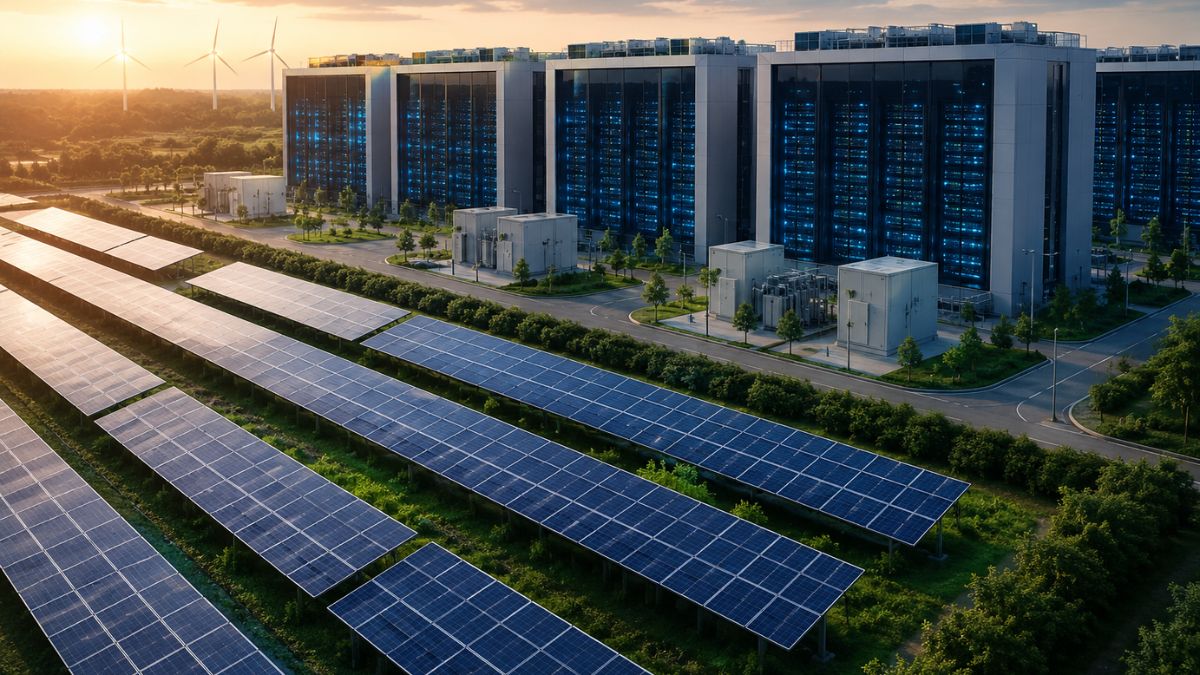
Gujarat’s newly announced data centre policy targetting Rs 6 lakh crore investment is expected to give a major boost to India’s renewable energy sector, especially solar power. Along with this, the policy aims to reduce annual operating costs for eligible data centres by about 22%.
According to a report by Nuvama Institutional Equities, the policy would improve project viability and encourage fresh investments. “We believe policy formalisation and targeted implementation shall boost anchor data centre capacity, forming an ecosystem facilitating future capacities,” the brokerage elaborated.
Gujarat data centre policy: The big drivers
The Gujarat government aims to add 7.5 GW of hyperscale and AI-ready data centre capacity under its dedicated policy. It plans to attract investments worth around Rs 6 lakh crore and has already received interest from 14 investors, with demand nearly double the target. The policy applies to projects with a minimum capacity of 150 MW.
Nuvama estimates the policy could reduce annual operating costs for eligible data centres by about 22% while providing a net capital subsidy of around 5%, improving project viability and encouraging fresh investments.
The policy provides a Rs 1 per unit power subsidy for 20 years along with 100% reimbursement of electricity duty over the same period.
Developers will also receive 100% SGST reimbursement on eligible capital and operational spending. Projects set up in Dholera will get an additional 2.5% capital subsidy.
Based on its estimates, Nuvama said these incentives translate into a net capital subsidy of around 5.2% and an annual operating cost subsidy of about 22.1% over 20 years.
Renewable energy use made mandatory
The Gujarat data center policy, which is effectively reducing the upfront cost of setting up a data centre by about 5%, requires data centres to source at least 51% of their electricity from renewable energy.
Nuvama believes this mandate will significantly increase demand for solar power and battery energy storage systems (BESS), making renewable energy a key beneficiary of the policy.
The policy also encourages the use of captive desalination plants to meet water requirements, allowing developers to build dedicated desalination facilities instead of relying on municipal or groundwater supplies.
11.5 GW data centre capacity could drive additional solar power demand
Nuvama estimates India’s data centre capacity could rise from around 1.5 GW currently to 11.5 GW by FY35 under its base-case scenario. Such an expansion would sharply increase electricity demand and create significant opportunities for renewable energy developers.
Meeting this demand would require about 97 billion units of electricity annually, creating demand for nearly 45 GW of additional solar capacity and around 63 GW of solar modules.
In the brokerage’s bull-case scenario, India’s data centre capacity could reach 25 GW, requiring 98 GW of solar capacity and 137 GW of solar module demand.
Solar sector to benefit the most
The brokerage expects India’s solar-driven power demand to grow at a 22% compound annual growth rate (CAGR) between FY26 and FY35.
It estimates that green hydrogen projects and AI data centres together could account for more than half of India’s future solar capacity additions.
“While the entire power chain shall benefit from new data centres, the solar PV chain is better placed relatively given its undervaluation to other segments at FY28E PER of 13x, representing Growth At A Reasonable Price (GARP),” the report said.
Solar share in power generation to rise sharply
Looking ahead, Nuvama expects India’s electricity demand to grow at a 6% CAGR over the next decade.
The brokerage forecasts total power consumption to increase from about 1,848 billion units (BU) in FY26 to nearly 3,228 BU by FY35. During the same period, the share of solar energy in the country’s power generation is expected to rise to 33% from 9%, driven by rapid growth in data centres and green hydrogen projects.