



In the past 15 years, the energy requirement in India has surged more than 100%. From 831 billion units (BU) in FY2010, it has surged to a whopping 1,694 BU in FY25. Power generation has also doubled during the period from 805 BU to 1,830 BU. (Source: CEA)
For FY26, the Ministry of Power has a target of producing around 2,000 BU of power, including renewable sources, of which, until 30 September, 2025, 961 BU have already been generated.
While India is already the third-largest producer as well as consumer of energy across the globe, demand is rising every day. This is on account of rapid urbanisation, rising temperatures due to global warming, increasing industrialisation, upcoming data centers and more.
Furthermore, the current Israel-US vs Iran war might further boost demand. The current shortage of cooking gas for instance is already making people shift to induction tops and heaters for cooking, which could increase energy demand to some extent .Amid rising energy demand, one company that is involved in manufacturing equipment that is necessary for electricity generation is witnessing a continuous surge in mutual fund investments.
During the month of February, mutual funds increased their stake in Bharat Heavy Electrical Limited (BHEL) by 3.14% percentage points. ICICI, Invesco, and SBI mutual funds were amongst the top buyers.
ICICI Pru Equity Arbitrage Regular Growth Fund bought around 10,318,875 shares of the company, which is around 1.02% of its asset under management (AUM). This fund has been slowly buying BHEL for the past three months. The fund bought 1,963,500 shares and 2,359,875 shares in December 2025 and January 2026, respectively.
Invesco India Arbitrage Growth Fund purchase 10,279,500 shares, worth around 1.28% of the fund’s AUM. This fund has also bought a stake in the company continuously since December 2025.
Then, there was SBI ELSS Tax Saver Regular Growth Fund which purchased 10,000,000 shares worth around 0.82% of the fund’s AUM.
So, is it only the rising energy demand that is attracting the mutual funds towards this heavy electrical equipment manufacturer, or is there more to it?
Let’s find out.
BHEL: At the Heart of India’s Power Push
BHEL is integral to India’s power generation and supply system. The company has supplied equipment for more than 1,000 power projects since its inception, including thermal, hydro, gas, and nuclear power plants. Over half of the conventional power plants, which use coal as the primary resource for power generation, have been set up with equipment from BHEL.
The product portfolio of BHEL includes steam generators, valves, soot blowers, turbo generators, piping systems, hydro power plant equipment, steam turbines, and other equipment primarily for coal-based power plants. The company also caters to solar power systems, transportation systems, and industrial systems.
Apart from power plant products, it offers engineering, procurement, and construction (EPC) solutions for the transportation industry, especially Indian railways, electricity transmission system, defence and aerospace sector, renewables, downstream oil and gas industries, and energy storage systems too.
Robust ₹2.2 Lakh Cr Order Pipeline
During the October-December quarter, BHEL received orders worth over ₹45,900 crore. Out of which, 76% of the orders are from the power sector, while the remaining are from other industries, including export orders.
The outstanding order book at the end of the quarter stood at a massive ₹2,22,800 crore. Around 80% of it is orders from the power sector, with the remaining 20% is from other industries, including exports.
During January and February 2026, the company received a few significant orders.
BHEL has secured a significant contract for Bharat Coal Gasification and Chemicals Limited (BCGCL), which is a joint venture between Coal India Ltd. and BHEL itself. The order is for a Coal Gasification & Raw Syngas Cleaning Plant in Odisha. The order value is around ₹5,400 crore, and it has to be executed in the coming 42 months.
BHEL received another order worth around ₹2,800 crore from BCGCL for a Syngas purification plant as well.
In the recent board meeting, the company confirmed an equity investment worth ₹3,064 crore in BCGCL for the upcoming four years.
During February 2026, BHEL received an order from Hindalco Industries Ltd., worth around ₹1,200 crore to ₹1,500 crore for designing, engineering, supply of equipment, installation, commissioning, and performance acceptance test for two 150 MW BTG Packages for Aditya Expansion Project Phase II.
The company also received an order worth around ₹1,200 crore to ₹1,500 crore from SAIL for Captive Power Plant expansion at SAIL’s IISCO Steel Plant in Burnpur.
Entry in Semi-High-Speed Propulsion Segment
During January 2026, BHEL achieved a milestone in its ‘Make in India’ initiative. The company commenced the supply of Semi-High-Speed Underslung Traction Transformers for the Vande Bharat Sleeper Train Project. The management expects this project to further strengthen the company’s position in the semi-high-speed propulsion segment.
BHEL also entered into a joint venture (JV) with Titagarh Rail Systems Ltd. in March 2026 for the maintenance of Vande Bhart Sleeper Trains, which was recently inaugurated. Currently, it is awaiting approval from the Department of Investment and Public Asset Management (DIPAM), post which the agreement will be finalised.
Financials, Return, and Dividend
Sales jumped 16.4% year-on-year (YoY) from ₹7,277 crore in Q3FY25 to ₹8,473 crore in Q3FY26. Net profit for the period went up from ₹135 crore to ₹390 crore, logging a massive 190% YoY growth.
This might be another reason for mutual funds to continuously increase their stake in the company.
Coming to the return on capital employed (ROCE), this PSU is lagging behind with just 4.9% when the industry median is way higher at 28%.
The dividend yield of the company stood at 0.19%, higher than the industry median of 0.03%.
Premium Valuation
The stock is currently trading at a price/earnings (PE) of 113.8x, which is way higher than the industry median of 31x. Even the price/ earnings to growth (PEG) ratio is at 20.1x, while the industry median is just 0.6x, indicating that the stock is overpriced even adjusted for growth.
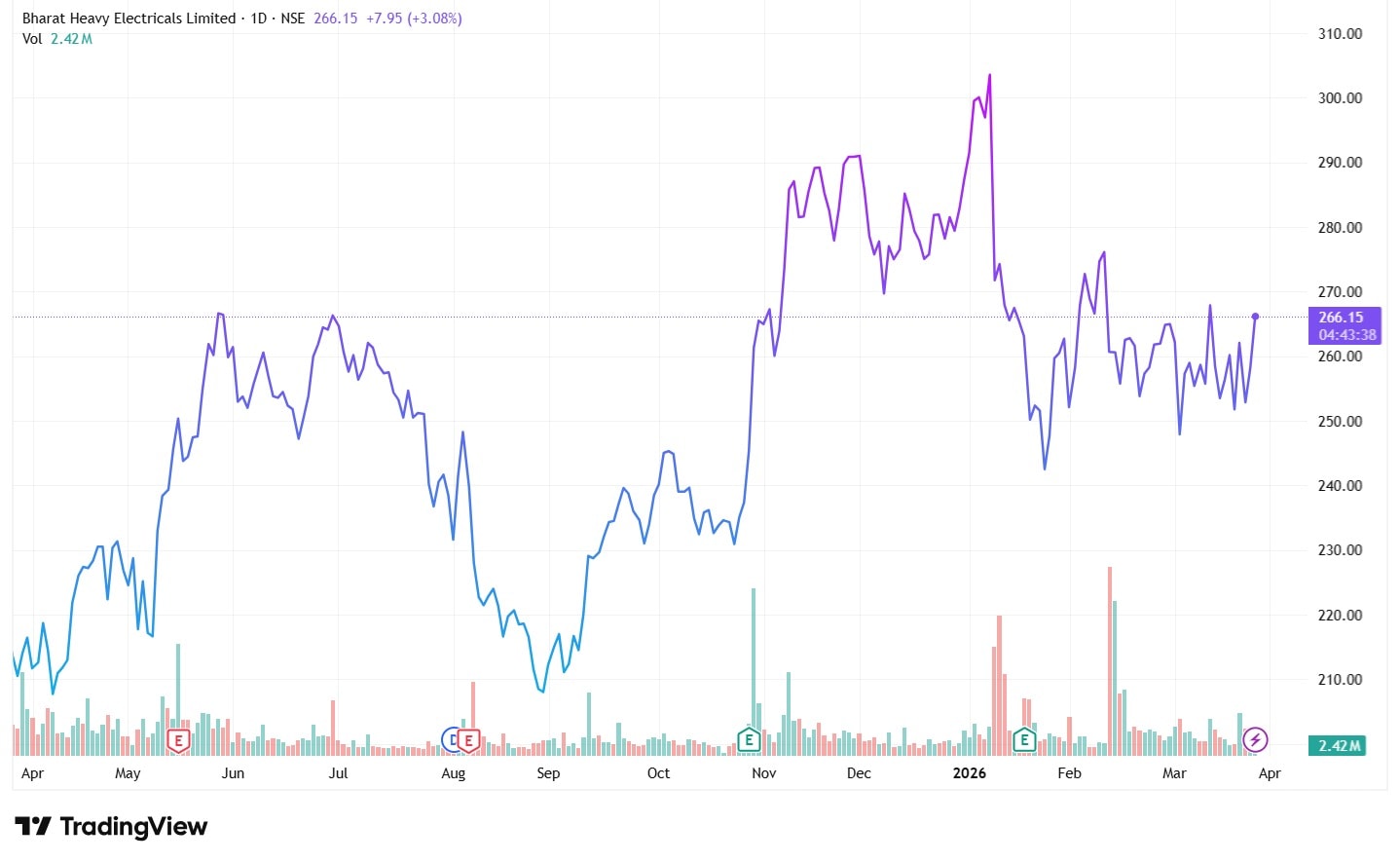
1-Year Share Price Chart of BHEL
Final Thoughts
Select mutual funds are continuously raising their stake in BHEL, perhaps reflecting the broader conviction in the heavy electrical manufacturer’s pivotal role in India’s structural growth, especially in the power and transportation sectors.
With a massive orderbook offering multi-year revenue visibility, sharply rising energy requirements, a strengthening position in the transportation industry, and diversifying business apart from the power sector, BHEL is a must-add to the watchlist stock.
Disclaimer:
We have relied on data from www.Screener.in throughout this article. Only in cases where the data was not available have we used an alternate, but widely used and accepted source of information.
The purpose of this article is only to share interesting charts, data points, and thought-provoking opinions. It is NOT a recommendation. If you wish to consider an investment, you are strongly advised to consult your advisor. This article is strictly for educational purposes only.
Maumita Mitra is a seasoned writer specializing in demystifying the world of investment for a broad audience. She has a keen eye for detail and a knack for explaining complex financial concepts in the simplest manner possible.
Disclosure: The writer and her dependents do not hold the stocks discussed in this article.
The website managers, their employees (s), and contributors/writers/authors of articles have or may have an outstanding buy or sell position or holding in the securities, options on securities, or other related investments of issuers and/or companies discussed therein. The content of the articles and the interpretation of data are solely the personal views of the contributors/ writers/authors. Investors must make their own investment decisions based on their specific objectives, resources, and only after consulting such independent advisors as may be necessary.